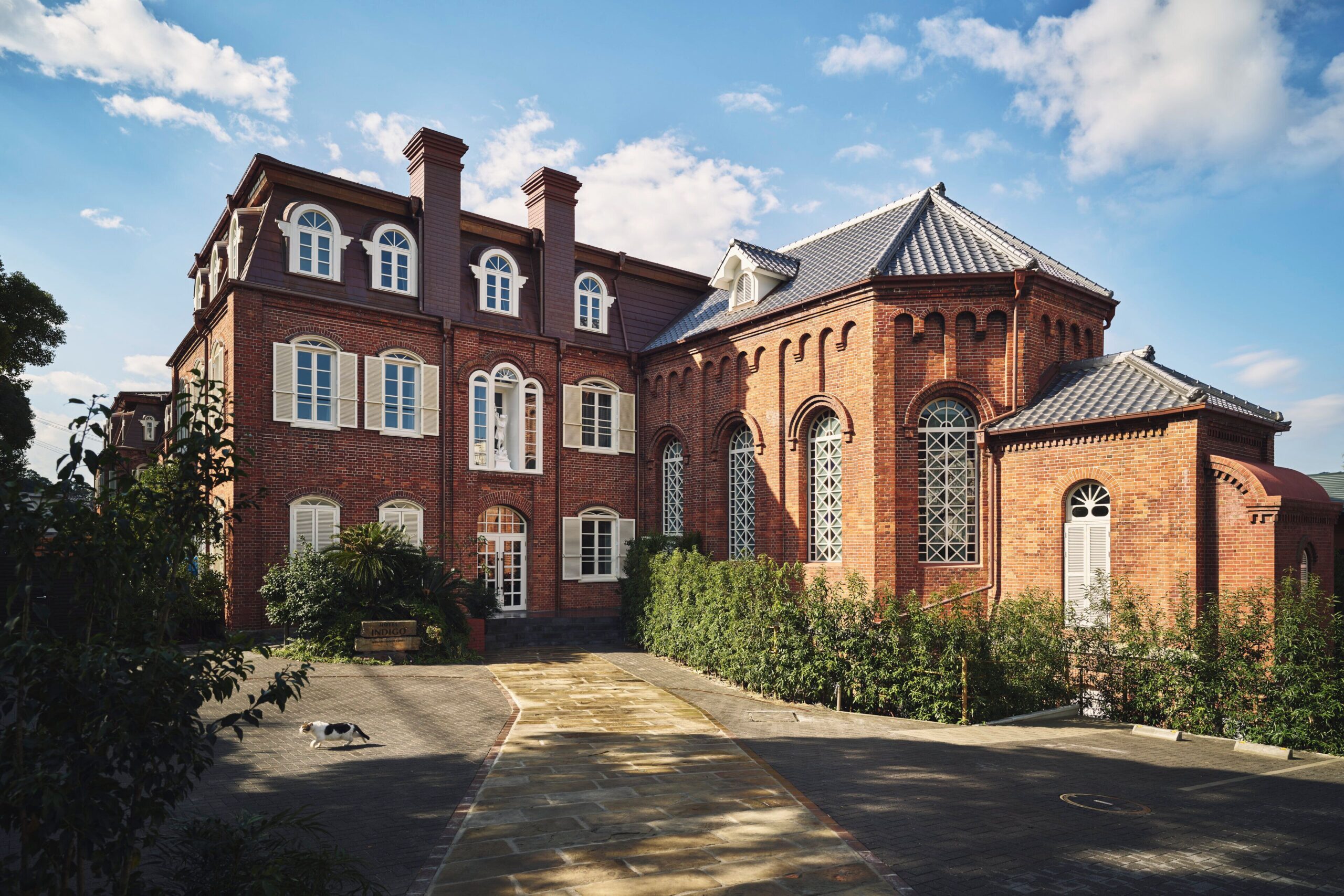
Minamiyamate is one of those rare districts where the history of a port city is still legible in the slope of the road, the outline of a church and the view between old garden walls. Hotel Indigo Nagasaki Glover Street occupies this setting with unusual confidence. Opened in December 2024, it brings together redbrick convent buildings whose story dates from 1898, a newly built wing and a former chapel now used as the hotel’s only restaurant.
The result is not a resort assembled around a long list of facilities. Its appeal is more concentrated: sixty-six rooms, a historic neighbourhood, a garden terrace overlooking Nagasaki Bay and meals served beneath stained glass. The reason to stay is the continuity between building and place. Glover Garden and Oura Church are close enough to shape the day, while the hotel’s arched windows, preserved masonry and layered interiors allow the character of Minamiyamate to continue after one returns indoors.
The booking decision: choose Hotel Indigo Nagasaki for the relationship between the building and Minamiyamate, rather than for the facilities of a self-contained resort. The Heritage Wing brings the 1898 fabric closest to the room; the Horizon Wing offers a newer, more open setting. One night is enough with dinner reserved in the former chapel, while two give a first Nagasaki stay a more gracious rhythm and leave time for the historic district beyond the hotel.
Check current rates at Hotel Indigo Nagasaki Glover Street on Expedia →(Paid link)
This makes the hotel a considered choice rather than an automatic one. Travellers who value a pool, a full-service spa or immediate station access may prefer another address. Those who want to sleep inside the history of Nagasaki’s former foreign settlement, dine in a memorable architectural space and begin the morning beside Glover Garden will understand its value more readily.
An 1898 Redbrick Convent in Minamiyamate
The Main Building carries forward the former Maria-en convent, established in 1898 in a Romanesque redbrick structure associated with the Catholic history of Minamiyamate. Hotel Indigo has not treated the property as a single preserved relic. The project combines preservation and restoration with new construction: the historic Main Building is now described as the Heritage Wing, while the North Building, or Horizon Wing, introduces a contemporary counterpart.
That distinction matters because the hotel’s strongest feature is not age alone. A historic shell can easily become a theme; here, the old and new wings allow guests to choose how directly they wish to engage with the architecture. The Main Building retains arched windows and the irregular charm of an inherited structure. The North Building uses larger expanses of glass and a calmer contemporary palette, looking back toward the redbrick buildings and out over the surrounding landscape.
Hotel Indigo describes Nagasaki through the idea of Wa-Ka-Ran: Wa for Japan, Ka for China and Ran for the Netherlands and the wider West. The phrase is more than branding when read against this neighbourhood. Nagasaki developed through exchange, restriction, faith and trade; Minamiyamate still holds the architecture of that encounter. The hotel’s success lies in letting those layers remain slightly unresolved rather than reducing them to a decorative motif.
Arrival Above the Port
Hotel Indigo Nagasaki Glover Street stands at 12-17 Minamiyamatemachi, above the compact centre and the waterfront. Mori Trust places the drive from Nagasaki Station at approximately eight minutes, while Expedia currently estimates around eleven minutes depending on traffic. The transfer is short, but the change in atmosphere is immediate: station buildings and commercial streets give way to the gradients, stonework and older silhouettes of the historic district.
Guests arriving by car should plan carefully. The hotel’s official information lists only three on-site spaces, available on a first-come basis, with a charge of ¥2,000 before tax per night. Expedia currently presents self-parking at approximately ¥2,200. The difference is effectively tax, but the more important point is capacity: parking should be confirmed rather than assumed.
Check-in begins at 3:00pm and check-out is at 11:00am. An afternoon arrival works particularly well. It leaves enough daylight to understand the garden, the redbrick elevations and the harbour beyond them before dinner. The hotel becomes more persuasive when arrival is not rushed, because its spaces reveal themselves through transitions—the courtyard, an arched window, a stair, a glimpse of stained glass—rather than through one grand lobby gesture.
Heritage Wing or Horizon Wing?
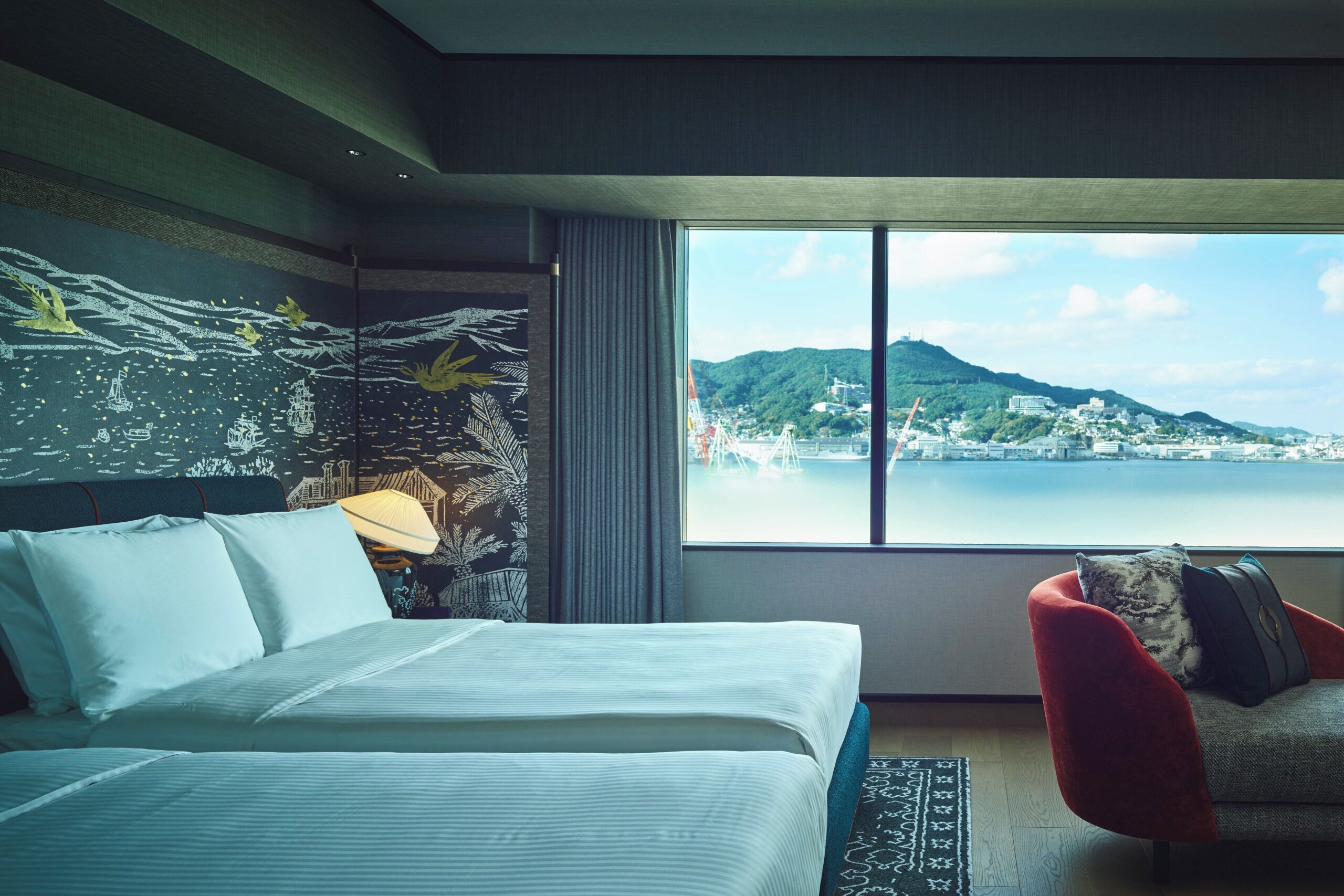
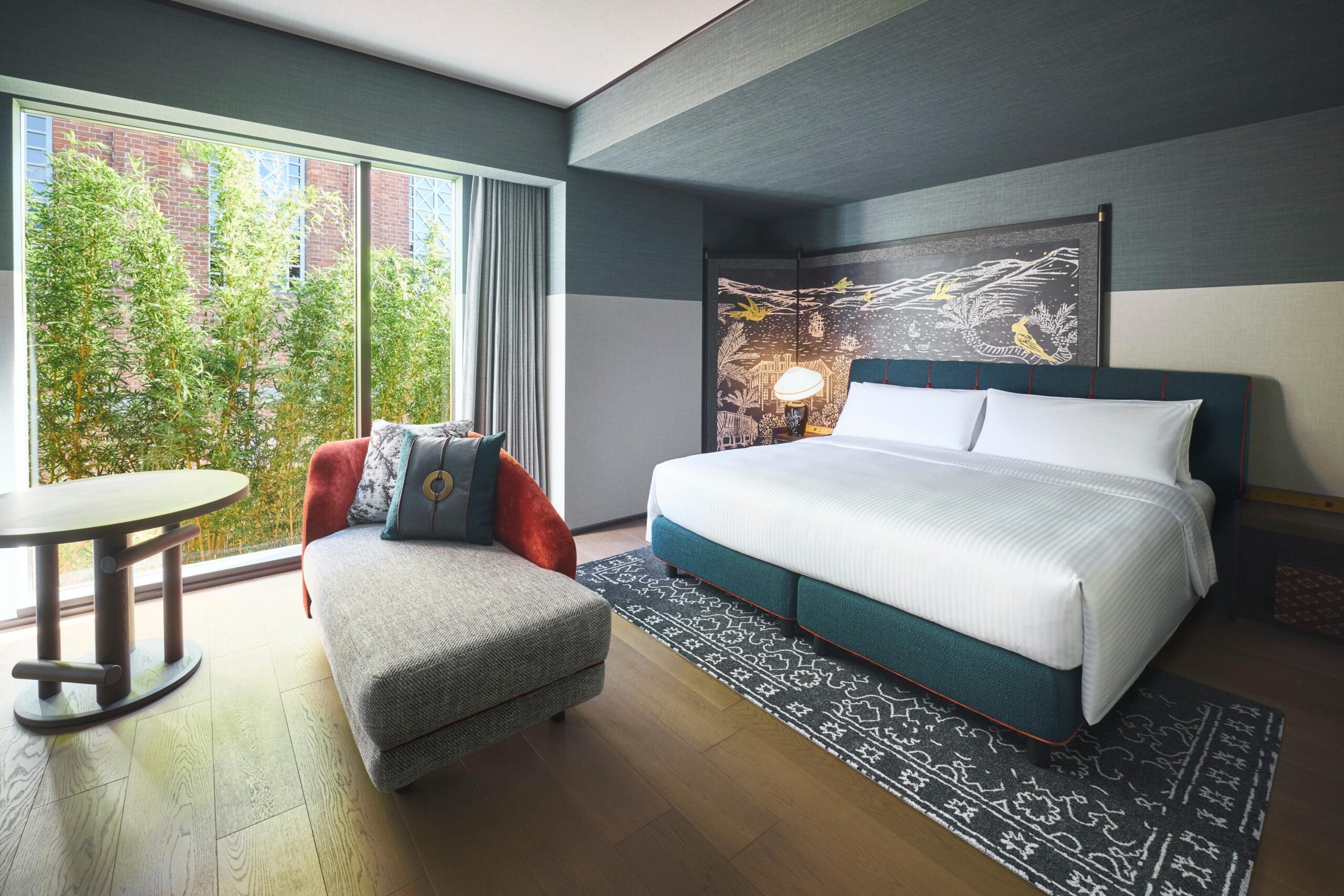
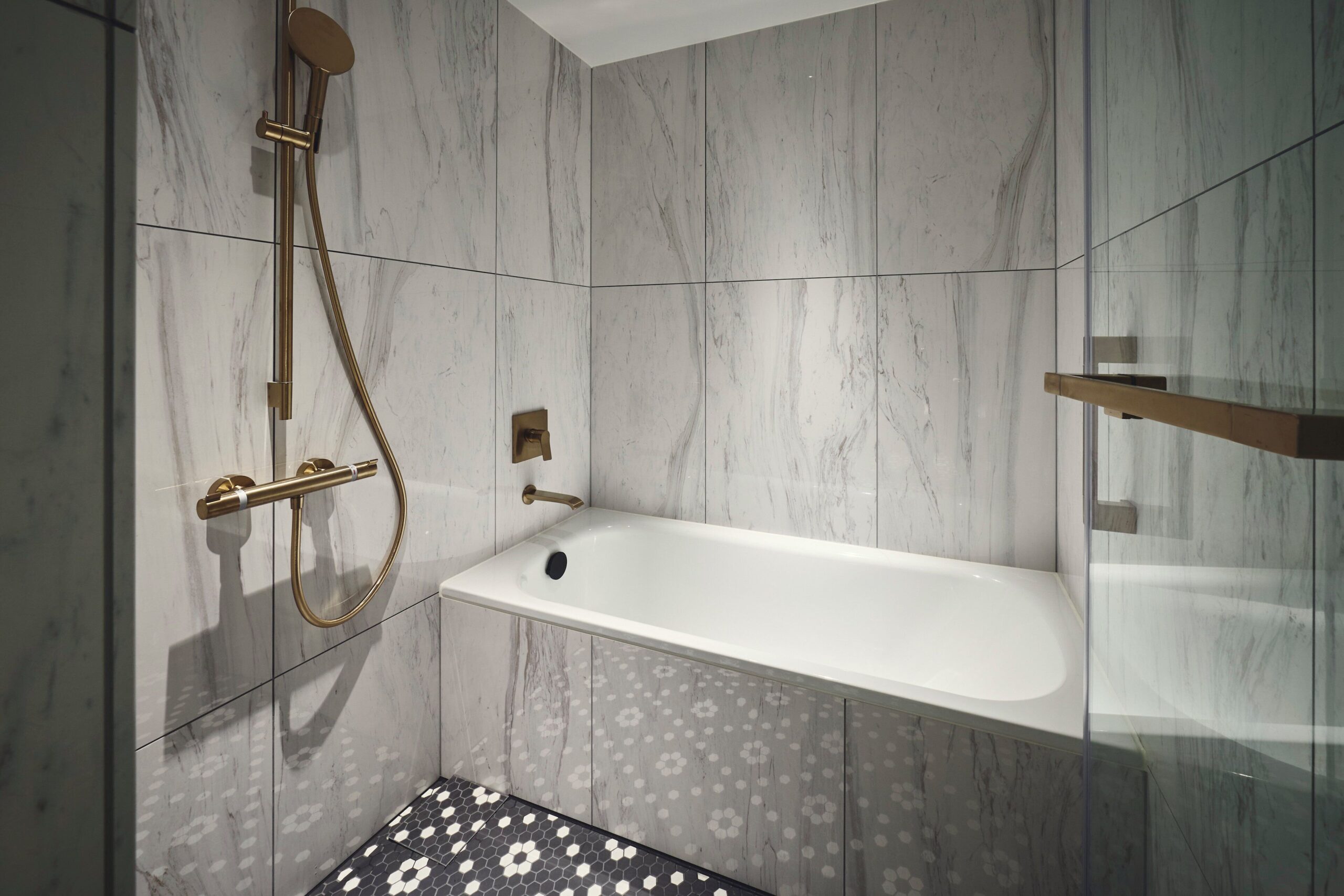
The most consequential booking decision is the choice between buildings. Main Building rooms place the stay inside the Heritage Wing, where the 1898 structure and its architectural details are most present. North Building rooms occupy the Horizon Wing, a new addition designed with broad windows, softer greens and blues and a stronger relationship to the view.
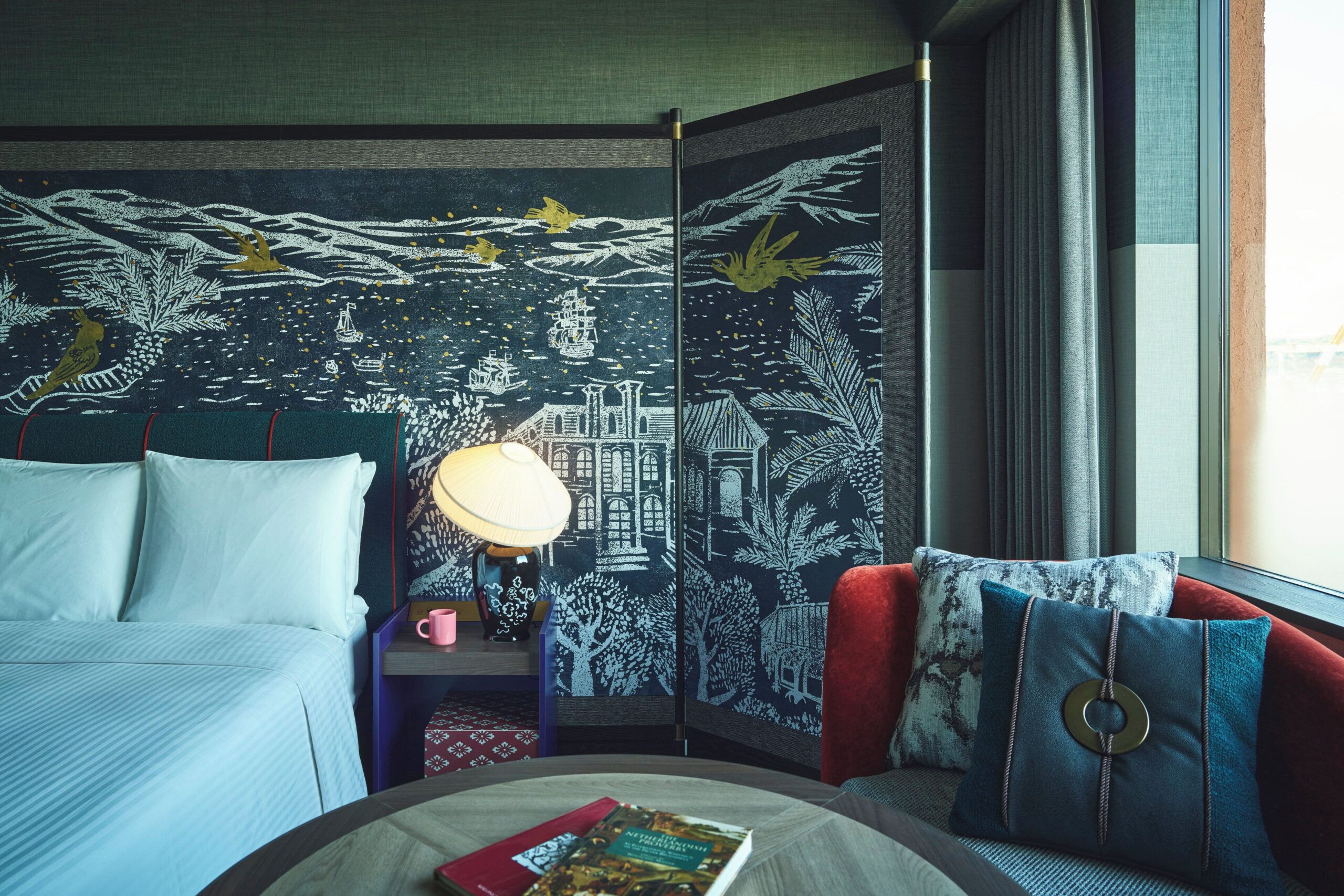
Neither choice is inherently superior. The Heritage Wing is likely to appeal to guests for whom the historic fabric is the principal reason to book. Its rooms vary more in size and proportion, a natural consequence of adapting an older building. The Horizon Wing offers a more regular contemporary experience and may feel calmer to travellers who prefer clean lines, larger windows and a clearer division between the hotel’s history and their private room.
Views also depend on the exact category. Some rooms look toward Nagasaki Bay, the sky or the hotel’s historic buildings; others emphasise greenery or the neighbourhood. Expedia photographs show several rooms with water or city views, but these should not be read as a promise for every reservation. Building, room name, outlook and terrace are separate choices, and each deserves attention before payment.
Choosing the Room by Space, View and Building
Standard rooms are not uniform. In the Main Building, Standard King rooms range from approximately 26 to 34 square metres. Premium King rooms are around 30 square metres, while Premium Twin rooms extend from roughly 35 to 49 square metres. Terrace categories are larger still, generally between 37 and 48 square metres, and use outdoor space to bring the historic setting more directly into the stay.
The North Building begins with Standard Twin rooms of approximately 31 to 33 square metres and Standard King rooms around 33 square metres. Premium Twin rooms range from about 37 to 39 square metres. These figures are useful because the difference between a compact Heritage room and a larger Horizon room may be more important than the difference between the words Standard and Premium.
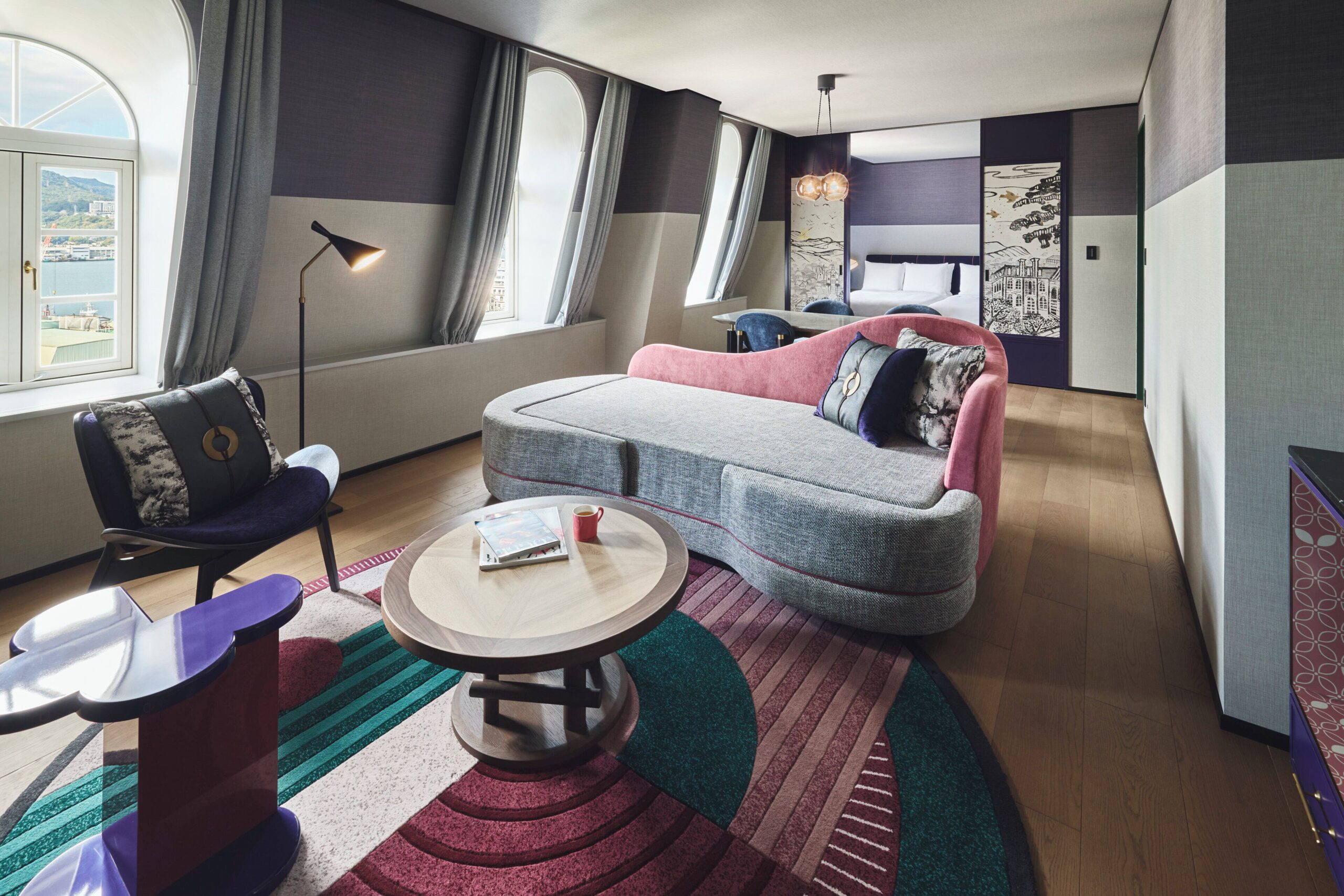
Suites create a clearer sense of occasion. Bay View suites are offered at approximately 55 and 61 square metres, while the Garden Terrace Suite reaches around 67 square metres and adds private outdoor space. The official room descriptions also note that all rooms are non-smoking and that the maximum occupancy is generally three guests, subject to category and extra-bed arrangements.
A small caution belongs here. The hotel advertises certain Main Building benefits, including a complimentary minibar and a station shuttle, for reservations made through the official IHG website. Travellers booking through Expedia should compare the inclusions shown for their specific rate rather than assume that website-exclusive privileges will carry across.
The Heritage Wing is the clearer choice when arched windows, historic fabric and the sense of staying within the former convent are central to the booking. The Horizon Wing suits travellers who prefer larger windows and a more contemporary atmosphere. A bay view, terrace or separate living room belongs to specific categories rather than to either wing as a whole, so the final decision should be made from the complete room name—not from the building name alone.
Compare Heritage Wing and Horizon Wing rooms for your dates →(Paid link)
Wa-Ka-Ran, Interpreted in the Rooms
The rooms avoid the anonymous beige that often accompanies the word luxury. Colour appears in murals, patterned surfaces and upholstered chairs; arched forms echo the architecture; references to trade and travel are folded into details rather than explained as a museum display. The mood is more curious than solemn, appropriate for a Hotel Indigo but grounded here in a particularly rich neighbourhood story.
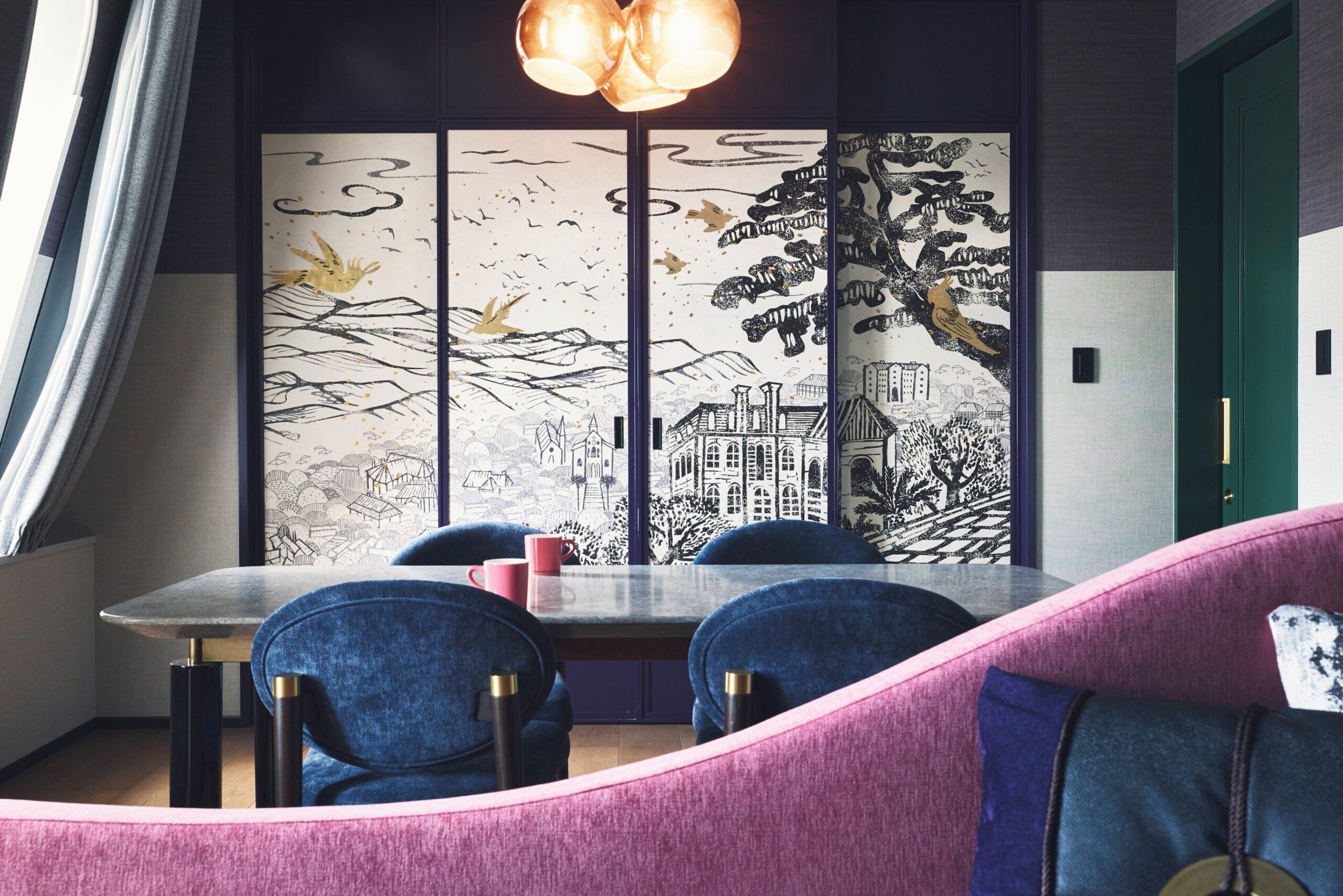
Wa-Ka-Ran is useful as a way of reading the interiors, provided it is not taken too literally. Japanese, Chinese and Dutch or Western influences did not meet in Nagasaki as a simple harmony. They arrived through centuries of exchange and control. The hotel translates that history into contemporary pattern and colour, allowing a guest to sense mixture and movement without claiming that every motif belongs to one fixed origin.
The lobby continues this approach. Official descriptions point to a fan-shaped rug that recalls Dejima and lighting inspired by brass instruments, while coloured tiles and graphic elements lend the public spaces a social quality. Through arched windows, the garden and bay prevent the design from becoming self-contained. The most successful details are those that redirect attention outward, back to Nagasaki.
Breakfast and Dinner in the Former Chapel
Restaurant Cathedréclat is the hotel’s defining interior. The space was formerly a chapel, and its ten-metre ceiling and stained-glass windows give breakfast and dinner a scale that no conventional dining room could easily reproduce. Calling the entire hotel a former cathedral would be inaccurate; it is this restaurant, within the former convent complex, that carries the chapel’s volume and light into its new use.
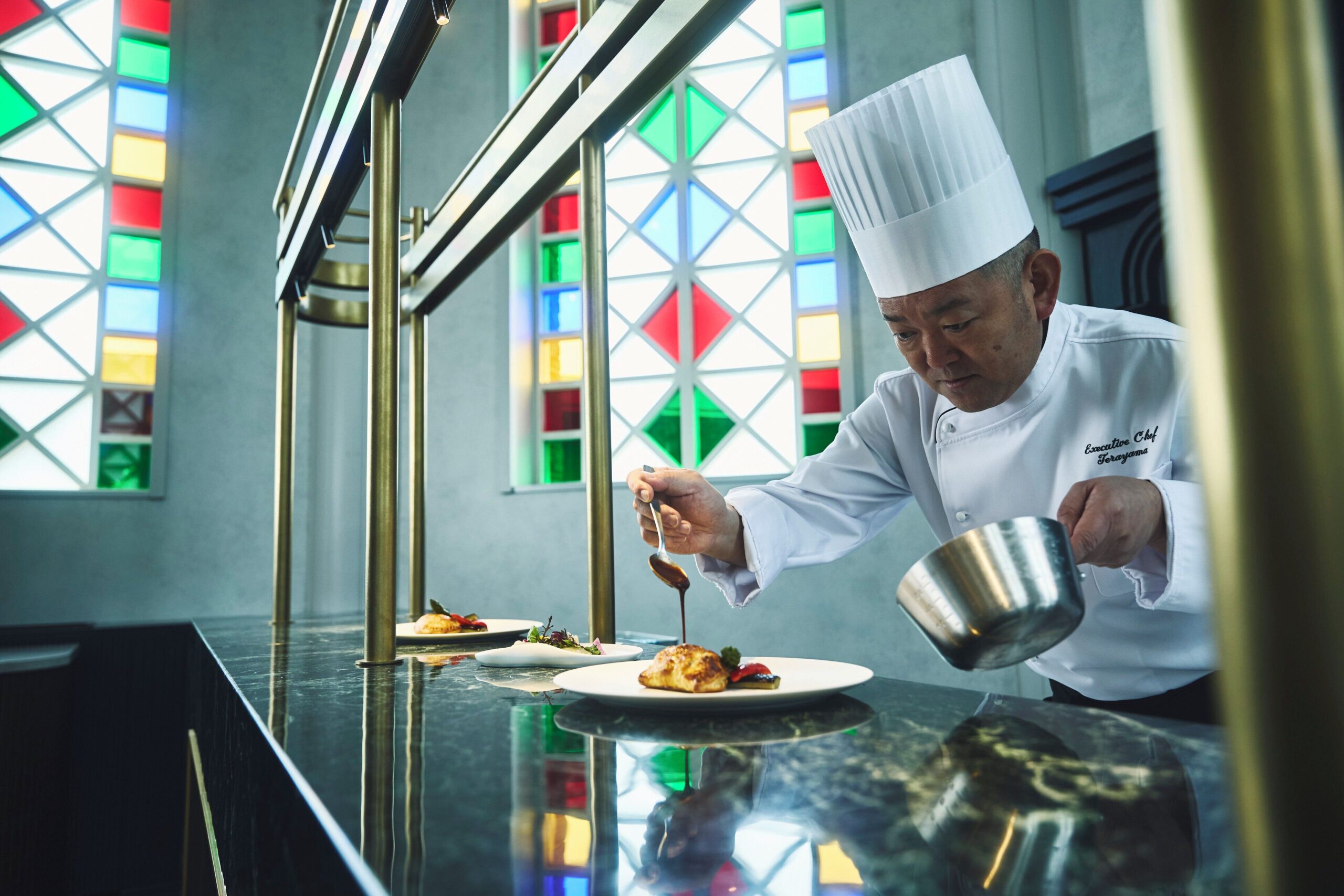
Breakfast is currently served from 7:00am to 11:00am, with last orders at 10:00am. The hotel presents Japanese and Western main choices alongside supporting dishes, allowing the meal to feel composed without becoming overly formal. Morning may be the room’s most revealing hour, when daylight passes through the stained glass and the architecture can be appreciated before the neighbourhood grows busy.
Lunch is generally scheduled from noon to 3:00pm, and dinner from 5:30pm to 10:00pm, with earlier last orders. Menus and prices are seasonal, so the current offering should be checked close to the stay. The signature course, Blanche, has been presented around local seafood, Nagasaki Wagyu and citrus, shaped by the city’s Japanese, Chinese and Western food cultures.
The restaurant is not simply a convenient answer to where to eat. For a one-night stay, dinner here completes the architectural experience begun at arrival. For two nights, one meal at Cathedréclat and one in the city offers a better balance, allowing the hotel’s interpretation of Nagasaki to sit beside the city’s living restaurants rather than replace them.
From Local Ingredients to Nagasaki’s Mixed Food Culture
Food is where the idea of Wa-Ka-Ran becomes most tangible. Nagasaki’s culinary identity was formed by ingredients, techniques and customs arriving from different directions, then being altered locally. Cathedréclat follows that pattern rather than reproducing one historical cuisine. The kitchen draws on regional seafood, meat and fruit, but the compositions are contemporary and intentionally playful.
Official hotel material has highlighted Nagasaki Wagyu, seasonal fish and a local citrus known as yukou, including in the bar’s signature drinks. These references are useful indications of direction, not guarantees that a particular dish or cocktail will remain on every menu. The pleasure lies in recognising the region without requiring dinner to become a catalogue of famous products.
Afternoon tea is another way to experience the former chapel, though current arrangements require advance planning and may change seasonally. Guests for whom the dining room is central to the stay should reserve rather than rely on walk-in availability. The same applies to dinner on weekends or during periods when Nagasaki’s festivals and cruise traffic bring more visitors into the city.
The Garden Terrace, Nagasaki Bay and the Neighbourhood
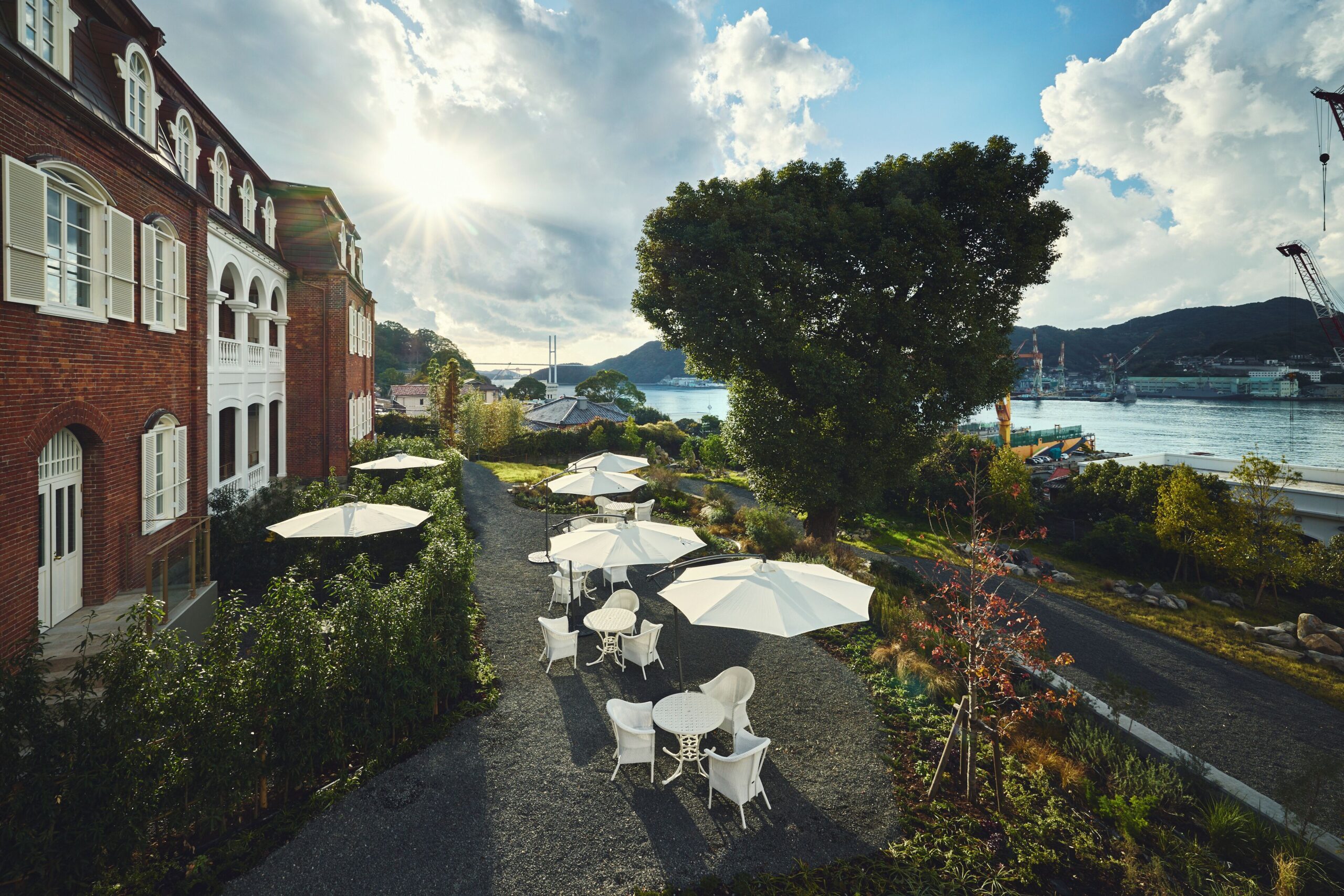
The Garden Terrace occupies ground that once served as a playground. During the hotel’s transformation, stones found on the property were reused, while an existing persimmon tree and an old camphor tree were retained. From here, the view opens toward Nagasaki Port and Megami Bridge, placing the brick buildings against the wider geography of harbour and hills.
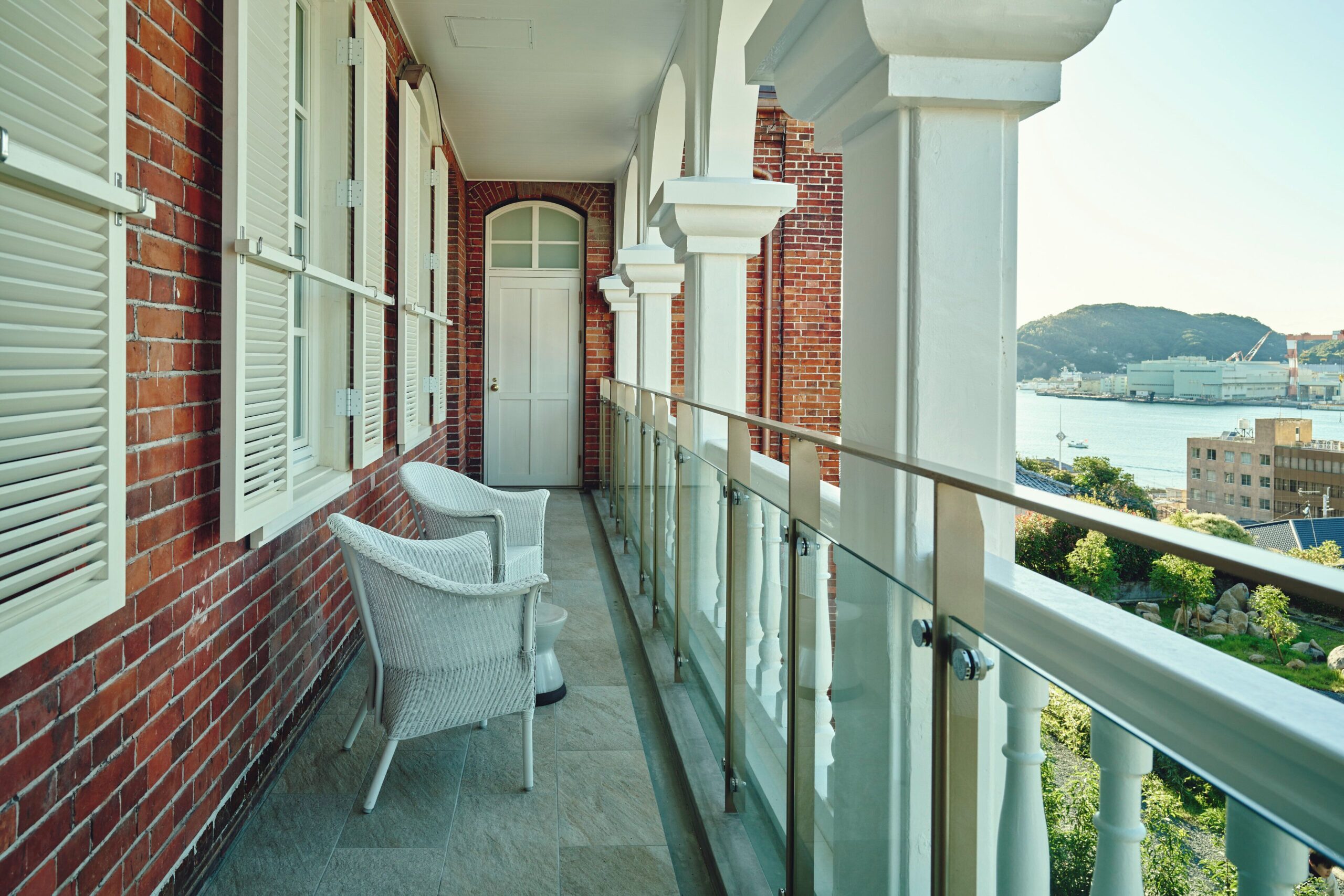
The terrace also clarifies why this address is more compelling than a historic building removed from its context. Ships cross the bay below; Glover Garden rises close by; Oura Church remains part of the surrounding walk. Expedia currently places Glover Garden at roughly one minute on foot and Oura Church at around four minutes, although entrances, gradients and individual pace will affect the practical experience.
A morning in Minamiyamate can therefore begin before transport becomes necessary. The former merchant houses of Glover Garden, the church, stone lanes and small viewpoints form a coherent route. Returning to the hotel for breakfast, tea or a quiet interval on the terrace gives the stay a sense of place that a station-centred itinerary cannot quite reproduce.
This is also where the hotel’s limits become advantages. It is not designed as a sealed resort. The absence of a large leisure complex encourages movement between hotel and district. The best stays allow the architecture inside and the neighbourhood outside to remain in conversation.
What the Hotel Offers—and What It Does Not Centre
Hotel Indigo Nagasaki Glover Street offers a restaurant, a garden and terrace, a lounge, complimentary Wi-Fi and a 24-hour fitness room. Expedia also lists 24-hour room service, concierge support and luggage storage. Within a property of sixty-six rooms, the scale feels closer to a highly individual urban retreat than to a full destination resort.
The official and Expedia facility listings do not present a swimming pool, onsen or full-service spa as part of the stay. Travellers should not interpret that as an omission to be excused after booking; it is a clue to the hotel’s purpose. The investment has gone into adaptive reuse, guest rooms, dining and the relationship with Minamiyamate.
For some trips, that concentration is exactly right. A short cultural stay in Nagasaki benefits from a hotel that can deliver one memorable dinner and a distinctive room without demanding an entire day beside a pool. For a restorative resort holiday, or for travellers who expect hot-spring bathing as part of a luxury stay in Japan, another property will be more suitable.
Who This Nagasaki Hotel Suits Best
Hotel Indigo Nagasaki Glover Street best suits travellers who choose a hotel for its address and architecture. It is particularly persuasive for a first stay in Nagasaki focused on Glover Garden, Oura Church and the old foreign settlement; for couples who prefer a composed dinner and a harbour view to a resort schedule; and for guests who enjoy seeing historic buildings adapted rather than frozen.
The hotel is less convenient for anyone who wants to step directly from the station into the lobby, return repeatedly to the room between distant sights or rely on plentiful on-site parking. It is also not the obvious choice for families seeking a pool, or for travellers whose definition of a luxury hotel begins with a spa and multiple restaurants.
Room selection determines much of the experience. Choose the Heritage Wing if the former convent is central to the trip; consider the Horizon Wing if window area, contemporary proportion and outlook matter more. Reserve Cathedréclat if the former chapel is part of the reason for coming, and leave time to walk the neighbourhood before breakfast or toward dusk.
The final measure of the hotel is not whether every element feels old. It is whether preservation, restoration and new construction allow the story of the place to remain visible. At its best, Hotel Indigo Nagasaki Glover Street does exactly that. The redbrick convent, the chapel restaurant, the new wing and the harbour beyond do not compete for attention; they become successive chapters in the same stay.
View current availability near Glover Garden on Expedia →(Paid link)
Related Reading
For two further examples of historic architecture given a new life, read our reviews of Shisui Nara, set within a former governor’s residence, and The Hotel Seiryu Kyoto Kiyomizu, created from a 1933 schoolhouse.