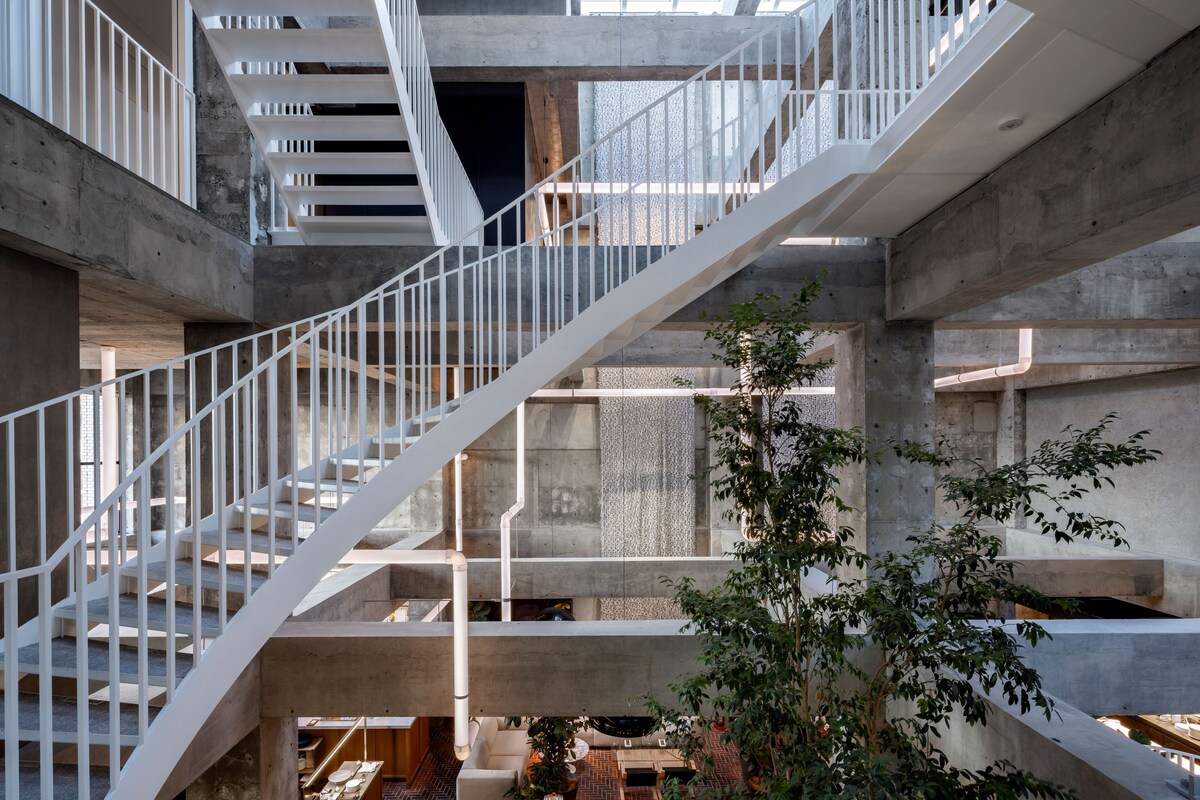
In Maebashi, the most arresting hotel arrival begins not with a polished lobby but with an absence. Floors have been removed from a 1970s hotel building, leaving concrete beams, bridges and staircases suspended within a soaring void. Greenery descends through the structure; Leandro Erlich’s illuminated pipes trace lines across the height of the atrium; voices rise from the lounge below. SHIROIYA HOTEL does not conceal the difficult fabric it inherited. It makes that fabric the centre of the stay.
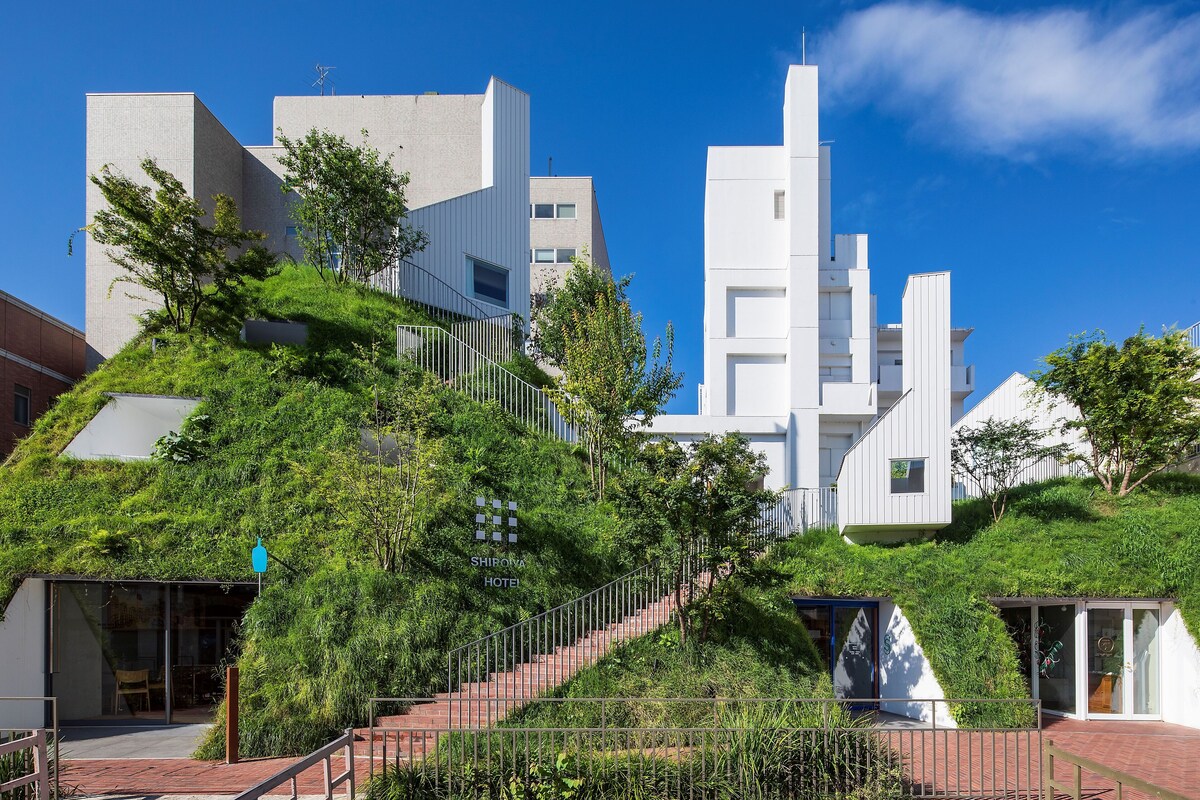
Outside, a second building answers the exposed concrete with an apparently grass-covered hill. Sou Fujimoto’s Green Tower recalls the banks of the old Tone River, while the Heritage Tower holds the remains of a hotel whose lineage reaches back to an Edo-period ryokan. Between them are only twenty-eight rooms, each containing original art and several conceived as complete installations by architects and artists. The result is neither a conventional city hotel nor a resort placed apart from daily life. It is an art destination woven into the regeneration of central Maebashi.
The booking decision: choose SHIROIYA HOTEL when architecture, art and dinner are intended to be part of the journey rather than background to it. A standard room gives access to the same atrium and collection; a concept room earns its premium when living inside one creator’s idea is the purpose of the night. One night is enough if arrival is early and dinner is reserved. Two allow the hotel, its private saunas and the quieter cultural landscape of Maebashi to be experienced without turning each element into an appointment.
Compare current SHIROIYA HOTEL room categories and rates on Expedia →(Paid link)
From a Three-Century Name to an Open Concrete Atrium
The Shiroiya name reaches back some three centuries, but the structure visible today is not a preserved Edo-period inn. The ryokan moved into the hotel business in the 1970s, closed in 2008, and later returned through Sou Fujimoto’s transformation of the concrete building and the addition of the Green Tower. Opened in December 2020 after six and a half years of work, the present hotel keeps several eras visible without pretending that they belong to one surviving structure.
Fujimoto’s intervention in the old building began by removing floors and exposing the existing columns and beams. What might have been treated as structural inconvenience became an indoor plaza. Walkways now cross the void; plants soften the concrete; guest-room windows and balconies look inward as though onto a small urban landscape. The atrium feels monumental, but its life comes from ordinary movement—the route to breakfast, a pause on a bridge, a drink taken below the art.
This history matters at booking because the Heritage Tower is not simply the older of two wings. It contains the strongest experience of the building’s transformation. Rooms may face the atrium rather than a distant landscape, and the pleasure comes from proximity to concrete, art and interior light. Travellers who equate luxury with a broad exterior view should read the category carefully. Here, an inward-looking room can be the more distinctive choice.
Heritage Tower or Green Tower?
The two towers offer contrasting ways to inhabit the same project. The Heritage Tower is rawer and more theatrical. Its bridges, open volume and traces of the 1970s structure place guests within the act of reuse. The Green Tower is a new building concealed beneath slopes of planting, its form inspired by recollections of the grassy banks of the Tone River. Balconies and greenery give it a gentler relationship with the outdoors.
Neither tower is automatically the premium choice. Select the Heritage Tower when the atrium, the exposed frame and the concentration of concept rooms are central to the stay. Select the Green Tower when a quieter room, a balcony and a stronger feeling of vegetation matter more than looking into the architectural void. The building name should be treated as the first booking decision, followed by room size, bed type, outlook and artwork.
The contrast also changes the rhythm of a one-night stay. In the Heritage Tower, simply moving between room, lounge and restaurant becomes part of the architectural experience. In the Green Tower, returning through the planted exterior and withdrawing from the atrium feels more like retreat. Couples should decide whether they want to remain inside the visual energy of the hotel or step away from it at the end of the evening.
Choosing the Room: Art Before Category
SHIROIYA has only twenty-eight rooms, yet the categories require more attention than the room count suggests. Superior rooms generally measure about 25 to 32 square metres, while Deluxe rooms extend from roughly 25 to 35 square metres. Deluxe Twin rooms are larger, at approximately 35 to 41 square metres, and are the more practical choice for friends or travellers who prefer two semi-double beds. The Executive Room reaches 52 square metres; the Junior Suite is 57 square metres and places a balcony above the Heritage Tower atrium.
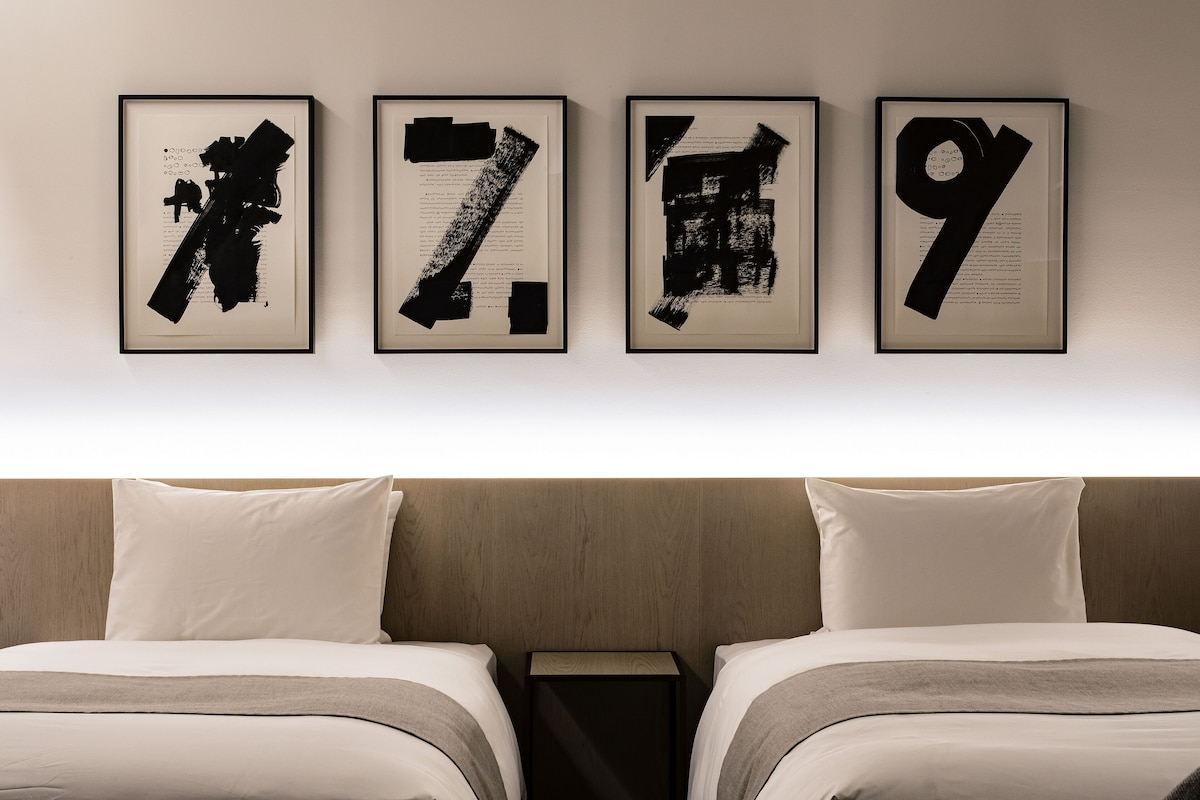
Size alone, however, does not explain the rate. Every room contains different art, and some of the smallest categories can be more memorable than a larger conventional room. The Leandro Erlich Room, for example, is only 25 square metres, yet its exposed brass-pipe motif turns the entire interior into an extension of the artist’s atrium installation. By contrast, a spacious Executive Room places Ryan Gander’s work against the old concrete structure and provides a more restful, functional plan.
The practical question is therefore not “Which is the best room?” but “How much of the stay should the room itself perform?” Guests who expect to spend most of the day exploring Gunma may be well served by a Superior or Deluxe room, retaining the full public-space experience. Those arriving specifically for design should consider a concept room or the atrium-facing Junior Suite. On Expedia, compare the complete room name and photographs rather than assuming that “Special,” “Deluxe” or “Suite” describes the artistic experience with sufficient precision.
Compare available art rooms and room sizes for your dates on Expedia →(Paid link)
Four Concept Rooms, Four Different Nights
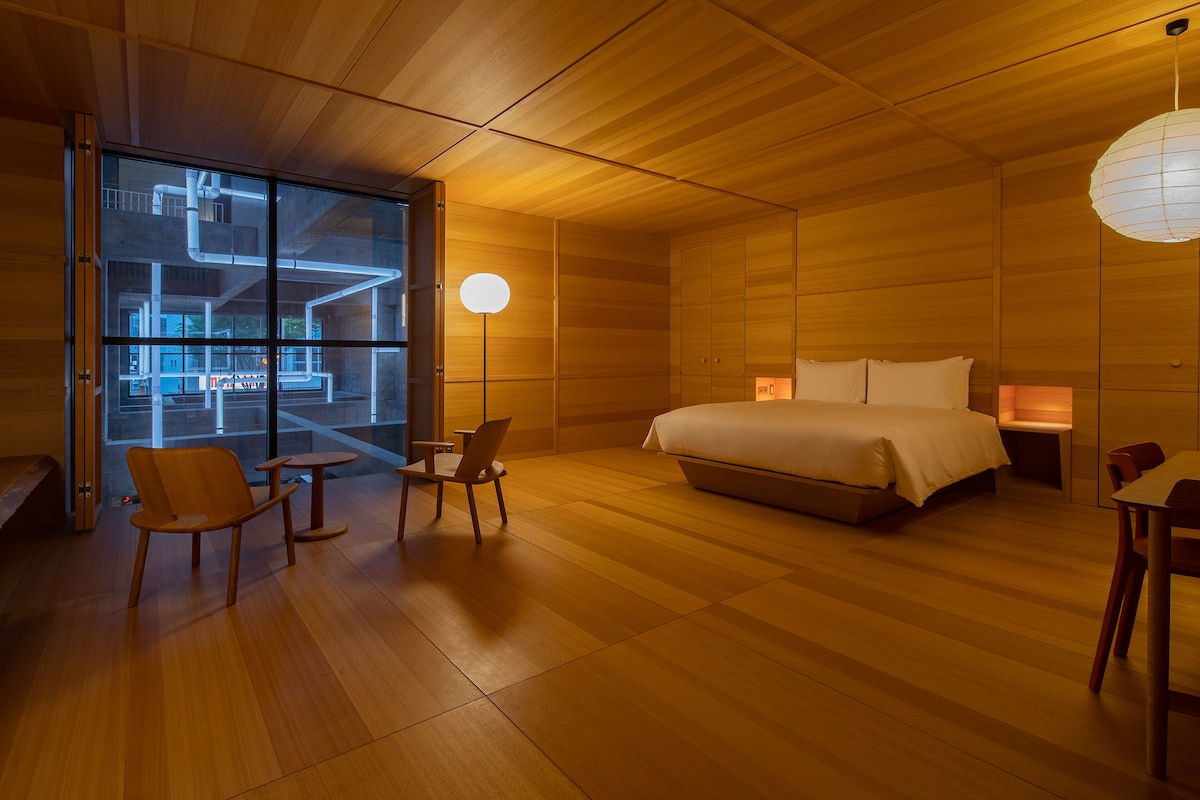
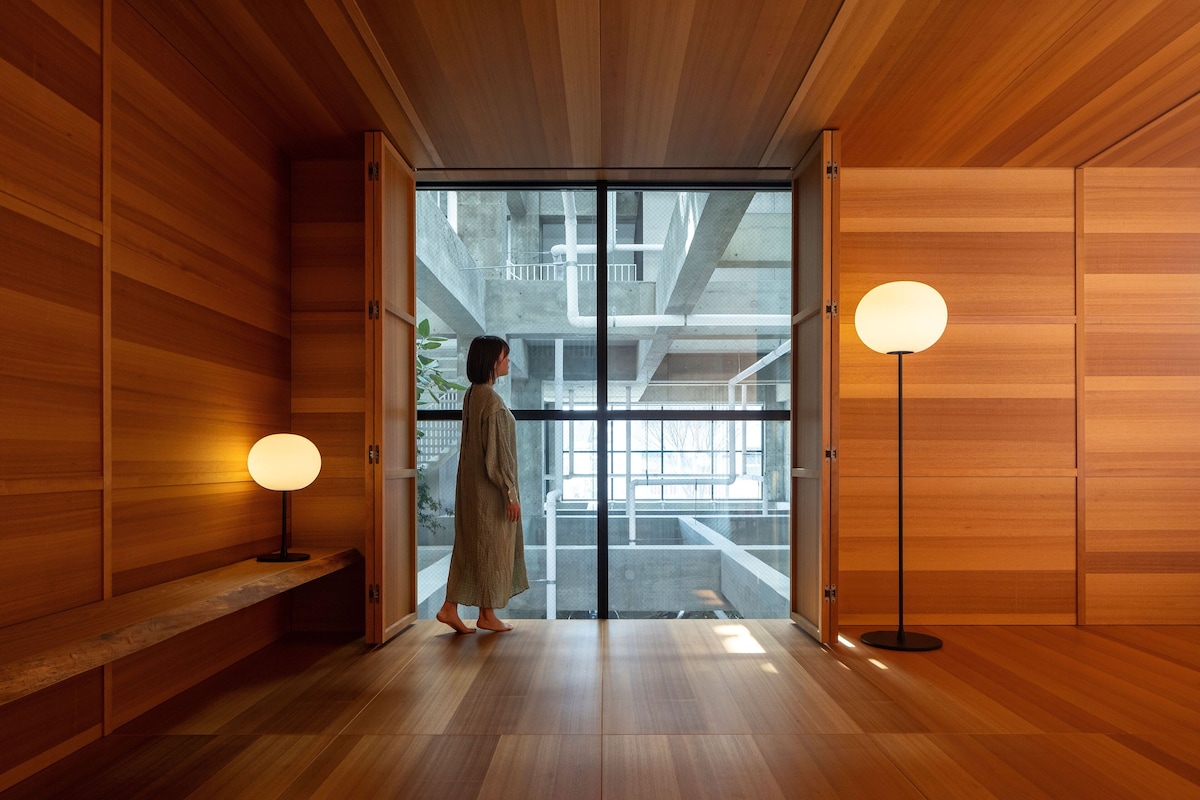
The Jasper Morrison Room is the most quietly luxurious of the four original concept rooms. At 57 square metres, it surrounds the guest with wood, stone and a cypress soaking tub, closer to a carefully made container than to an exhibition space. Wooden shutters open toward the Heritage Tower void. Morrison omitted the television, allowing materials, proportion and the atrium beyond the glass to hold attention. It is the concept room to choose when calm, bathing and understated design matter more than spectacle.
Michele De Lucchi’s 51-square-metre room is known as the 2725 Elements Room. Thousands of wooden shingles reinterpret traditional itabuki work, with light entering between the pieces and altering their depth through the day. The effect can recall a mountain hut, though the precision is unmistakably architectural. This room also has no television. Its premium is most meaningful to a guest who wants craft and enclosure rather than a conventional view.
The Sou Fujimoto Room measures 37 square metres and brings the hotel’s idea of growth into a pale, minimal interior punctuated by living green. Integrated vases and ficus leaves make vegetation part of the furniture rather than decoration placed after design. Twin beds make it a useful option for friends as well as couples, while the restrained palette offers relief from the visual density of the atrium.
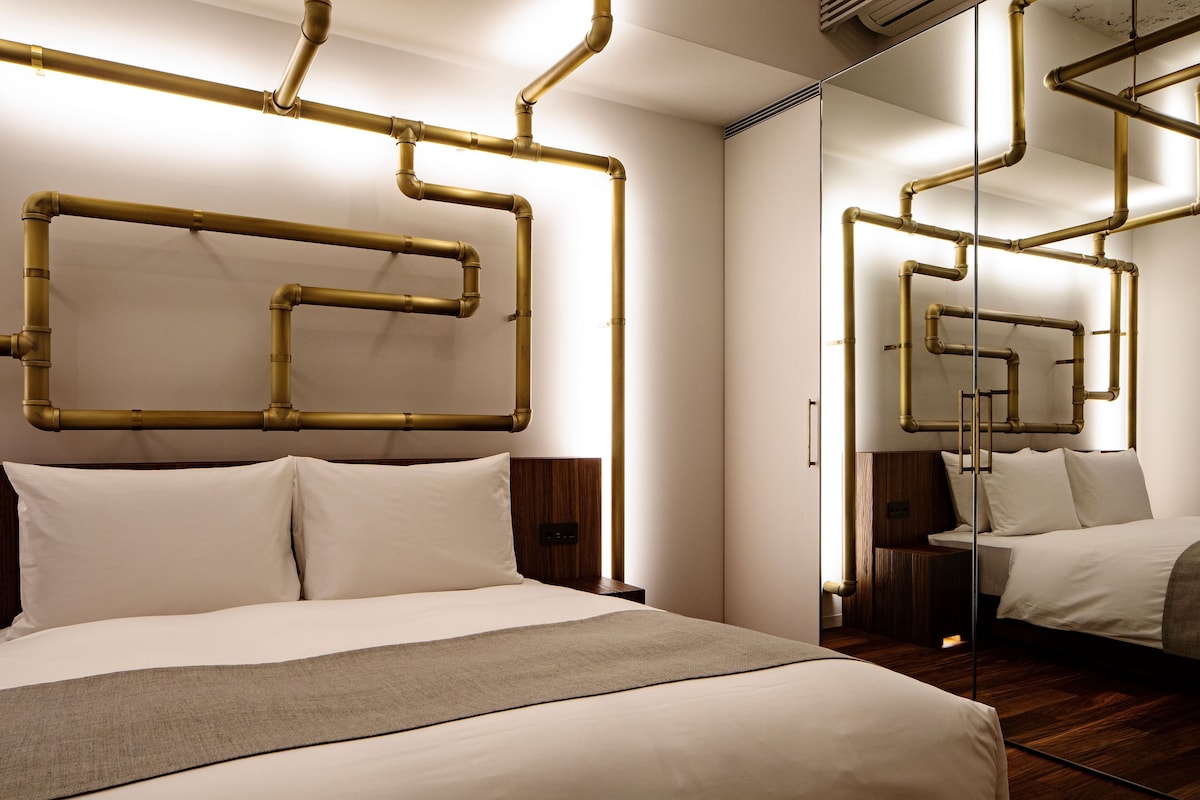
Leandro Erlich’s room is the smallest of the four at 25 square metres, but perhaps the most playful. Brass pipes travel across walls, furniture and bathroom details, exposing and reinventing what hotels usually hide. The room’s relationship with Erlich’s illuminated pipe installation in the atrium gives the night a conceptual continuity: the artwork is no longer something passed on the way to the lift, but the logic of the room itself.
All four are best approached as different experiences rather than upgrades arranged in a simple hierarchy. Jasper Morrison offers material calm and the most generous area; De Lucchi offers enveloping craft; Fujimoto offers growth and lightness; Erlich offers wit and immersion. Availability may decide the matter, but the strongest booking begins with the atmosphere desired, then checks bed type and dimensions.
The Larger Rooms and Residences
Travellers who want more conventional space without surrendering the hotel’s art can look beyond the four concept rooms. The 57-square-metre Junior Suite occupies the top floor of the Heritage Tower and projects over the atrium, giving a privileged view of Erlich’s Lighting Pipes. A freestanding bathtub and an open plan make it suited to a celebratory stay, while original works by Hiraku Suzuki and Mineki Murata keep the suite connected to the wider collection.
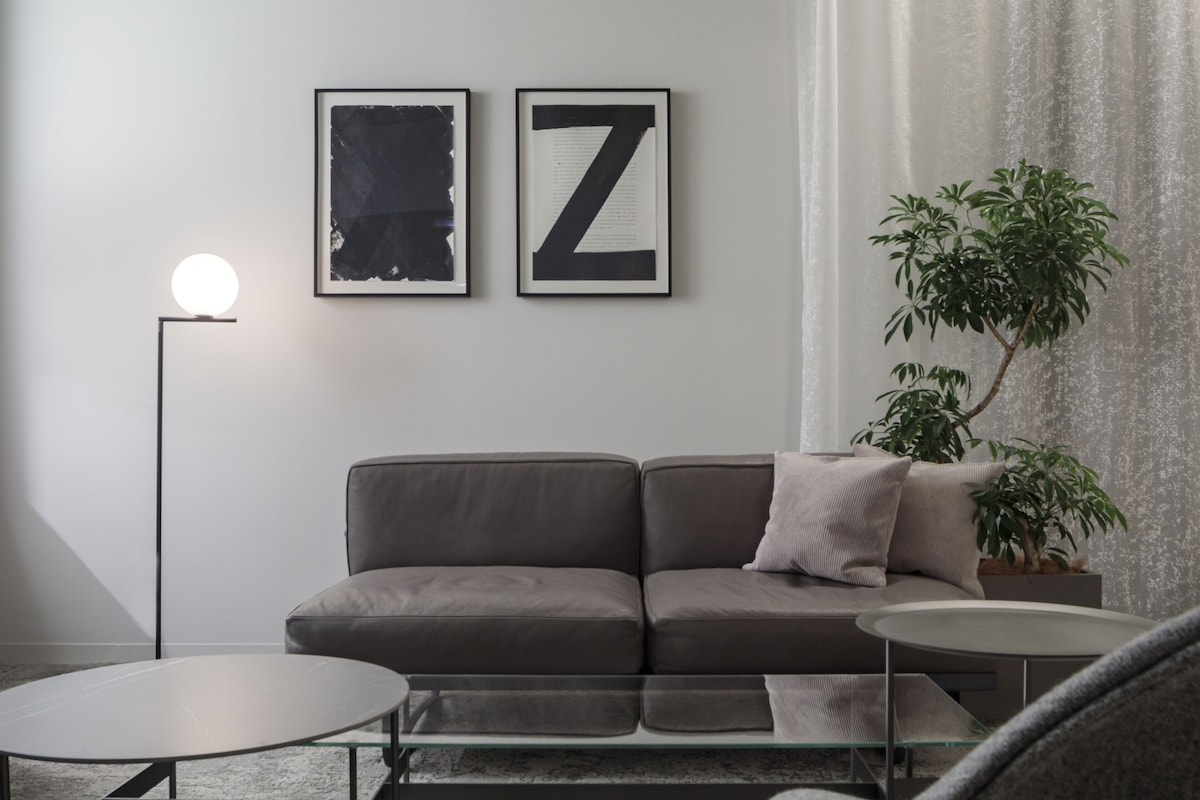
The 52-square-metre Executive Room is less theatrical but more adaptable. A substantial desk, twin beds and soft furnishings set against raw concrete make it persuasive for a longer stay or for guests who need the room to function as well as inspire. The newer residence categories move still further toward a collected interior: the 59-square-metre minä perhonen Residence layers textiles, vintage seating and work by Akira Minagawa, while the 56-square-metre Premium Residence uses a darker palette, Cassina pieces and a work by baanai.
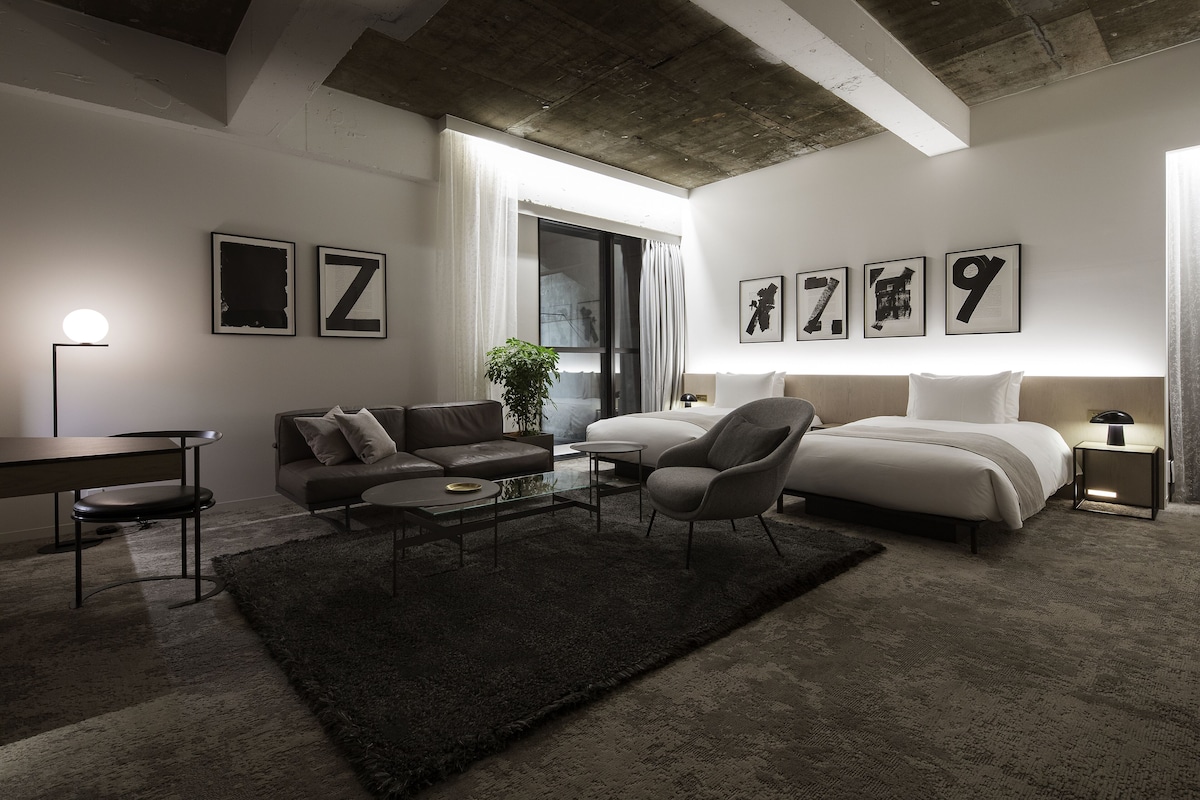
These rooms are not automatically better than the concept rooms. They answer different priorities. Book the Junior Suite for the atrium and an occasion, the Executive Room for usable space and twin beds, the minä perhonen Residence for textile-led warmth, and the Premium Residence for a composed design interior. The price difference is easiest to justify when the specific room—not merely extra floor area—will remain part of the memory of Maebashi.
Living with Art Rather Than Visiting a Gallery
The hotel’s collection is not confined to framed work along corridors. Lawrence Weiner’s language occupies the architecture; Erlich’s pipes animate the atrium; works by artists including Tatsuo Miyajima, Hiroshi Sugimoto, Chiharu Shiota and Ryan Gander appear across rooms and shared spaces. The experience is cumulative. A piece first encountered at check-in may return from another angle at breakfast, or become visible from a bridge that seemed merely functional the evening before.
This is why an early arrival is worth more here than a late checkout alone. Check-in begins at 3:00pm, and the first hours allow daylight to reach the concrete and planting before the atrium changes under artificial light. The hotel rewards circulation. It is better to make several slow passages through the building than to attempt to “see the art” in one deliberate circuit.
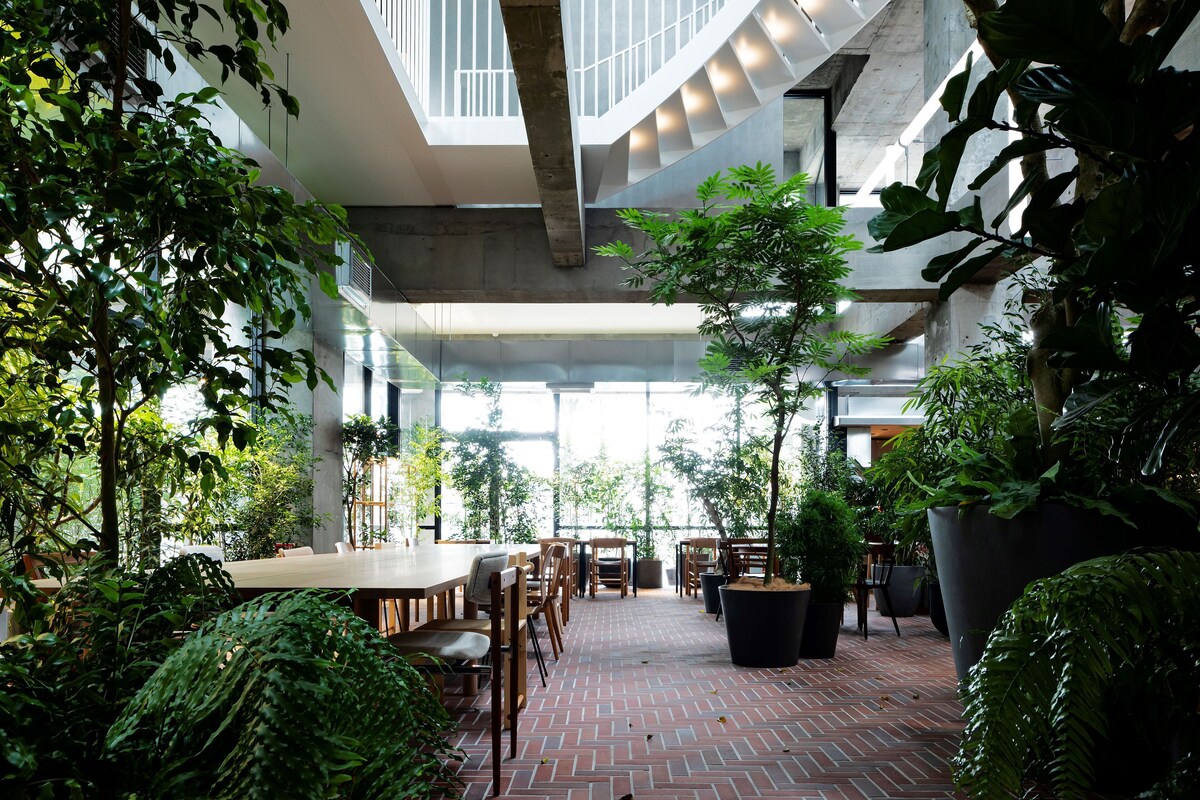
The public nature of the lounge also prevents the property from becoming a private museum. Local visitors come for coffee, pastries, lunch and conversation. That mixture is part of Fujimoto’s idea of an indoor plaza and part of the hotel’s relationship with Maebashi’s renewal. Guests seeking sealed resort exclusivity may find the ground floor busier than expected; those interested in a hotel that participates in its city will see that activity as essential.
Dinner, Breakfast and the Atrium Lounge
Food is one of the reasons to remain in the hotel for a one-night stay. SHIROIYA the RESTAURANT presents a course built around Gunma ingredients and the region’s food culture, served from an open kitchen that makes preparation part of the evening. The restaurant has appeared in Gault & Millau for consecutive years, but the more useful promise for a guest is its specificity: dinner connects the abstract international language of the architecture to produce and traditions closer to Maebashi.
The LOUNGE occupies the base of the atrium and shifts character through the day. Breakfast is currently served in the morning by reservation, followed by lunch and afternoon tea; from early evening, the Art Lounge offers staying guests complimentary alcoholic and non-alcoholic drinks. Light entering from above, plants descending through the structure and the movement of people on the bridges make the space feel different at each meal.
A restaurant, bakery, patisserie and Blue Bottle Coffee café create more choice than the room count suggests, though opening days vary. The bakery and patisserie have regular closing days, and dinner at the RESTAURANT should be reserved rather than treated as an available table after arrival. For one night, dinner in the hotel gives the stay a coherent arc. For two, one evening can be left open to the small restaurants and bars of central Maebashi.
Three Private Saunas in the Green Tower
The Green Tower contains three private saunas that appear to emerge from the planted hill: a Finland Sauna, a Bedroom Sauna and a Herbal Mist Sauna. They are not an included resort facility. Each is offered in an eighty-minute session and requires advance reservation. The Finland Sauna and Herbal Mist Sauna may also be booked by non-staying visitors, while the Bedroom Sauna is reserved for hotel guests. Current pricing should be confirmed directly with the hotel.
That distinction should influence the booking. A traveller choosing SHIROIYA for a restorative wellness stay should secure a sauna before arrival and understand that the hotel does not offer an onsen, swimming pool or large spa complex. The private format is more intimate and more closely aligned with the architecture, but it is an additional, scheduled experience rather than something to enter spontaneously throughout the day.
For a one-night itinerary, the late-afternoon or morning session fits most naturally around dinner and breakfast. For two nights, the sauna can become a slower interval rather than another item compressed between art and food. The premium is most persuasive for couples or friends who value privacy; guests seeking extensive thermal facilities will be better served by a dedicated onsen resort elsewhere in Gunma.
Maebashi Beyond the Hotel
SHIROIYA stands approximately fifteen minutes on foot or five minutes by taxi from Maebashi Station. From Tokyo, the journey typically involves the Joetsu or Hokuriku Shinkansen to Takasaki, followed by the JR Ryomo Line to Maebashi. The transfer is manageable for a single night, but the hotel’s purpose becomes clearer when the visit is not treated as an anonymous stop between Tokyo and the mountains.
Arts Maebashi is a short walk away, and the observation deck at the Gunma Prefectural Office, Maebashi Park and the city’s compact centre can be combined without a car. These are not blockbuster sights arranged around a luxury resort. Their appeal is quieter: an art institution, civic architecture, a river city and a centre negotiating its own renewal. The hotel belongs to that story rather than floating above it.
Guests arriving by car should use the hotel’s partner-parking guidance. The published arrangement currently provides complimentary parking from 3:00pm on check-in day until noon after check-out at designated facilities, with charges outside those hours. Consecutive-night guests are directed to a particular partner car park. Presenting the parking ticket at reception and confirming the current arrangement avoids treating a city-centre hotel as though it had a private resort lot.
What to Know Before Booking
First, select the room by building and artwork, not by size alone. An atrium-facing Heritage room and a greener, balcony-oriented room in the new tower create different stays. Expedia’s category names should be matched to the room photographs and, where necessary, to the hotel’s current descriptions before payment.
Second, reserve the experiences that define the trip. Dinner at the RESTAURANT, breakfast and the private saunas have their own capacity and operating patterns. The bakery, patisserie and other venues may close on particular days. A room reservation does not guarantee every dining or sauna experience, so the stay should be assembled rather than left entirely to arrival.
Third, understand what the hotel does not centre. There is no large pool, full-service spa or communal onsen in the published facility list. Some concept rooms intentionally omit televisions. Views may look into the atrium rather than across a distant landscape. These are not shortcomings hidden behind design language; they are consequences of a hotel devoted to architecture, art, food and a city-centre setting.
Finally, allow the room to justify its rate. A late arrival after dinner and an early departure would reduce even the most remarkable concept room to unusual decoration. Arrive while daylight remains, move through the atrium before and after dinner, and leave space for breakfast or a walk through Maebashi. One night can be complete; two are preferable when a sauna, a leisurely dinner and the city beyond the hotel all matter.
Who Should Stay Here
SHIROIYA HOTEL is most persuasive for couples and solo travellers who choose accommodation for architecture, contemporary art and the character of a room. It suits a design-led weekend from Tokyo, a food journey centred on Gunma ingredients, or a regional itinerary that needs a cultural pause between larger destinations. It is also a thoughtful choice for travellers who prefer a small hotel with a strong point of view to a five-star property offering every conventional facility.
It requires more planning for families who need extensive recreation on site or intend to dine together at the RESTAURANT, which generally welcomes guests aged thirteen and above except for private parties. It will also feel less natural to travellers expecting an onsen, a swimming pool or a broad scenic view from every room. Guests uncomfortable with public visitors in the lounge may prefer a more secluded resort; the hotel is intimate, but its ground floor is deliberately connected to the city.
For the right guest, the choice of room can be wonderfully personal. Jasper Morrison for quiet material warmth; Michele De Lucchi for craft; Sou Fujimoto for lightness and growth; Leandro Erlich for conceptual play; the Junior Suite for an atrium occasion; the Green Tower for a calmer relationship with planting. The hotel sells best when that choice is made explicitly, not when every room is treated as interchangeable.
A Hotel That Lets Maebashi Remain Visible
Many art hotels collect objects after the architecture has been completed. SHIROIYA feels different because art, building, landscape and urban purpose developed together. The rough frame of a closed 1970s hotel was not erased; it was opened. A new green hill did not imitate the old ryokan; it introduced another memory of the city. Rooms do not repeat one corporate interior; they allow creators to alter the conditions of sleep.
The most successful stay therefore moves between scales. It notices the great void of the Heritage Tower, then the grain of wood around a bath; the public energy of the lounge, then the privacy of a sauna; the international names in the collection, then ingredients from Gunma at dinner. By morning, Maebashi is no longer merely the location written beneath the hotel’s name. It is the reason the building could become what it is.
View current SHIROIYA HOTEL availability on Expedia →(Paid link)
Related Reading
For two further stays where architecture changes the experience of a night, read our reviews of Auberge eaufeu, created from a former school in Komatsu, and The Hotel Seiryu Kyoto Kiyomizu, shaped from a 1933 schoolhouse.