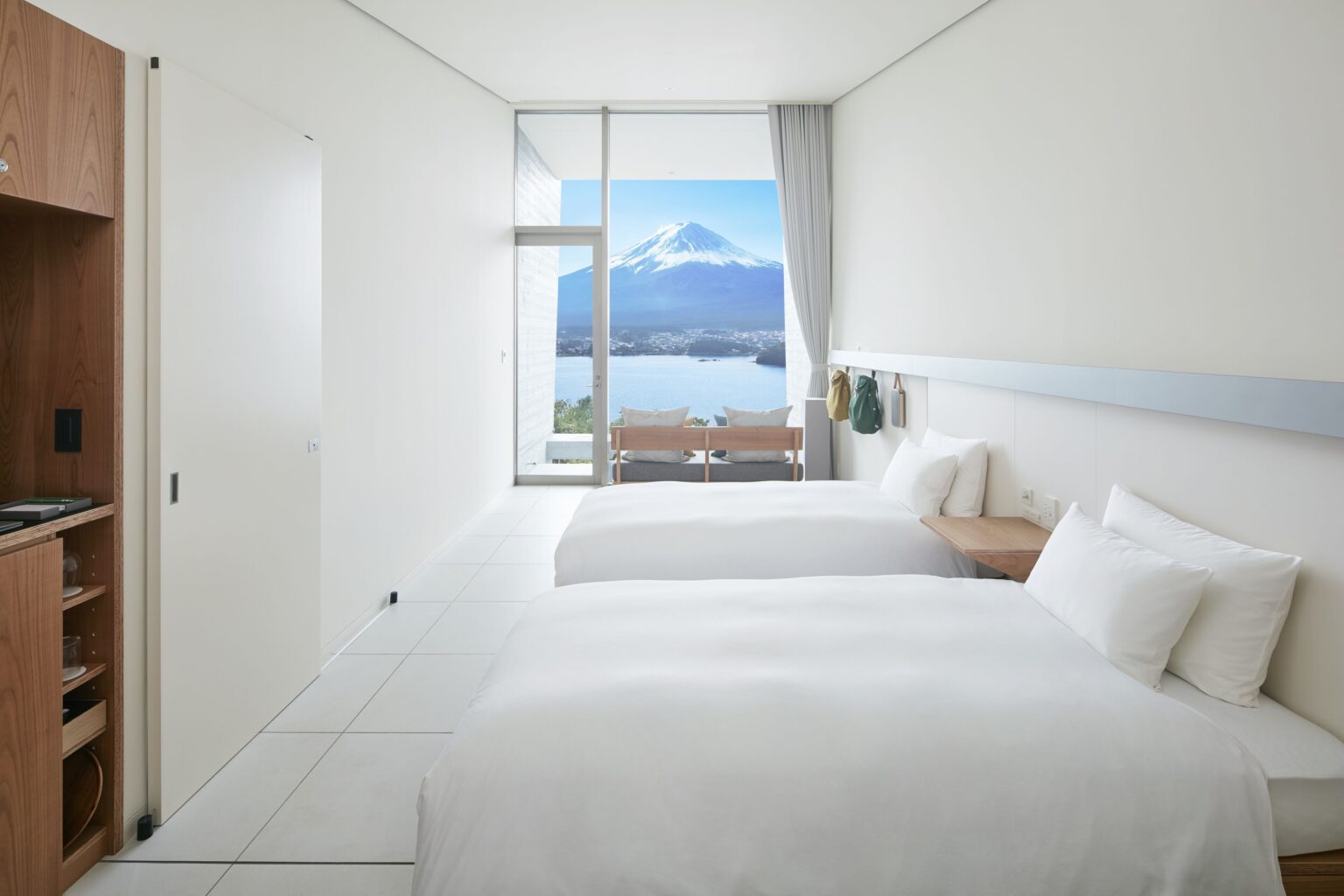
Above Lake Kawaguchi, HOSHINOYA Fuji makes Mount Fuji part of the architecture rather than a distant attraction. Forty concrete cabins climb a wooded slope, each opening toward the lake through a broad window and a furnished terrace. The mountain may command that frame in clear weather or disappear completely into cloud. Either way, the stay continues through red-pine decks, woodsmoke, early light on the water and meals designed to keep the forest close.
This is luxury glamping without a tent. Guests sleep in a private, climate-controlled cabin with a proper bathroom, while the outdoor character of the resort appears in the terrace living room, Cloud Terrace and a programme of forest and lake activities. That distinction is central to the booking decision. HOSHINOYA Fuji is not an onsen ryokan, a full-service lakefront resort or a base chosen mainly for sightseeing efficiency. It is for travellers willing to give the hillside itself a meaningful share of the itinerary.
Booking Snapshot
- Best for
- Couples and quiet-resort travellers who want a private cabin, forest time and the possibility of Mount Fuji from their own terrace.
- Room decision
- Compare the exact bed arrangement, occupancy and terrace photographs. The resort has twin, king and family-oriented configurations for one to three guests.
- View
- Cabins are oriented toward Lake Kawaguchi and Mount Fuji, but weather can hide the mountain and the foreground and angle differ by cabin.
- Dining
- Breakfast and dinner are generally separate from the room. Reserve the essential meals after confirming the cabin, especially for a short stay.
- Access
- Plan on a taxi from Kawaguchiko Station. The resort currently lists no dedicated hotel shuttle and the hillside has no elevator.
- Recommended stay
- Two nights give the forest, dining and one substantial activity enough room; one night is possible but more tightly scheduled.
Check HOSHINOYA Fuji dates and current cabin availability on Expedia(Paid link)
In this guide
The Booking Decision
Choose HOSHINOYA Fuji when the view and the hours spent within the resort are meant to be the journey. The cabins are deliberately restrained, giving the window and terrace the visual importance that a conventional hotel might give to decoration. Beyond the room, the shared experience moves upward through the forest: a sequence of decks, fire, coffee, books and seasonal programmes rather than a lobby-led collection of facilities.
The property is most convincing for guests who will protect time for that rhythm. A morning can begin with canoeing or breakfast delivered to the cabin, an afternoon can pass at Cloud Terrace, and dinner can remain beside the trees. Travellers who leave immediately after breakfast and return late at night will still have a dramatic room, but they will use only a fraction of what makes the price distinctive.
It is equally important to know what not to expect. The word glamping does not mean a canvas tent or shared washing facilities here; these are permanent cabins with hotel comfort. Conversely, the resort should not be booked as an onsen destination. The appeal is not a public hot-spring bath, swimming pool or spa circuit, but privacy, landscape and a curated outdoor life. Guests who require those resort facilities may prefer another address around the Fuji Five Lakes.
Choosing a Cabin, Not Merely a Bed
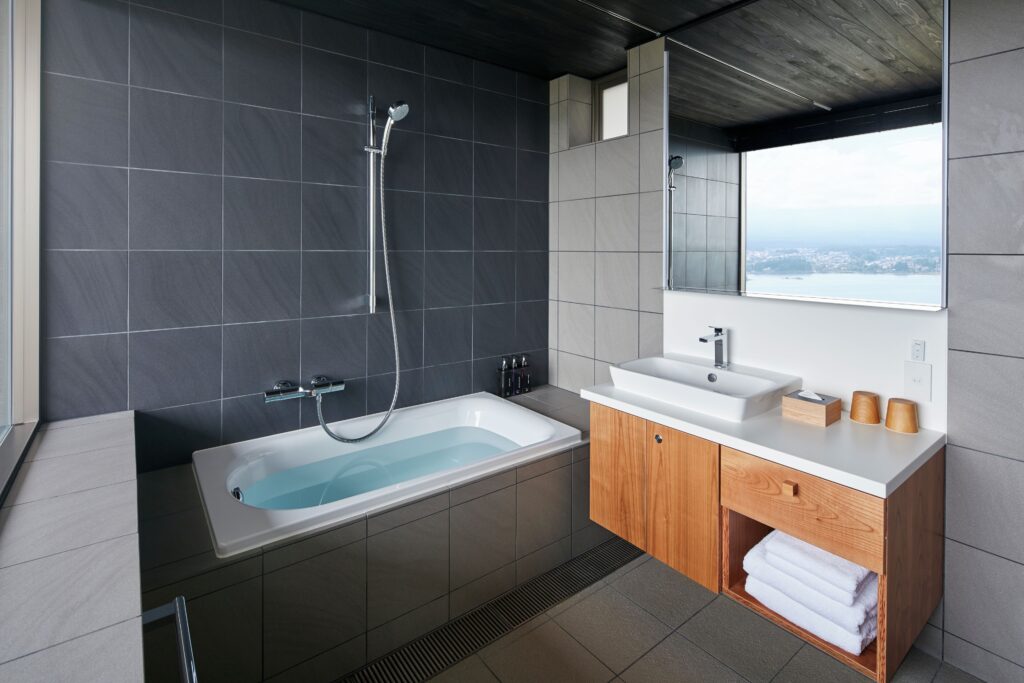
HOSHINOYA Fuji has 40 cabins and accepts between one and three guests depending on the selected arrangement. The official presentation describes each cabin as a telescope aimed toward the lake, with the furnished terrace forming a large part of daily life. The basic decision is therefore not whether to book a view at all, but how the party will sleep and how much of the stay will be spent on that outdoor-facing threshold.
For two friends or a couple who prefer separate beds, a twin arrangement is the clear starting point. A king configuration suits a couple who values a single generous bed, while a family-oriented listing matters when three guests need confirmed sleeping space. Expedia and the official booking engine can translate or group cabin names differently, so the complete listing should be read rather than inferred from a photograph.
| Decision | Why it matters | What to confirm |
|---|---|---|
| Bed arrangement | Twin, king and family configurations change how comfortably one to three guests share the room. | The complete cabin name, number of beds and maximum occupancy on the exact rate. |
| Terrace use | The terrace living room is a major part of the design, not a narrow balcony added to the room. | Current photographs, seasonal furniture and whether the layout suits children or mobility needs. |
| View expectations | Cabins face the lake and mountain direction, but weather and foreground vary. | Treat photographs as examples and never pay a premium on the assumption of guaranteed clear skies. |
| Rate conditions | Meals, activities and cancellation terms can alter the real cost of the stay. | Inclusions, payment timing, cancellation deadline and whether breakfast is attached to the selected offer. |
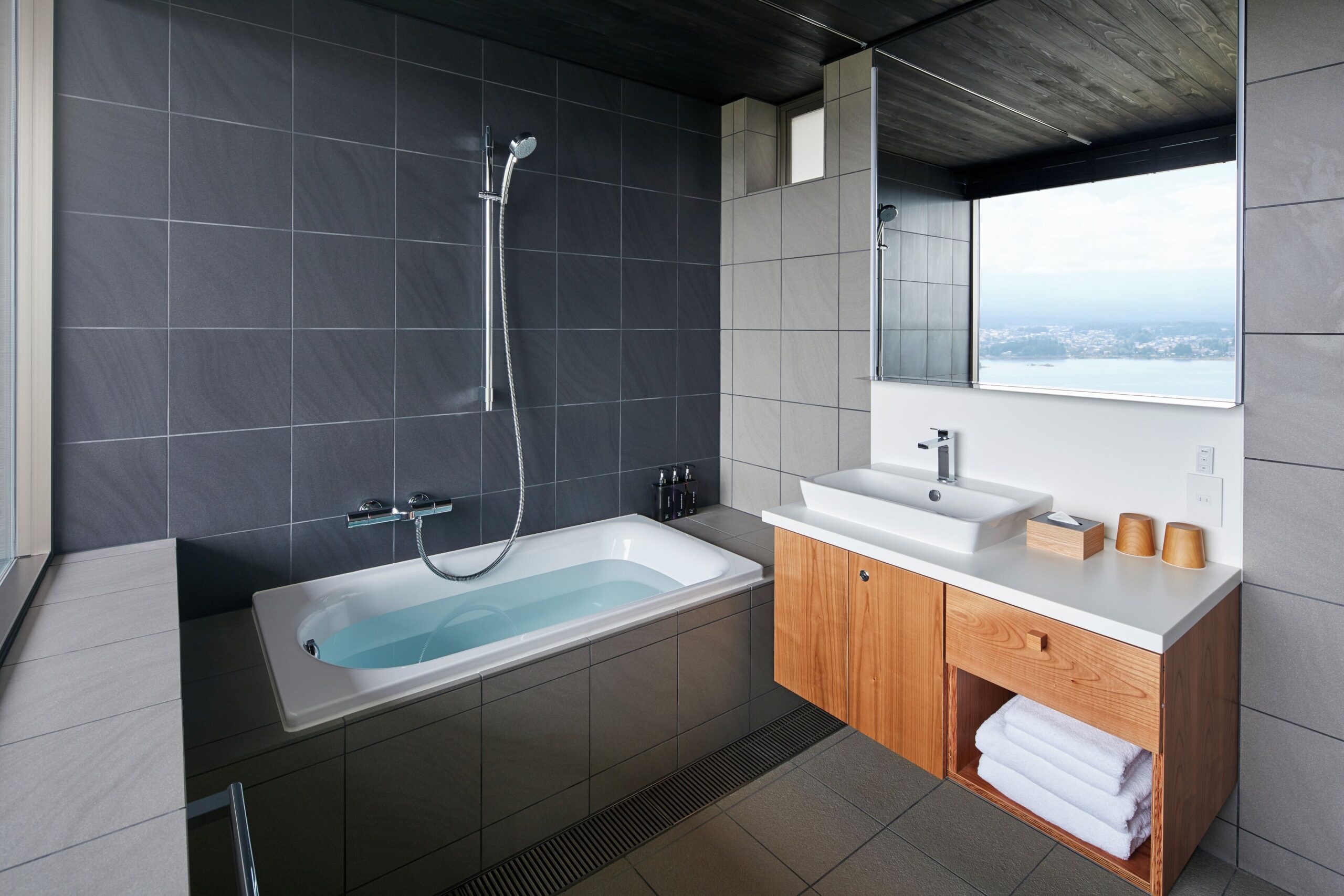
There is no useful reason to chase the most expensive available option without first deciding how the room will be used. If the day is centred on Cloud Terrace and guided activities, bed arrangement and cancellation flexibility may matter more than a marginal difference in floor area. If the terrace is intended to hold breakfast, reading and a private dinner, its photographs and seasonal comfort deserve closer attention.
Families should enter every child accurately and check the stated occupancy rather than assume that a broad terrace means extra sleeping capacity. The resort’s current general guidance allows bed sharing for children under 12 within the room’s maximum occupancy, but the rate, meals and age entry must still be confirmed on the actual booking. A cabin intended for two should not be stretched to three merely because the architecture looks spacious.
Compare HOSHINOYA Fuji cabin listings and rate conditions on Expedia(Paid link)
A Window Reserved for Mount Fuji
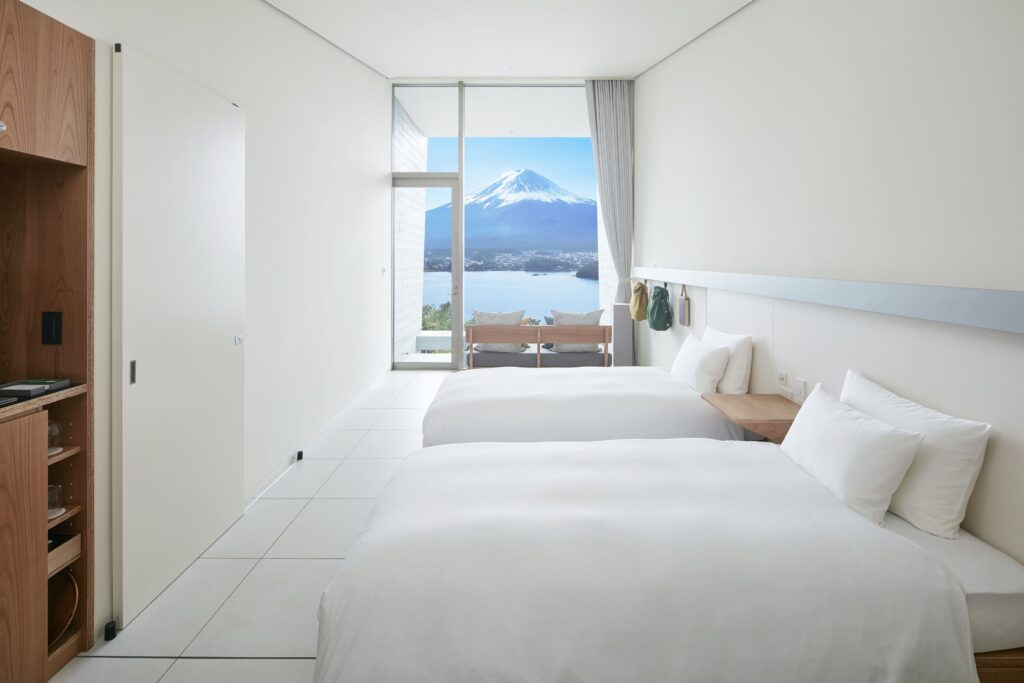
The room’s most memorable gesture is also its simplest. Beds, seating and terrace return the eye to the same landscape, allowing Lake Kawaguchi and the mountain beyond to govern the interior. The concrete walls hold the cabin quietly, while the glazed front opens the view with very little visual interruption. It is a disciplined design: the room does not compete with the reason most guests have travelled here.
The terrace living room softens the boundary between shelter and open air. In warm weather, it belongs to lake breezes and long daylight. In colder months, seasonal arrangements such as the terrace kotatsu allow the outdoor-facing space to remain usable, though comfort will always depend on temperature, wind and personal tolerance. It is better understood as a protected place to meet the season than as a perfectly controlled second lounge.
Mount Fuji itself remains beautifully unreliable. Clouds may erase the summit for hours or reveal it between breakfast and checkout. A one-night guest can encounter rain and mist; a two-night guest simply has more opportunities for the weather to change. The correct promise is the orientation of the cabin and the quality of the frame, not the certainty of what nature will place inside it.
This uncertainty does not make the stay unsuccessful. When the mountain withdraws, the lake, rain-darkened trunks and shifting mist acquire greater presence. The best booking expectation is therefore not “I will wake to a perfect Fuji photograph,” but “I will live for a while in a room designed around this landscape.” The first can disappoint through no fault of the hotel; the second remains available in almost any weather.
Cloud Terrace Among the Red Pines
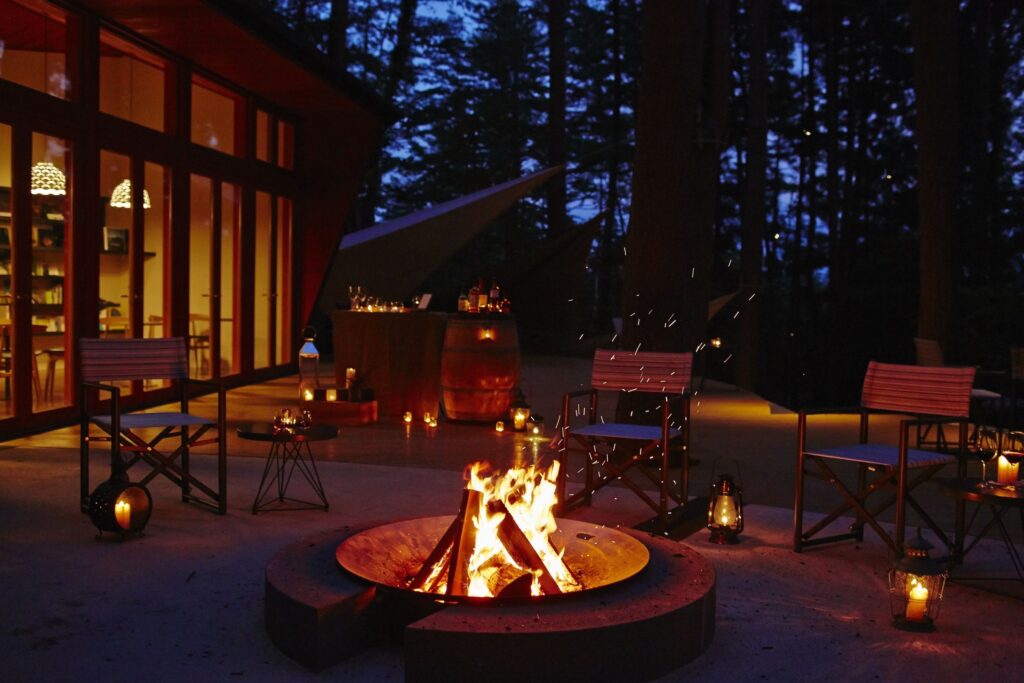
Higher on the slope, Cloud Terrace moves through the red-pine forest as a series of wooden decks. The climb changes the resort’s scale. Cabins occupy the lower hillside; above them, seating, fire and paths gather beneath the canopy. Some places invite conversation, while others are better suited to a book or the quiet observation of light moving through the branches.
The Library Cafe gives this shared landscape an indoor counterpoint, with books related to nature, food and Mount Fuji and a wood-burning stove for colder hours. The fire-led spaces and seasonal offerings can make the terrace feel programmed, but its greatest luxury is less formal: there are places where nothing is required. Coffee, a hammock and an unscheduled hour may be more faithful to the resort than filling every available activity slot.
That freedom is easiest to protect when the stay is not over-planned. Select one meaningful experience, reserve the meals that matter, then leave enough open space to use Cloud Terrace according to the weather. A clear afternoon, a damp forest and a cold evening by fire each create different versions of the same resort. The schedule should be able to move with them.
Morning on the Lake, Afternoon in the Forest
Early Morning Canoeing is one of the clearest ways to understand the setting. It brings the day down from the hillside to Lake Kawaguchi, where the water and changing light create a more immediate relationship with the landscape. Like all outdoor programmes, it remains dependent on conditions, and the mountain is not guaranteed to appear simply because the activity begins at dawn.
Other programmes lead into the wider Fuji environment through forest walks, lava terrain and routes across the foothills. The Jukai Morning Tour, for example, is a guided walk with an age requirement and advance reservation, while longer themed stays can combine trekking, local culture and meals. These experiences change by season and some are offered only in Japanese, so the current activity page should be checked for dates, language, age, equipment and cancellation terms.
The temptation is to regard a long list of activities as a checklist. That would miss the point. One lake experience and one forest experience can give a two-night stay shape without turning it into camp. Guests who prefer stillness can let the terraces and cabin do more of the work; guests who need movement can choose a guided programme with a clearer sense of place than a generic fitness class.
Dinner Beside the Trees
In the dining room, Gastronomic Wild draws on ingredients and traditions from the Mount Fuji region and presents them through the flame, smoke and informality associated with the resort’s glamping idea. Local produce, game and Yamanashi wine can enter the menu, while a central grill gives dinner a theatrical warmth that still belongs to the forest outside. The exact dishes and price are seasonal, so the value lies in the concept and setting rather than a fixed menu described months in advance.
Dinner can also remain with the cabin. Current options include red-wine sukiyaki and seasonal shabu-shabu prepared for the terrace, with indoor arrangements available when weather intervenes. These meals are especially persuasive for a couple who has booked the property for privacy: they allow the view and terrace to continue into the evening rather than becoming something left behind at the restaurant door.
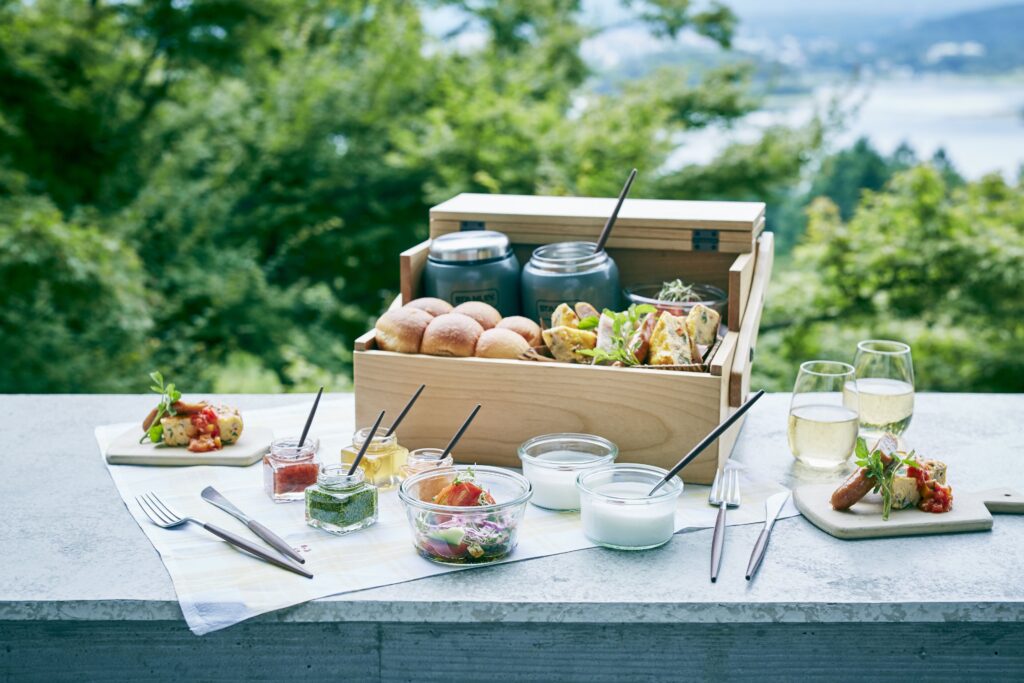
Breakfast creates a similar choice. A wooden breakfast box can be delivered to the cabin with bread, egg, sausage and fruit, while the dining room offers a more conventional seated morning. The room delivery uses the architecture well and avoids surrendering a clear early view. The dining room, however, gives a broader sense of service and may be preferable when the terrace is very cold or wet.

Meals are not automatically incidental to the room rate. Several formats require advance requests and have cancellation charges, while dietary accommodation can be limited for particular menus. After booking the cabin, decide the first dinner and breakfast rather than waiting until arrival. On a one-night stay especially, an unavailable preferred time can change the rhythm of the entire visit.
Choosing a Season Without Chasing a Guarantee
Winter often brings crisp air and a higher chance of a sharply outlined mountain, together with the pleasure of fire and the terrace kotatsu. It also brings cold. The contrast between a warm cabin and the outdoors is part of the experience, but guests who dislike low temperatures should not choose January for a photograph alone. Appropriate clothing remains essential even at a luxury resort.
Spring softens the hillside and can introduce blossom into the view; summer draws attention to the cooler forest evenings and longer use of the decks; autumn gives the surrounding landscape richer colour. Each season supports the resort differently. Seasonal programmes are attractive additions, but they should never be treated as permanent facilities or assumed to repeat on identical dates the following year.
Visibility is often best considered across time of day rather than through a promise attached to a particular month. Early morning can be clearer, cloud can build later, and weather changes quickly around the mountain. A two-night stay, an unhurried morning and a willingness to return to the terrace may improve the chance of seeing Fuji more than an aggressively scheduled itinerary.
One Night, Two Nights or Three?
One night can reveal the room, Cloud Terrace and one carefully chosen dinner, but it compresses the stay. A 3:00 p.m. check-in, activity deadlines, dinner, breakfast and noon checkout leave little room for both lake and forest. It works as a celebratory stop on a wider Fuji itinerary, particularly when the cabin itself is the priority, but every choice must be made in advance.
Two nights are the most balanced recommendation. The first afternoon can belong to the terrace and fire; the full day can hold canoeing or a guided forest experience without sacrificing an idle afternoon; the second dinner can contrast the dining room with a meal in the cabin. The extra morning also offers another chance for the mountain to emerge.
Three nights suit travellers who want a longer wellness programme, a more ambitious excursion or genuine withdrawal from a fast itinerary. Beyond that, the answer depends on how actively the guest enjoys a contained resort. HOSHINOYA Fuji is not positioned at the centre of an urban neighbourhood where a new restaurant and museum appear with every walk. Its repetition—lake, forest, fire, terrace—is intentional.
Arrival, the Hillside and Mobility
HOSHINOYA Fuji is at 1408 Oishi in Fujikawaguchiko. The current official directions point guests to a taxi from Kawaguchiko Station and do not list a dedicated hotel shuttle. From Tokyo, trains or highway buses typically reach Kawaguchiko in about two hours before that final taxi. Drivers can reach the property in roughly 20 minutes from the Kawaguchiko Interchange, and free outdoor parking is listed.
The arrival is designed around the hillside rather than a conventional hotel forecourt. Expedia currently notes that the property has no elevator, and the shared forest spaces involve slopes and walking. Guests for whom stairs, uneven ground or distance between facilities may be difficult should contact the resort before committing to a rate and request precise guidance on the route to the cabin and dining areas.
The absence of a shuttle also matters at departure. A taxi should be considered part of the plan rather than left to chance at the last moment, particularly during busy weekends. Travellers combining the stay with another region should allow realistic transfer time; a morning view of Mount Fuji is less enjoyable when watched against an unnecessarily tight train connection.
Before You Book
- Read the complete cabin listing. Confirm bed type, occupancy, terrace photographs, inclusions and cancellation rules on the exact Expedia rate.
- Do not treat the view as a weather guarantee. The cabins are oriented toward Lake Kawaguchi and Mount Fuji, but cloud can conceal the mountain for part or all of a stay.
- Expect a cabin, not a tent. The glamping idea is expressed through private terraces, forest decks, fire and activities; sleeping and bathing remain indoors.
- Do not book for an onsen or pool. The property’s core experience is the cabin and forest. Verify every facility rather than importing expectations from another HOSHINOYA resort.
- Reserve meals after the room. Dinner, breakfast and activities have separate prices, deadlines, age or language conditions and cancellation terms.
- Plan the final transfer. Take a taxi from Kawaguchiko Station and remember that the resort currently lists no shuttle.
- Ask about mobility before paying. The hillside has no elevator, and access to Cloud Terrace and other spaces may involve slopes or steps.
- Check current operating notices. Temporary closures and maintenance periods can change; rely on the conditions attached to your dates.
When the Cabin Becomes a Frame
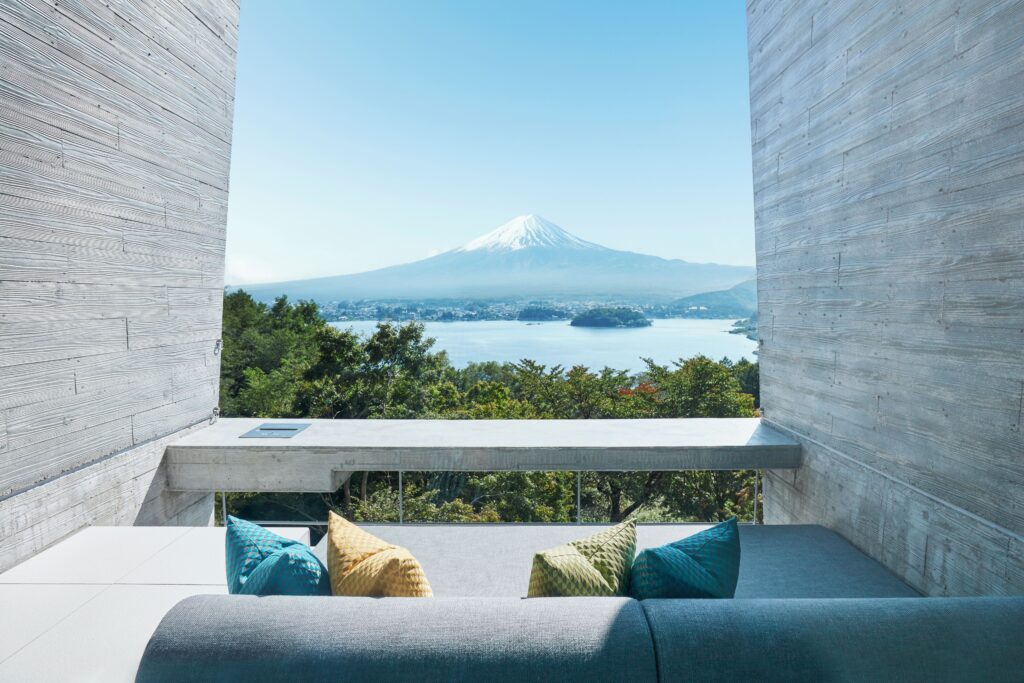
The lasting image of HOSHINOYA Fuji is not simply a snow-capped mountain. It is the act of looking: from bed through glass, from a terrace held between room and weather, from a canoe on still water or from a deck beneath red pines. The resort earns its distinction by allowing those perspectives to shape the day rather than treating the view as decoration behind a conventional hotel stay.
Book it for a private cabin that can hold long hours, a forest shared through fire and quiet decks, and dining that remains close to the landscape. Choose the bed arrangement carefully, reserve the essential meals, and allow two nights if time and budget permit. Travellers seeking a public onsen, a large pool or a sightseeing base with minimal time on the property should recognise the mismatch. Those who want the mountain and forest to determine the rhythm of the stay will find the concept unusually complete—even when Fuji itself is hidden in cloud.
View current HOSHINOYA Fuji rates and booking conditions on Expedia(Paid link)
Related Luxury Hotel Guides
Luxury Hotel Guides in Japan
HOSHINOYA Okinawa Review
HOSHINOYA Taketomi Island Review