On the western coast of Okinawa’s main island, a long wall of pale stone follows the edge of the sea. It is the first expression of HOSHINOYA Okinawa: not a barrier from the landscape, but a contemporary evocation of the gusuku that once enclosed the life and culture of the Ryukyu islands.
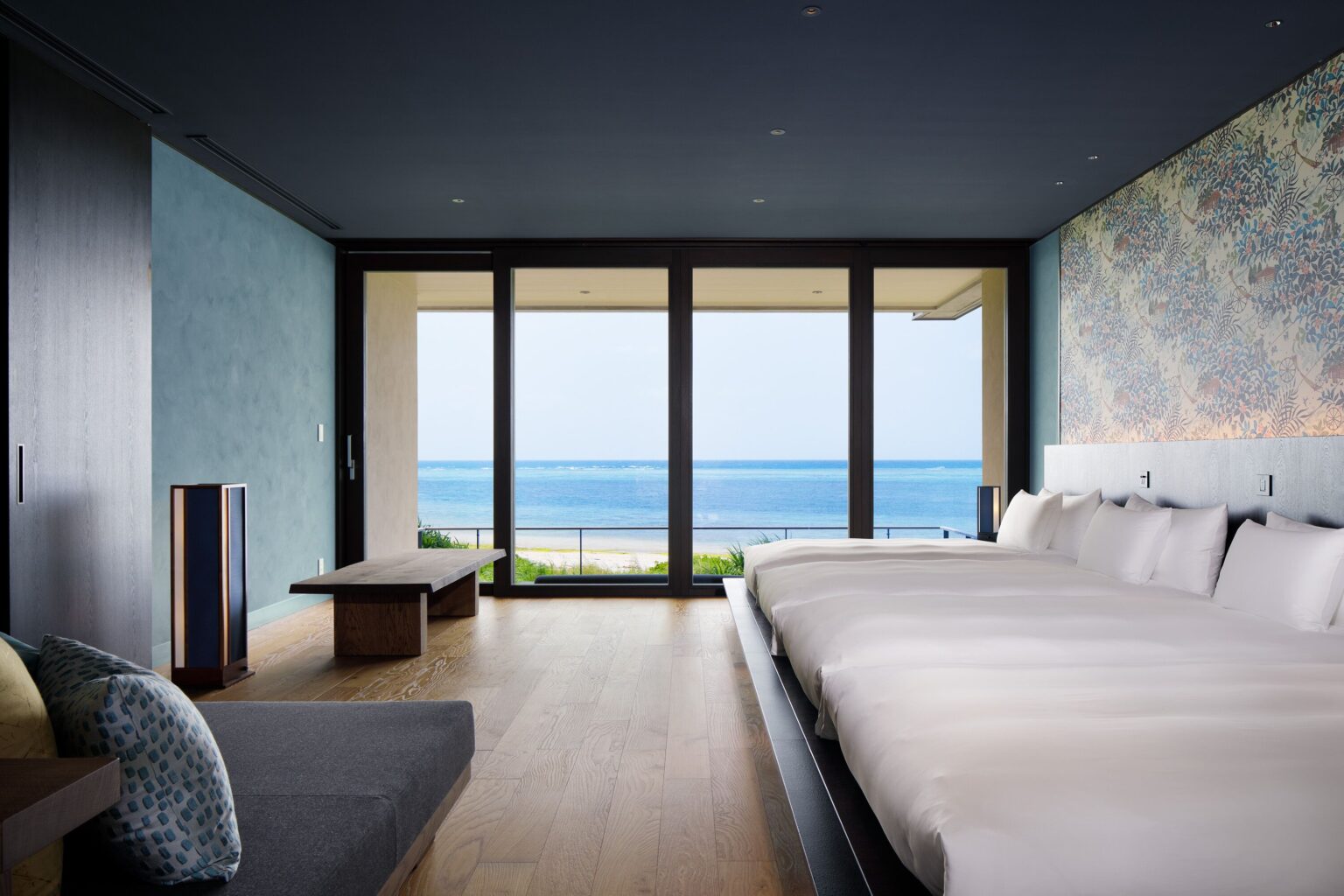
Beyond it, guest rooms, gardens and water are arranged close to the shore. The East China Sea remains present through the day—from breakfast in an indoor patio to an evening swim—giving the resort a rhythm that belongs distinctly to Yomitan. Yet the most useful way to understand this stay is not simply as an architectural retreat. It is a resort that asks guests to spend time where they are: in a large oceanfront room, beside a pool that remains available around the clock, and at meals that often need to be planned before arrival.
Booking Snapshot
- Best for
- Couples and families who want an oceanfront room to be a central part of the holiday, rather than merely a place to sleep.
- Room decision
- Tin is the most restrained choice; Haru prioritises a terrace-style living area; Fushi offers more interior space and floor-level seating; Tida adds a private pool and two-bedroom scale.
- Coast
- Gima Beach directly in front is a natural, rocky and tidal shoreline. For white sand and swimming, Nirai Beach is about ten minutes away on foot.
- Pool
- A heated, ocean-facing pool with four connected depths is available throughout the year and 24 hours a day, subject to operating conditions.
- Dining
- Dinner and breakfast are not incidental here. Reserve the dining room or an in-room option after confirming the room booking and current deadlines.
- Recommended stay
- Two nights reveal the basic rhythm; three allow time for Yomitan, the pool and a less scheduled day without compressing each meal and activity.
Check HOSHINOYA Okinawa rooms and current availability on Expedia →(Paid link)
In this guide
The Booking Decision
Choose HOSHINOYA Okinawa when the room, coast and hours within the resort are intended to form the journey. Every accommodation is low-rise and oceanfront, and every category contains the doma dining area that gives the property its domestic character. The standard decision is therefore not between a sea view and no sea view. It is between different amounts of space and different ways of living beside that view.
The resort is especially persuasive for a slower Okinawa itinerary: mornings without an early departure, afternoons divided between pool and shoreline, and meals treated as part of the reservation rather than found spontaneously at the end of the day. It is less compelling for travellers who plan to leave immediately after breakfast and return late each evening. In that case, much of the value—the room’s generous plan, the patio kitchen, the pool at changing hours and the activities rooted in Yomitan—will go unused.
There is also an important beach distinction. The natural shore directly outside is atmospheric and close, but it is not presented by the hotel as a conventional sandy swimming beach. Guests imagining effortless movement from room to white sand should plan around nearby Nirai Beach instead. Knowing this before booking prevents a beautiful coastal setting from being asked to provide a different kind of beach holiday.
A Wall That Holds a Landscape
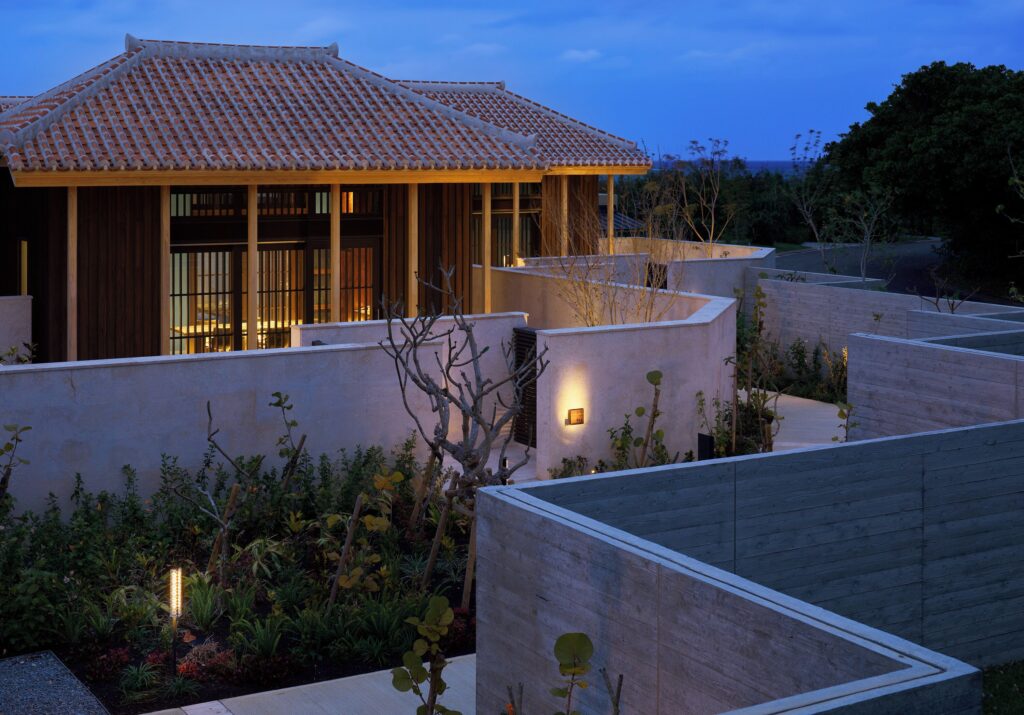
The resort’s 4.5-metre Gusuku wall takes its form from the gently curved limestone walls of Ryukyu-era castle sites. Openings in the stonework carry a pattern drawn from Yomitan textiles, allowing light and air to pass through while recalling wishes for longevity, prosperity and generations to come. It is not a replica of a historic fortress. Its achievement is editorial: the wall establishes the property’s scale, texture and sense of enclosure before the sea reappears beyond it.
Inside are orchards, fields and tropical planting. Low guest-room buildings follow roughly one kilometre of coast and rise no higher than two storeys. The architecture avoids the aerial panorama of a tower hotel in favour of proximity—the water is seen through planting, across a terrace or beyond a dining table. This means that a room’s exact angle and foreground can differ even though the official accommodation description calls every room oceanfront.
The landscape also shapes how the resort is used. Paths between stone, garden and shore make walking part of the experience; the dojo and activity programme give the grounds a cultural dimension; and the pool occupies the edge between built landscape and horizon. Guests looking for a compact hotel in which every facility is reached by lift may find this horizontal plan less immediate. Those who enjoy the gradual transition from room to garden to water will understand why the property feels more like a coastal settlement.
Rooms Kept Close to the Sea
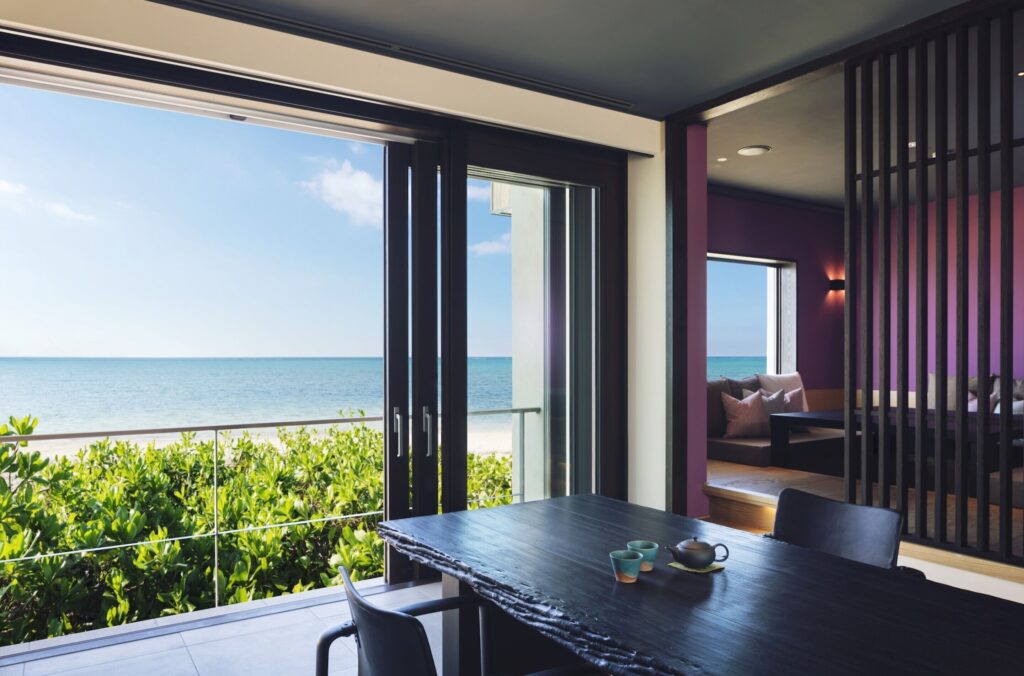
All 100 rooms are designed around a bright indoor patio known as the doma. It holds a generous table and kitchen facilities, creating a place where conversation and private dining can continue beside the coast. Separate bathing areas and the broad footprint make even the entry category feel closer to an apartment than a conventional hotel room. The practical question is how much space, terrace life and privacy the stay requires.
| Category | Space and layout | Best suited to | Check before booking |
|---|---|---|---|
| Tin | About 64 m² on current Expedia listings; king and twin configurations may appear. | One or two guests who want the oceanfront setting without paying for a four-bed suite. | Confirm bed type, occupancy, outlook photographs and the complete room name. |
| Haru | 88–94 m²; four beds and a terrace-style living area that brings daily life toward the sea. | Families or friends who value outdoor-adjacent living and room to gather. | The official site does not accept requests for a specific room; photographs and plans are examples. |
| Fushi | 93–94 m²; four beds, an ocean-facing doma and a relaxed floor-seating living area. | Guests who prefer a generous interior lounge and a distinctly Japanese way of sitting together. | Compare Fushi with Haru by living style, not by a small difference in square metres. |
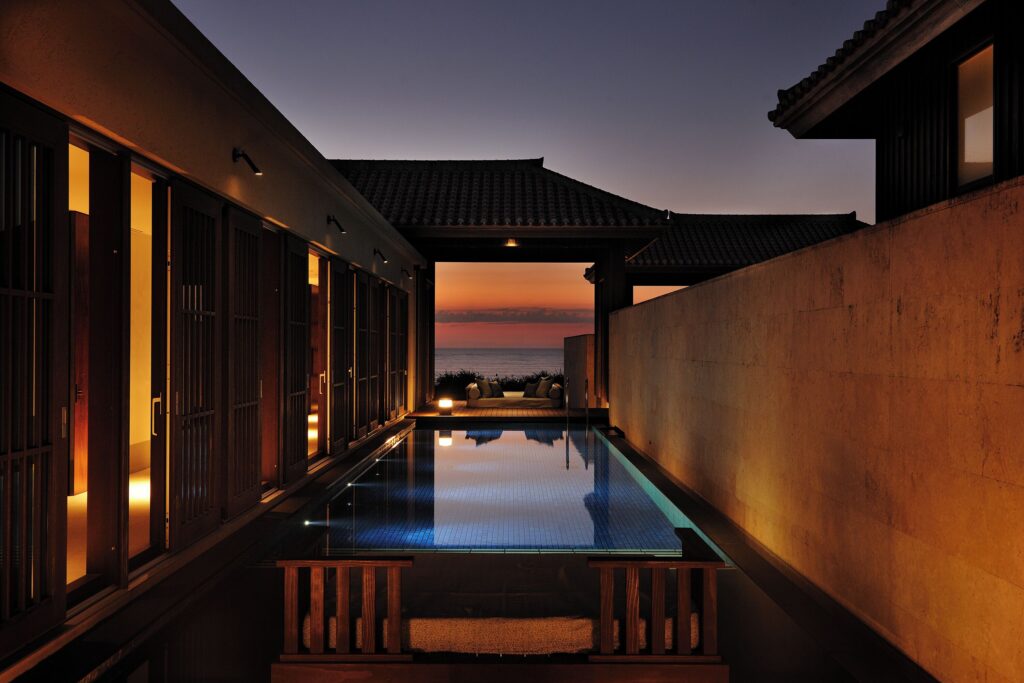
| Tida | 256–258 m²; four beds across two sleeping areas, a private pool and a terrace connected toward the beach. | A milestone stay, two couples or a family seeking privacy and villa scale. | Confirm the exact occupancy, bedding, cancellation terms and whether the private pool justifies the substantial premium. |
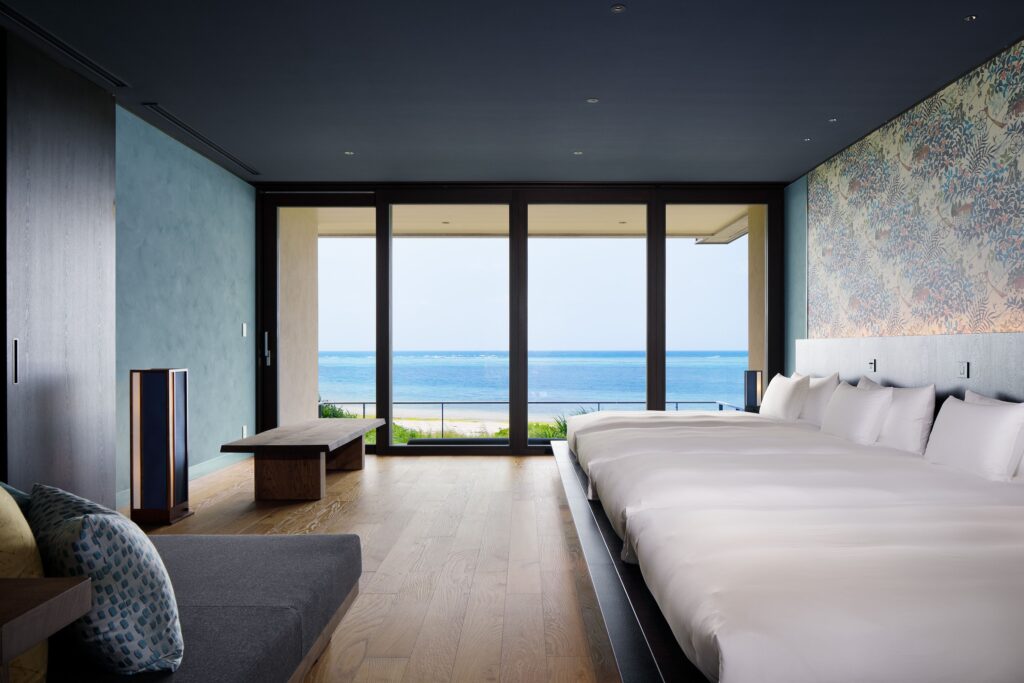
For a couple, Tin is the disciplined choice when the shared resort spaces and Yomitan matter as much as the room. Haru and Fushi become more persuasive for longer stays or groups of up to four, but they offer different pleasures: Haru directs attention toward its terrace living, while Fushi makes the interior gathering space more distinctive. Tida is not merely the largest category. Its private pool and two-bedroom scale change the degree of seclusion, making it a separate proposition rather than an incremental upgrade.
Room outlooks and layouts vary within a category, and the official site states that a specific room cannot be selected. Expedia may display several translated names for the same underlying category, so compare the complete name, bed configuration, floor plan, occupancy and photographs before payment. Do not infer a private pool from an image unless the booked category explicitly says Tida or otherwise confirms that facility.
Compare Tin, Haru, Fushi and Tida room options on Expedia →(Paid link)
The Coast in Its Natural Form
Gima Beach, immediately before the rooms, is a natural coast edged by coral reef. Its character is rocky and tidal, better understood through a walk at the waterline than as a conventional sweep of resort sand. That unmanicured quality is one reason the landscape feels particular to Yomitan: the shore is allowed to change visibly with the tide rather than being presented as a uniform recreational surface.
For swimming from white sand, Nirai Beach is about ten minutes away on foot according to the resort. Its shallow water offers a different experience from the natural shore outside the rooms. Keeping those two coastlines distinct makes the booking decision clearer: one brings geology, tide and wave sound close to the accommodation; the other is the place to plan a familiar beach afternoon.
Sea conditions, swimming areas and marine programmes remain weather-dependent. A photograph of calm turquoise water cannot guarantee the conditions of a particular day, especially during Okinawa’s typhoon season. Guests travelling primarily for sea swimming should check beach operations and forecasts close to arrival, while accepting that the heated pool gives the resort a reliable water experience when the open coast does not.
Water Through Morning and Night
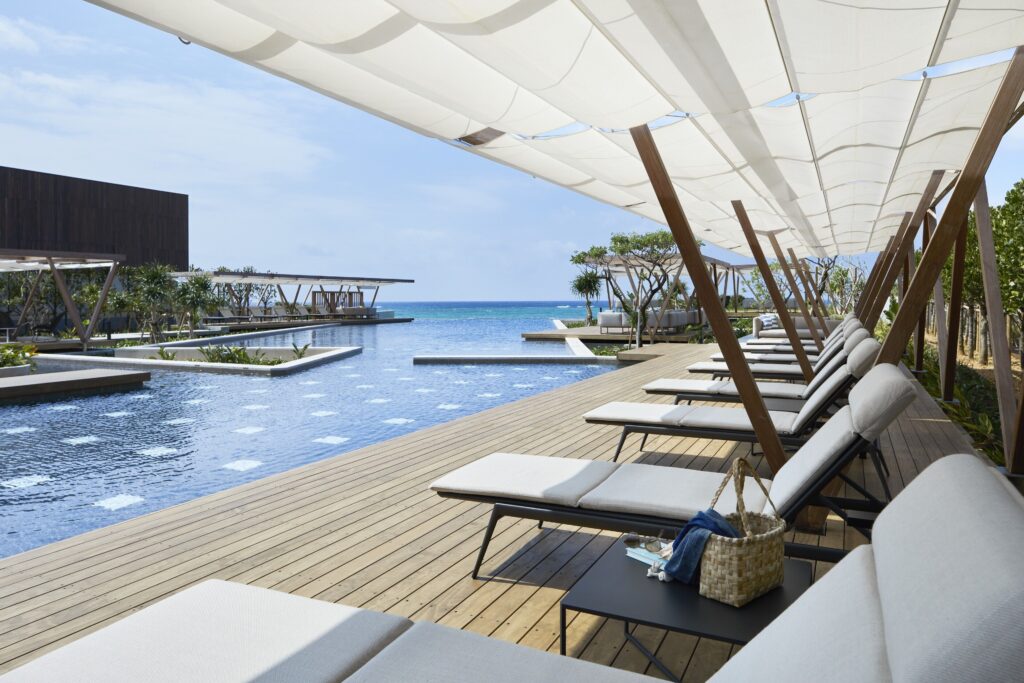
The pool traces the contours above the coast in four connected areas of different depths. Heated throughout the year and available 24 hours a day under the hotel’s current guidance, it can belong equally to the pale quiet of early morning, the colour of sunset and the darkened water after dinner. Shallow sections hold chairs within the water, while daybeds sit along the poolside.
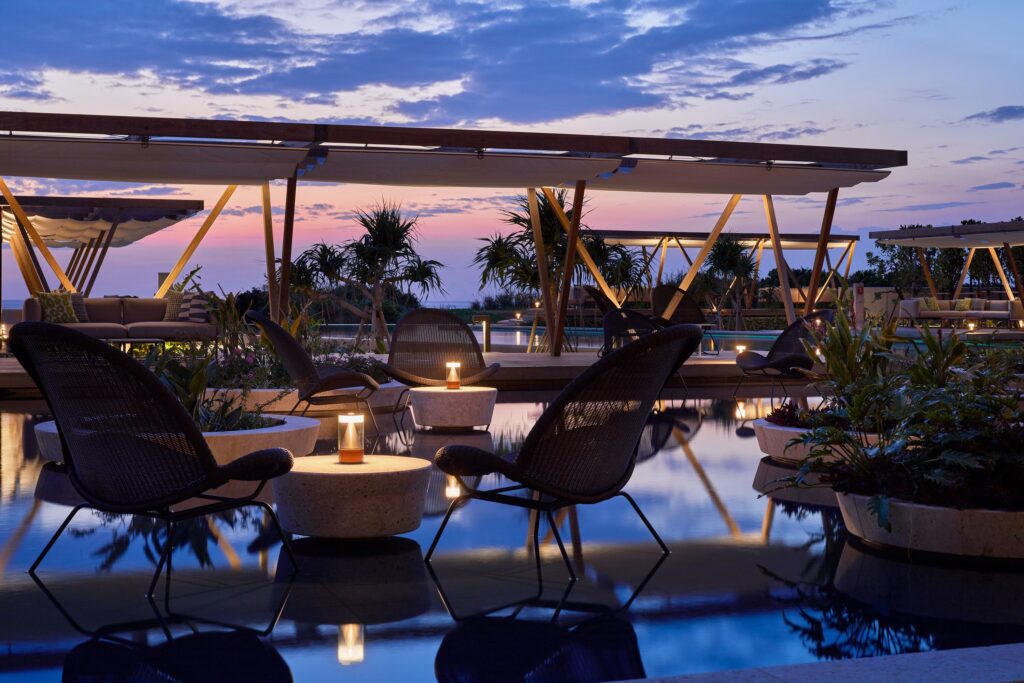
The shifting depth is not only visual. It permits different kinds of use within one landscape: a proper swim, time in shallow water, or simply a seat facing the horizon. This flexibility matters to couples and families sharing the same resort. It also argues for returning more than once rather than treating the pool as a single afternoon appointment.
Twenty-four-hour availability should not be mistaken for an unchanging programme. Seasonal events, weather and maintenance may affect parts of the experience, and special poolside offerings change through the year. The stable reason to book is the all-season heated setting itself, not a temporary event advertised for one travel period.
Dinner Between Okinawa and Italy
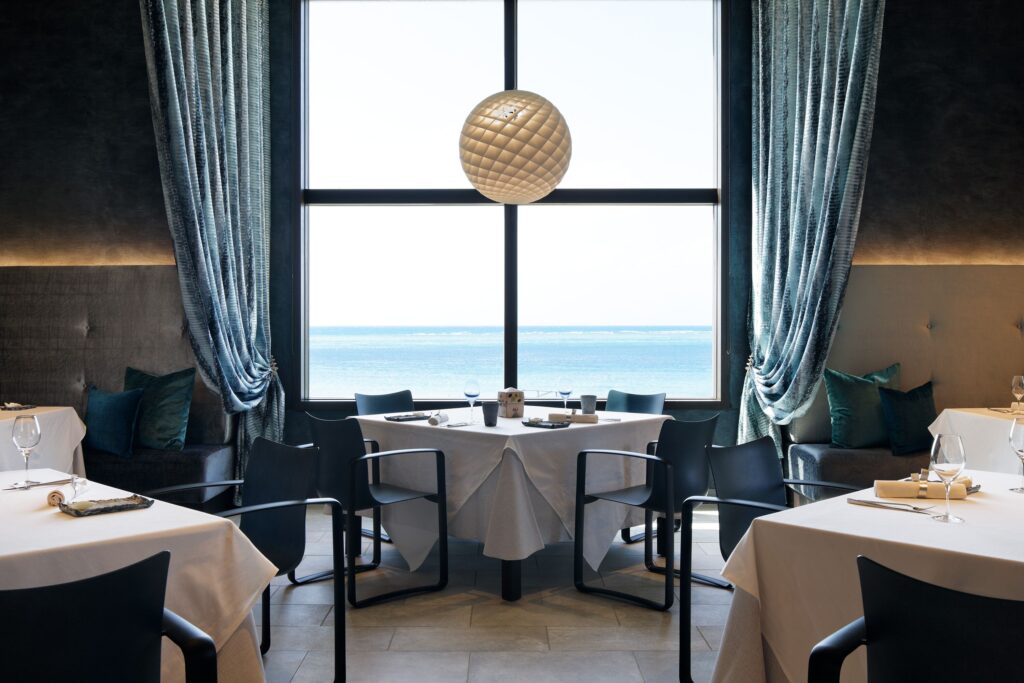
The signature dinner, Ryukyu Gastronomia—Bellezza, brings Okinawan ingredients and elements of the islands’ food traditions into an Italian framework. It is less a catalogue of familiar regional dishes than a meeting of warm-climate cuisines, shaped by local produce and the principle of food as part of wellbeing. For guests who want a formal culinary centre to one evening, it is the clearest reservation to make.
Another evening can remain inside the room. With the gathering dining service, the kitchen delivers prepared components to the patio refrigerator; guests finish cooking later using the patio’s kitchen amenities. This is not ordinary room service. It asks for a little participation, but rewards it with privacy and control over timing—especially valuable for families or anyone reluctant to interrupt the room’s calm for another formal meal.
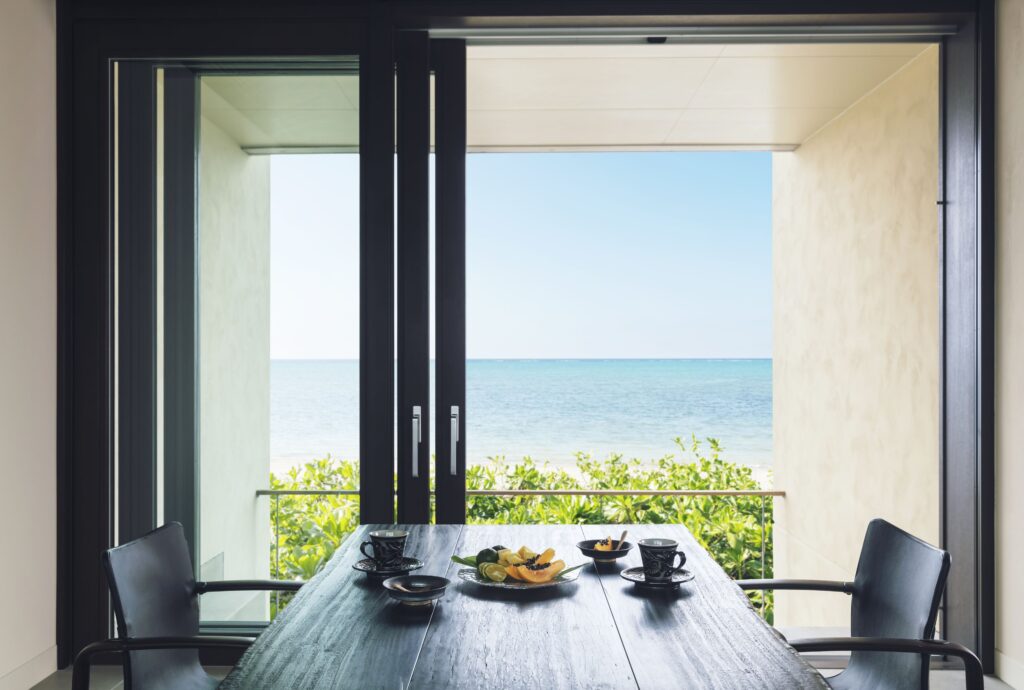
Breakfast may be taken in the dining room or ordered for the guest room, with Japanese and Western in-room choices currently offered. The decision is not simply culinary. Dining-room breakfast creates a more conventional hotel morning; in-room breakfast allows the doma and ocean view to fulfil the role for which the room was designed. One of each across a two-night stay is a sensible way to understand both.
BANTA CAFE and OLU Grill nearby widen the choice, but availability, menus and deadlines should be checked for the actual dates. Restaurant dinner and breakfast require reservations under current guidance, generally after the room reservation is complete. Prices and times are deliberately not fixed here because they can change. The practical lesson is stable: decide the first dinner before arrival, particularly on a short stay.
One Night, Two Nights or Three?
One night can show the architecture, room and sunset, but it compresses the resort into a sequence of deadlines. Arrival at 3:00 p.m., a reserved dinner, the pool, breakfast and a noon checkout leave little room for Yomitan or for doing nothing. It may work as a celebratory stop within a longer Okinawa journey, especially in Tida, but it is not the most natural expression of the property.
Two nights are the practical minimum for most guests. The first afternoon establishes the coast and pool; the full day can hold a cultural activity, beach walk or quiet time in the room; the second evening can contrast dining-room formality with a private meal. Three nights make sense for travellers who want Nirai Beach, a Yomitan excursion and a genuinely unhurried day without stacking them together.
The resort’s idea of living beside the sea becomes more convincing when the schedule loosens. This is also why the room category and length of stay should be decided together. A larger Haru or Fushi is easier to justify over several days, while a couple on a short itinerary may prefer Tin and direct more of the budget toward dinner or activities.
For Couples, Families and Quiet-Resort Travellers
Couples will find privacy in the generous rooms, late pool access and the ability to dine without leaving their accommodation. A Tida villa creates the strongest sense of retreat, but it is not essential to the hotel’s character; Tin still retains the oceanfront doma and access to the same landscape. The premium should be paid for the private pool and space, not simply for a belief that lower categories lack the view.
Families are explicitly accommodated. The official policy currently permits children under 12 to share existing bedding without meals or extra bedding, up to the room’s occupancy limit, and the resort lists a kids’ room and children’s amenities. Haru and Fushi sleep up to four in their stated layouts, while the in-room dining options reduce the pressure of formal meals. Exact child counts, bedding and meal charges still need to be entered and confirmed at booking.
The property is less suitable for guests seeking nightlife, a central urban base or a broad sandy beach directly outside every room. It also demands care from anyone with mobility concerns: the resort is low-rise and spread along the coast, and Expedia currently notes that the property does not have elevators. Confirm the route, room position and required assistance directly before booking rather than assuming that a two-storey plan is automatically step-free.
Arriving in Yomitan
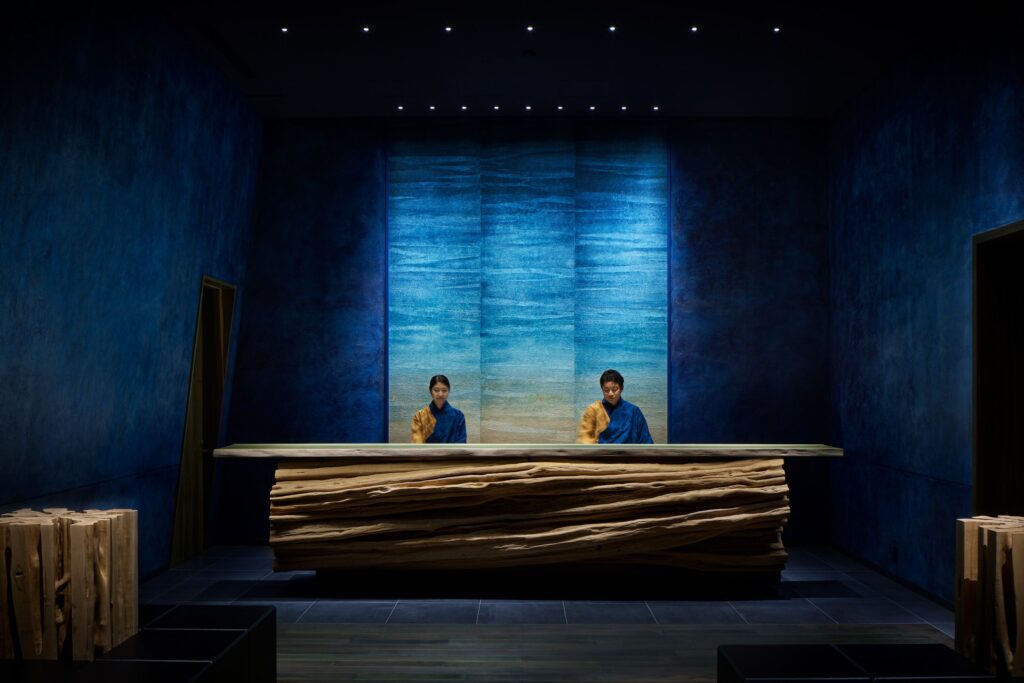
HOSHINOYA Okinawa is at 474 Gima in Yomitan, on the central-western coast of Okinawa’s main island. Expedia currently estimates about 70 minutes by car from Naha Airport, though traffic can lengthen the journey. The official resort information lists a paid airport limousine bus, as well as affiliated rental-car and hired-car arrangements that should be requested by the stated advance deadline.
A car provides the greatest flexibility for restaurants and wider exploration, and the hotel lists free outdoor parking without advance reservation. Travellers who intend to remain largely within the resort may prefer a limousine bus or hired transfer, but should coordinate its timetable with flight arrival and check-in. There is no advantage in arriving at the resort with an ambitious off-site schedule if the principal reason for booking is time beside the sea.
Yomitan rewards a focused rather than hurried plan. Nirai Beach, BANTA CAFE and the immediate coast can be folded into the stay without turning it into a driving tour. More distant Okinawa attractions require realistic journey times. The correct access choice therefore follows the itinerary: transfer for a self-contained retreat, rental car for a broader island stay.
Before You Book
- Read the complete room name. Tin, Haru, Fushi and Tida differ in size, bed arrangement and style of living; only Tida should be assumed to include a private pool.
- Do not request a guaranteed room position. The official site says photographs and plans are examples and that a specific room cannot be selected.
- Distinguish the two beaches. Gima is the natural, rocky shore before the rooms; Nirai is the nearby white-sand beach identified for swimming.
- Plan dinner early. Dining-room meals, gathering dining and breakfast options have reservation rules and cancellation conditions that should be checked after securing the room.
- Confirm children and bedding. The current official policy allows under-12s to share existing bedding within the occupancy limit, without included meals or extra bedding; enter every child accurately.
- Check access conditions. Coordinate the paid airport bus or an arranged transfer in advance, and ask about step-free routing if stairs or the spread-out grounds may be difficult.
- Review weather and cancellation terms. Okinawa weather can affect beaches, transport and activities. Expedia and official-site conditions may differ, so read the terms attached to the exact rate selected.
When the Light Reaches the Wall
The lasting image of HOSHINOYA Okinawa is not one room or facility, but the line drawn between stone and sea. Morning enters through the patterned Gusuku wall; the tide alters the natural shore; sunset moves across the pool; dinner returns to ingredients grown and cooked in the islands. The design succeeds because these elements are not decorative additions. They organise how the day is spent.
Book it for an oceanfront room that can hold breakfast, conversation and long pauses; for a pool that changes with the hour; and for a coast that remains natural rather than uniformly resort-made. Choose the room according to how the group will live inside it, reserve the essential meals, and allow at least two nights if the budget and itinerary permit. Travellers who need a central sightseeing base or a sandy swimming beach immediately at the door should recognise the compromise. Those who want to remain close to one stretch of Yomitan coast will find the resort’s purpose unusually coherent.
View current HOSHINOYA Okinawa rates and booking conditions on Expedia →(Paid link)
Related Okinawa Luxury Hotel Reviews
Luxury Hotel Guides in Japan
Hoshinoya Taketomi Island Review
The Busena Terrace Review
Halekulani Okinawa Review
The Ritz-Carlton Okinawa Review
Hyatt Regency Seragaki Island Okinawa Review