The overglaze colours of Kutani porcelain sharpen the outline of a dish. A Yamanaka lacquerware bowl catches a quiet sheen in the hand. Along Kakusenkei Gorge, the Daishoji River threads between rocks, while seafood from Hashitate Port and Kaga vegetables find their way into the evening meal.
Kaga Onsen encompasses three distinct hot-spring towns: Yamashiro, Yamanaka, and Katayamazu. This guide visits Beniya Mukayu and Araya Totoan in Yamashiro Onsen, and Kayotei and Hanamurasaki in Yamanaka Onsen. At Beniya Mukayu, the centre is a garden on Mount Yakushi. Kayotei reaches outward to local artisans and growers. Araya Totoan has guarded its spring across eighteen generations. Every room at Hanamurasaki looks over Kakusenkei Gorge.
Farther north, Wakura Onsen is gradually recovering the rhythms of a seaside hot-spring town: seafood from Nanao Bay, Noto vegetables, and inns facing the water. As of summer 2026, eleven properties are again accepting general leisure travellers following the 2024 Noto Peninsula Earthquake. Their return is growing, while restoration work continues.
Kutani Colour, Lacquered Wood, and the Sound of Kakusenkei
Tableware carries part of the meal in Kaga. Kutani porcelain, built up with vivid overglaze decoration, and Yamanaka lacquerware, prized for the lightness of its turned wood and the finish of its lacquer, have long held the food of this region.
Spring brings mountain vegetables and bamboo shoots; summer, ayu; autumn, mushrooms and tilefish; winter, Kano crab and yellowtail. The menu moves between the Sea of Japan and the mountain villages, with colour and grain marking the season alongside the ingredients.
In Yamanaka Onsen, the Daishoji River through Kakusenkei becomes the view from rooms and open-air baths. In Yamashiro Onsen, public baths, a temple, kilns, and ryokan gather around the Soyu bathhouse in the district known as the Yunogawa. Step outside the inn, and the two towns reveal different arrangements of water, craft, and daily life.
Beniya Mukayu Opens onto the Forest of Mount Yakushi
Beniya Mukayu stands on Mount Yakushi above the streets of Yamashiro Onsen. Yakuoin temple once stood on this ground, where monks are said to have used hot-spring water and medicinal plants in caring for people. That memory continues through three libraries and Entei Shujutsuin, a spa working with both the spring and herbs.
There are sixteen rooms. Every room faces the forest garden and has a private open-air hot-spring bath. At the garden’s centre stands a red pine approximately three hundred years old, surrounded by mountain cherry, maple, camellia, and moss. Tatami, washi, bamboo, and diatomaceous earth bring materials that change with time into rooms where garden and bath remain within one view.
Dinner and breakfast are served at Kaiseki Horin, a dining room defined by twenty-five pillars and a terrace facing the garden. Food, bathing, reading, and herbal treatments all extend from the same ground on Mount Yakushi.
Visit the official Beniya Mukayu website
Kayotei: Ten Rooms Across 10,000 Tsubo
Kayotei is a ten-room ryokan set within approximately 10,000 tsubo of grounds in Yamanaka Onsen. Sukiya-style rooms, tatami corridors, and works in wood and stone give the garden-surrounded building its measured depth.
The kitchen works with local seafood and seasonal vegetables, serving them on pieces made by regional artists. Kayotei’s longstanding relationships reach beyond the inn to Yamanaka wood turners and lacquer artisans, other makers, and the farmers who grow its vegetables. The work of Kaga continues behind the rooms and table.
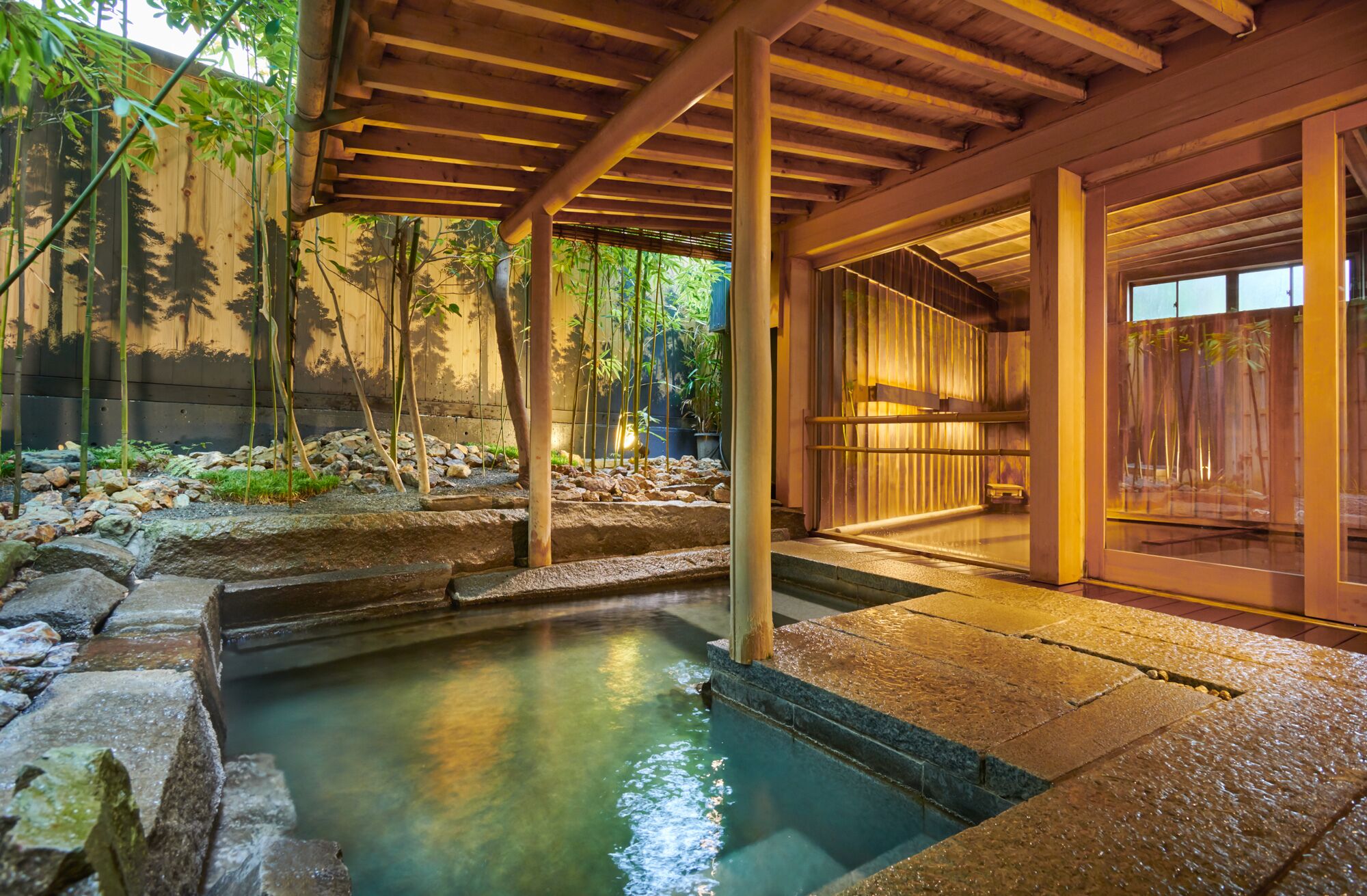
Takase has a hinoki open-air bath, while Kakusen has one built in stone; both offer Yamanaka hot-spring water around the clock. Check-in begins at 1:00 p.m. and checkout is at noon, leaving the afternoon, evening, morning, and the approach to midday for the garden, bath, and meals.
Visit the official Kayotei website
Araya Totoan: Eighteen Generations at the Source of Yamashiro Onsen
Araya Totoan is a source inn in the Yunogawa surrounding Yamashiro Onsen’s Soyu bathhouse. The first Genemon Araya was appointed custodian of the spring by the Maeda family of the Daishoji domain. The present proprietor is the eighteenth generation.
The spring rises from shallow ground beneath the property and supplies approximately 100,000 litres each day. The baths include the hinoki-lined Ruriko; Gensenkaku, shaped around the flow of the spring and the memory of its garden; and the private Karasu-yu, with two baths at different temperatures and a mist produced from the source water.
Eleven of the seventeen rooms have open-air baths supplied from the spring. Araya Totoan is also closely connected with the artist and epicure Kitaoji Rosanjin. In the early Taisho era, Rosanjin studied ceramics in Yamashiro under the first Suda Seika, supported by the fifteenth proprietor and other local patrons. Early red-painted dishes, the Akegarasu screen, calligraphy, and seal carvings remain in the inn.
Meals draw on seafood from Hashitate Port, Kaga vegetables, and local fruit, with Kutani porcelain and Yamanaka lacquerware at the table. The Soyu, Rosanjin’s former residence Iroha Soan, and the Kutani-yaki Kiln Exhibition Pavilion are within walking distance, carrying the histories of the spring and its ceramics into the surrounding town.
Check current availability for Araya Totoan on Expedia →(Paid link)
Visit the official Araya Totoan website
Hanamurasaki: Kakusenkei from Every Guest Room
Hanamurasaki faces Kakusenkei Gorge along the Daishoji River. According to the ryokan’s official information, every guest room has a view of the gorge. Light on the river, fresh green leaves, autumn colour, and snow become part of the rooms and shared spaces.
Alongside traditional rooms and Japanese rooms with beds, the selection includes Modern Suites that reinterpret contemporary Japanese architecture, a Universal Suite with an open-air bath and sauna, and Art Suites developed through collaborations with local artists. Each room type sets a different interior against the same river valley.
Dining centres on an omakase kaiseki menu that changes monthly. Ayu, tilefish, Kano crab, winter yellowtail, Noto beef, and rice grown in Ishikawa appear with the season, while Kutani porcelain and lacquerware adjust the character of each course.
The teahouse serves Japanese tea, and art continues through guest rooms and common areas. Gorge, tea, tableware, and the work of contemporary artists meet inside one building in present-day Yamanaka Onsen.
Check current availability for Hanamurasaki on Expedia →(Paid link)
Visit the official Hanamurasaki website
Staying Across Yamashiro and Yamanaka Onsen
In Yamashiro Onsen, a walk through the Yunogawa brings the Soyu and Kosoyu bathhouses, Yakuoin Onsenji temple, Iroha Soan, and the Kutani kiln remains into close range. Beniya Mukayu enters the forest of Mount Yakushi above the town. Araya Totoan stands inside the townscape formed around the spring and public baths.
Kakusenkei forms the axis of Yamanaka Onsen. Kayotei spreads ten rooms through its extensive grounds; Hanamurasaki looks over the gorge from every room. A walk from Korogi Bridge to Ayatori Bridge, a visit to a Yamanaka lacquerware workshop, or a bath at Kiku-no-Yu continues the encounter with vessels and woodwork begun inside the ryokan.
Eleven Inns Welcome Travellers Back to Wakura in 2026
The Noto Peninsula Earthquake of January 1, 2024, caused severe damage in Wakura Onsen, and every property belonging to the local ryokan association suspended operations. Damage extended beyond the buildings to the seawall, hot-spring pipes, water supply, and drainage system, so restoration has moved at a different pace for each inn.
As of July 31, 2026, the Wakura Onsen Tourism Association lists eleven properties open to general leisure travellers: Hanagoyomi, Aji na Yado Hosenkaku, Yuno Hana, Noto Raku, TAOYA Wakura, Hamazuru, Noshu Iroha, Biwanso, Hotel Kaibo, Okudaya, and Shirasaginoyu Noto Kaishu.
Biwanso and Hotel Kaibo are operating on an interim basis while work continues inside the properties and along the seawall. The number of rooms in use, meal service, and access to bathing facilities vary by property, making the latest individual operating information an essential part of planning.
Okudaya and Shirasaginoyu Noto Kaishu both reopened in July 2026. The Wakura Onsen Tourism Association lists Noto Kaishu with one hundred rooms, meal service, and hot-spring facilities available. The public bath Soyu, Wakura Onsen Omatsuri Hall, and Notojima Aquarium are also open.
See the latest accommodation information from the Wakura Onsen Tourism Association
Kagaya Group and Wakura’s Next Chapter
Kagaya Group has announced a plan to reorganise its four Wakura Onsen ryokan into three.
Niji to Umi is targeting the second half of fiscal 2026 for reopening, Aenokaze the first half of fiscal 2027, and Kagaya the end of fiscal 2027. The new Kagaya is planned as an approximately forty-room ryokan incorporating Matsunomidori. The present Matsunomidori and Kagaya’s four existing buildings are scheduled for demolition.
These dates remain targets and may change with construction and regional infrastructure conditions. Current accommodation information and future reopening plans are recorded separately here, and this guide will be updated as new operating information is announced.
From Kagaonsen Station to Nanao Bay
Yamashiro and Yamanaka Onsen are approximately fifteen to twenty-five minutes by car from Kagaonsen Station on the Hokuriku Shinkansen. Some ryokan offer transfers with advance reservations. Kayotei is about twenty minutes from the station by taxi, while Hanamurasaki offers a complimentary station transfer between noon and 6:00 p.m.
JR’s Nanao Line connects Kanazawa with Wakura Onsen. Rather than making a same-day return journey between Kaga Onsen and Wakura, a multi-night route through Kanazawa or Nanao leaves time for the meals and baths of each place.
In Kaga, Kutani porcelain, Yamanaka lacquerware, Kakusenkei Gorge, and the spring at Yamashiro shape four different nights. In Wakura, seafood from Nanao Bay, Noto vegetables, and the seaside hot-spring town are moving into their next form as restoration advances. Checking the current operating details while building the itinerary is part of travelling through Ishikawa in 2026.
Six hotels and ryotei ryokan within Kanazawa are covered in a separate guide. South of the city, Auberge eaufeu in a former Komatsu school and Wataya beside Shirayama Hime Shrine each have a dedicated article.
For journeys extending beyond Ishikawa, continue through our luxury hotel guides across Japan.