Color from Kutani ware, the sheen of lacquer, seafood arriving at Omicho Market, and sudare-fu served with duck in jibuni: Kanazawa’s craft and food traditions enter its places to stay in very different ways.
Beside Kanazawa Station, contemporary hotels frame the city through large windows, high floors, and modern art. In Korinbo, a stay begins among the streets leading to Kenrokuen Garden and the Nagamachi samurai district. At the city’s ryotei ryokan—traditional inns rooted in the culture of formal dining—the guest room, garden, tableware, and evening meal belong to the same composition.
The three hotels and three ryotei ryokan below are not interchangeable versions of luxury. They differ in scale, service rhythm, and the place food occupies in the night. Together, they show six distinct ways to stay in Kanazawa.
Art at the West Exit and Hokuriku on the Plate — Hyatt Centric Kanazawa
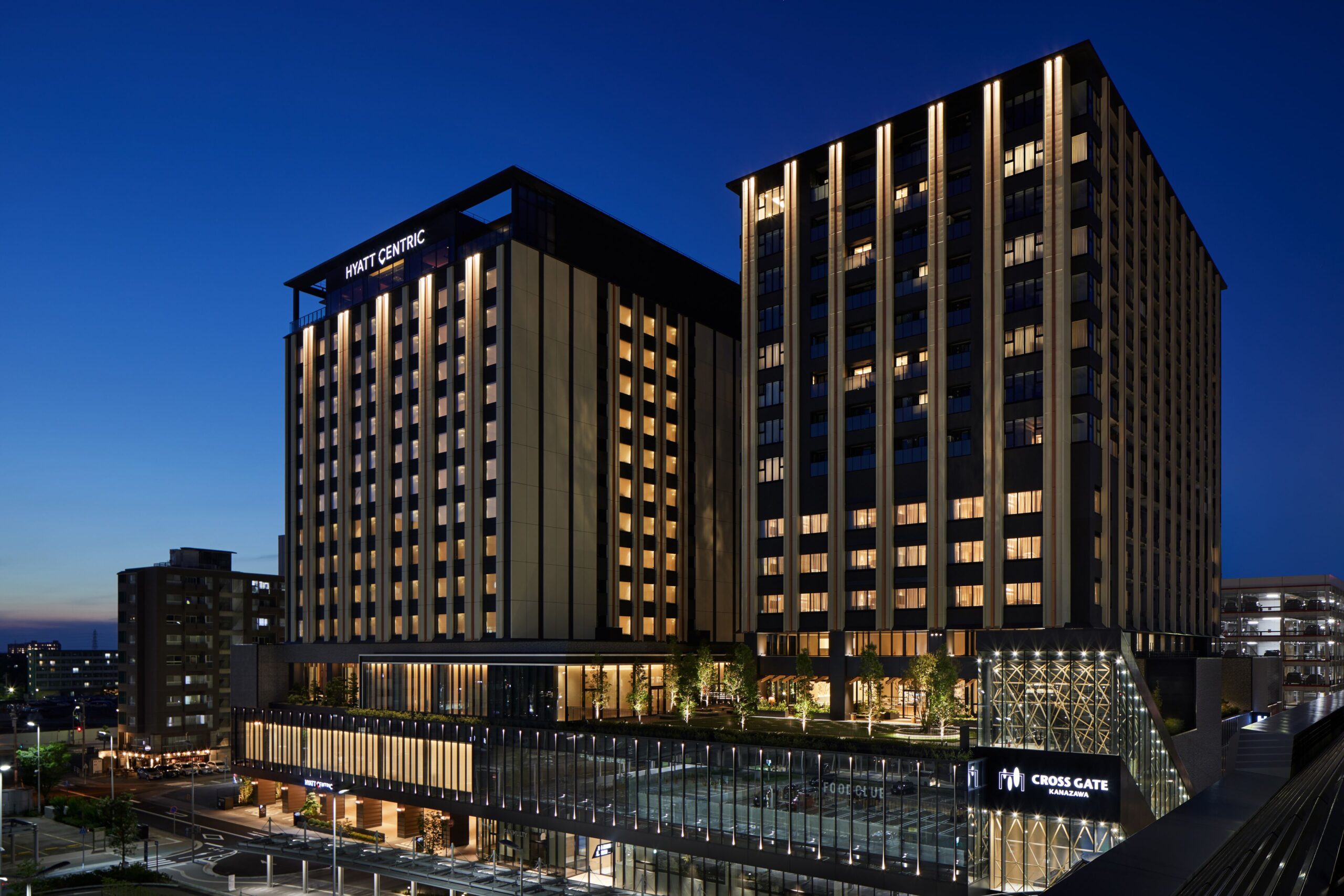
Hyatt Centric Kanazawa stands at the west exit of Kanazawa Station. The hotel has 253 rooms, including seven suites. Standard rooms begin at 32 square metres, with oversized windows, a separate shower, and artwork connected to the city.
Some pieces around the hotel incorporate remnants left by the production of traditional crafts. Kutani ware room-number plates and art inspired by Kaga vegetables give local materials a contemporary setting rather than treating them as ornamental shorthand.
FIVE – Grill & Lounge uses ingredients from the Hokuriku region in its grill dishes and seasonal menus. On the 14th floor, RoofTerrace Bar combines an indoor bar with an open-air terrace. Ceramic panels, lacquer pieces, and work by local artists sit alongside views across Kanazawa.
The station is close at hand, but the hotel does not describe itself as directly connected to the railway concourse. Its west-exit position still makes it practical on an arrival day or before an early onward journey.
A Room Above the City — Hotel Nikko Kanazawa
Hotel Nikko Kanazawa rises 30 storeys opposite the Kenrokuen Exit of Kanazawa Station. Every guest room is on the 17th floor or above. Depending on the side of the building and the weather, views extend toward the Sea of Japan or across the city to the mountains.
The 27th-floor NIKKO rooms were renovated in 2020. They range from 22-square-metre doubles to a 108-square-metre Imperial Suite, with 44-square-metre deluxe twins and 64-square-metre suites between them. Bathrooms on this floor separate the bath, toilet, and washbasin.
Much of the hotel’s evening life is also high above the station. The 30th floor holds European restaurant La Plage and sky lounge Le Grand Chariot. Teppanyaki Icho, Chinese restaurant Toh-Lee, and main bar Vol de Nuit occupy the 29th floor.
Checkout is at noon. Because several room names changed in 2026, the floor, room size, and bed configuration are more useful than an older room name when comparing booking listings.
Kanazawa on Foot from Korinbo — Kanazawa Tokyu Hotel
Kanazawa Tokyu Hotel is in Korinbo, around six minutes by taxi from Kanazawa Station. An official accommodation plan describes Kenrokuen Garden as a ten-minute walk from the hotel. Nagamachi’s former samurai residences and the museums around Hirosaka also fit naturally into a day begun here.
Guest rooms are divided between Standard floors on levels 6 to 12 and Luxury floors on levels 13 to 15. The Luxury floors have key-controlled security, and their rooms include Kutani ware mugs.
The second-floor Club Lounge is available to guests in the Luxury-floor and other designated rooms. Its 124-square-metre space displays work by Kanazawa craft artists and serves drinks with a local connection, including house-roasted Kaga bancha and sake from a Kanazawa brewery.
This is a different city rhythm from a station-side stay: an early walk through Kenrokuen, museums during the day, and Nagamachi toward evening, with Korinbo as the point of return.
Four Akita Cedar Rooms and Kaga Cuisine — Asadaya Ryokan
Asadaya Ryokan was established in 1867. It is a four-room ryotei ryokan in Jukken-machi, with sukiya-style rooms built in Akita cedar. Small courtyard gardens, a Wajima-lacquered telephone, and carefully chosen Japanese furnishings establish the scale of the house.
Tsuzumi, renovated in October 2021, measures 91.7 square metres. A living and dining room faces a small garden, while a separate bedroom and windowed bathroom complete the suite. It is the only room on its floor, and both bathing and meals take place within it.
Dinner draws on seasonal seafood, sweet shrimp, crab, mountain produce, and other ingredients selected for the guest. The vessels and room setting are part of the meal rather than decoration around it. The hours from dinner to breakfast therefore have a different structure from a hotel stay built around an outside restaurant reservation.
There is no lift in the building. Asadaya’s official directions give a journey of about ten minutes by taxi from the east side of Kanazawa Station. Guests concerned about stairs should confirm the room floor and route through the building before booking.
A Garden Falling Toward the Sai River — Kincharyo
Kincharyo opened in 1933 after taking over a villa built by Baron Yokoyama, whose family had served among the senior retainers of the Maeda clan. The site uses a roughly 40-metre slope descending from Teramachi toward the Sai River. A main building and five sukiya-style detached houses stand within a garden of about 3,300 square metres.
Its guiding phrase is “one party, one house.” A detached room and its garden are prepared as one private setting. Current official information accepts overnight guests in only one room and only for two people, placing the stay far outside the operating scale of a conventional multi-room ryokan.
Kaga kaiseki here combines techniques from Kyoto tea cuisine with seafood from the Sea of Japan and produce from Kaga and Noto. Kutani ware, Ohi ware, Wajima lacquerware, and Kanazawa maki-e carry those dishes to the table.
Availability and guest conditions should be checked against Kincharyo’s current information. Older tourism listings still show room counts and capacities that do not match its present one-room, two-person policy.
Six Rooms, Inherited Vessels, and Hashiba-machi — Kinjohro
Kinjohro was established in 1890 in Hashiba-machi, close to the Asano River. The ryotei ryokan has six rooms: Take, Fuji, Kiku, Yuki, Tsuki, and Hana.
The details vary from room to room. Some have a bath in red granite, others a hinoki cypress bath; some use futons, while others have a separate bedroom with beds. Bath mats made with diatomaceous earth from Noto, skincare developed from the rice-fermentation work of Kanazawa brewery Fukumitsuya, and pillows from an Ishikawa bedding specialist bring regional materials into the quieter parts of the stay.
Kinjohro’s cuisine uses seafood from the Sea of Japan, delicacies from Noto, Kaga vegetables, and sake made with water flowing from Mount Hakusan. Vessels and art handed down through the house are used in the dining rooms rather than kept apart as a collection. Breakfast and dinner are served in the guest room or a private dining room.
Hashiba-machi places Kazuemachi and Higashi Chaya within walking distance, while returning indoors changes the scale to that of a six-room inn. Check-in is at 4:00 p.m. and checkout at 11:00 a.m.
How the Day Changes Between the Station, Korinbo, and a Ryotei Ryokan
Hyatt Centric Kanazawa and Hotel Nikko Kanazawa connect rail travel with the city from opposite sides of the station. Hyatt places Kanazawa craft in a contemporary art setting. Hotel Nikko uses rooms above the 17th floor and restaurants on levels 29 and 30 to keep the skyline present through the evening.
Kanazawa Tokyu Hotel begins from Korinbo. Kenrokuen, Nagamachi, and Hirosaka shape the hours outside the hotel, while the Luxury floors and Club Lounge give the return its own texture.
At Asadaya, Kincharyo, and Kinjohro, dinner is not an optional hotel amenity. Garden, architecture, vessels, Kaga cuisine, and the guest room form a continuous experience. Their limited inventory and set meal times also mean that arrival time and booking conditions carry more weight than they do at a large hotel.
Art beside the west exit, mountains from the 27th floor, a morning walk from Korinbo, Akita cedar underfoot, a garden descending toward the Sai River, and inherited vessels in Hashiba-machi: the address and the work of each house leave a different Kanazawa behind.
Continuing from Kanazawa to the Hot-Spring Towns
For a journey continuing south to Yamashiro, Yamanaka, or Katayamazu, see our guide to luxury ryokan in Kaga Onsen and Wakura Onsen.
For a wider regional comparison, visit our guide to luxury ryokan across Japan. If an in-room hot-spring bath is central to the journey, our guide to private-onsen ryokan in Hakone explains how five properties differ.