Check Auberge eaufeu rates and availability on Expedia →(Paid link)
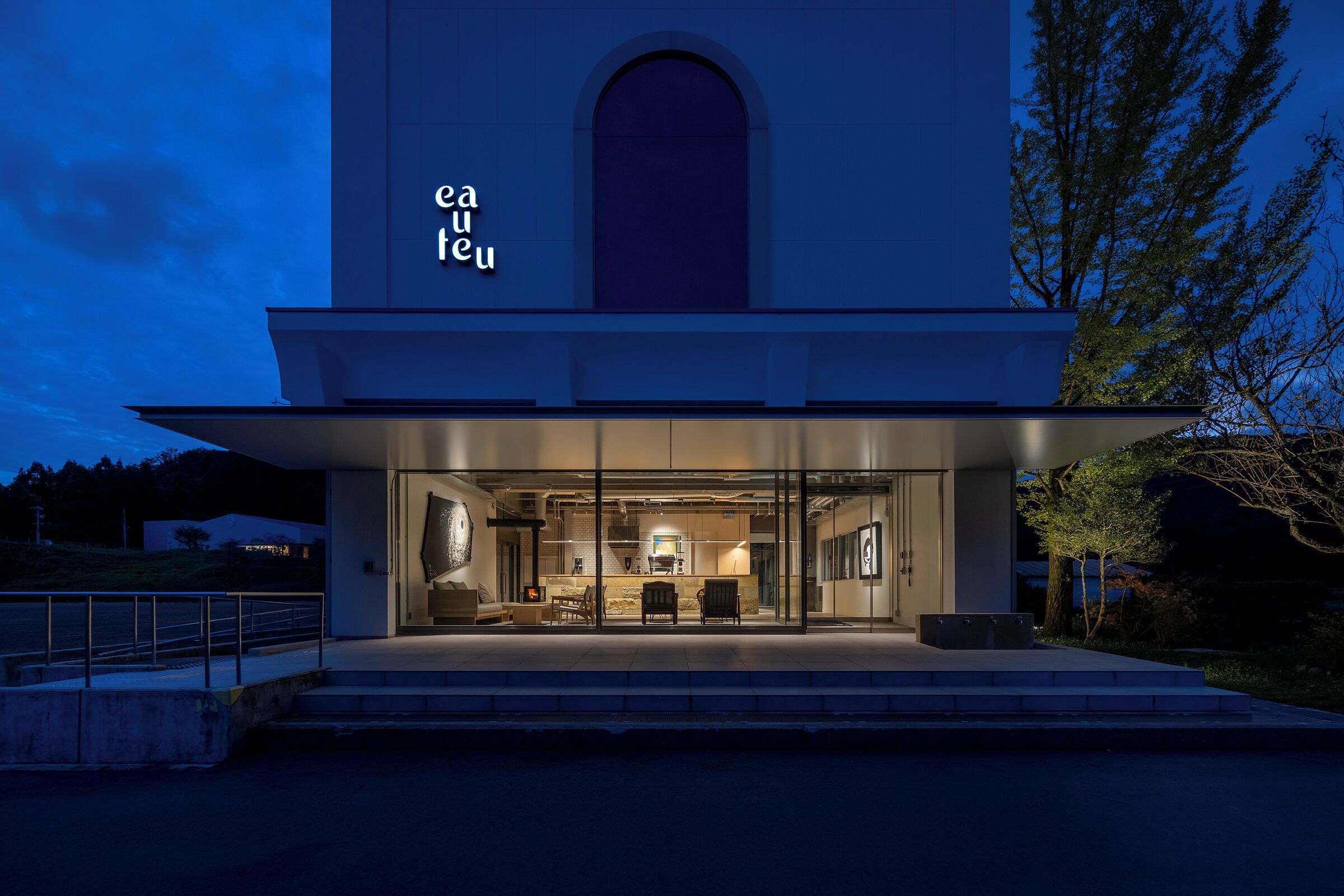
Beyond central Komatsu, the road enters a landscape of fields, wooded slopes, and the exposed rock face of the Kanagaso quarry. At its foot stands Auberge eaufeu, an inn and restaurant created inside the former Nishio Elementary School.
The entrance, broad corridors, and large classroom windows still reveal the building’s earlier life. Within that structure are 12 guest rooms, a restaurant led by chef Shota Itoi, and contemporary works made in response to the surrounding land.
Water runs through the story of the auberge. It descends from nearby Mount Kannon, sustains the fields and living things of the valley, and eventually reaches the sea. At eaufeu, that movement gives a natural frame to a meal that connects mountain produce with seafood from the coast.
 (Paid link)
The Outline of Nishio Elementary School Remains
The building served local children for roughly half a century before Nishio Elementary School closed in March 2018. Its long, low profile, generous corridors, and classroom proportions were retained when it was transformed into an auberge.
The name joins two French words: eau for water and feu for fire. One comes from the mountain and the other from the kitchen. Together they describe how the former school has been given a new purpose through the natural setting and the act of cooking.
Traces of school life have not been polished away. They appear while walking to a room, looking across the old schoolyard, or recognizing the scale of a former classroom. The building’s past stays present without turning the auberge into a museum.
Twelve Rooms Made from a Library, Classrooms, and Music Rooms
Auberge eaufeu has 12 rooms. Their differences follow the previous uses and positions of the spaces rather than a repeated hotel floor plan.
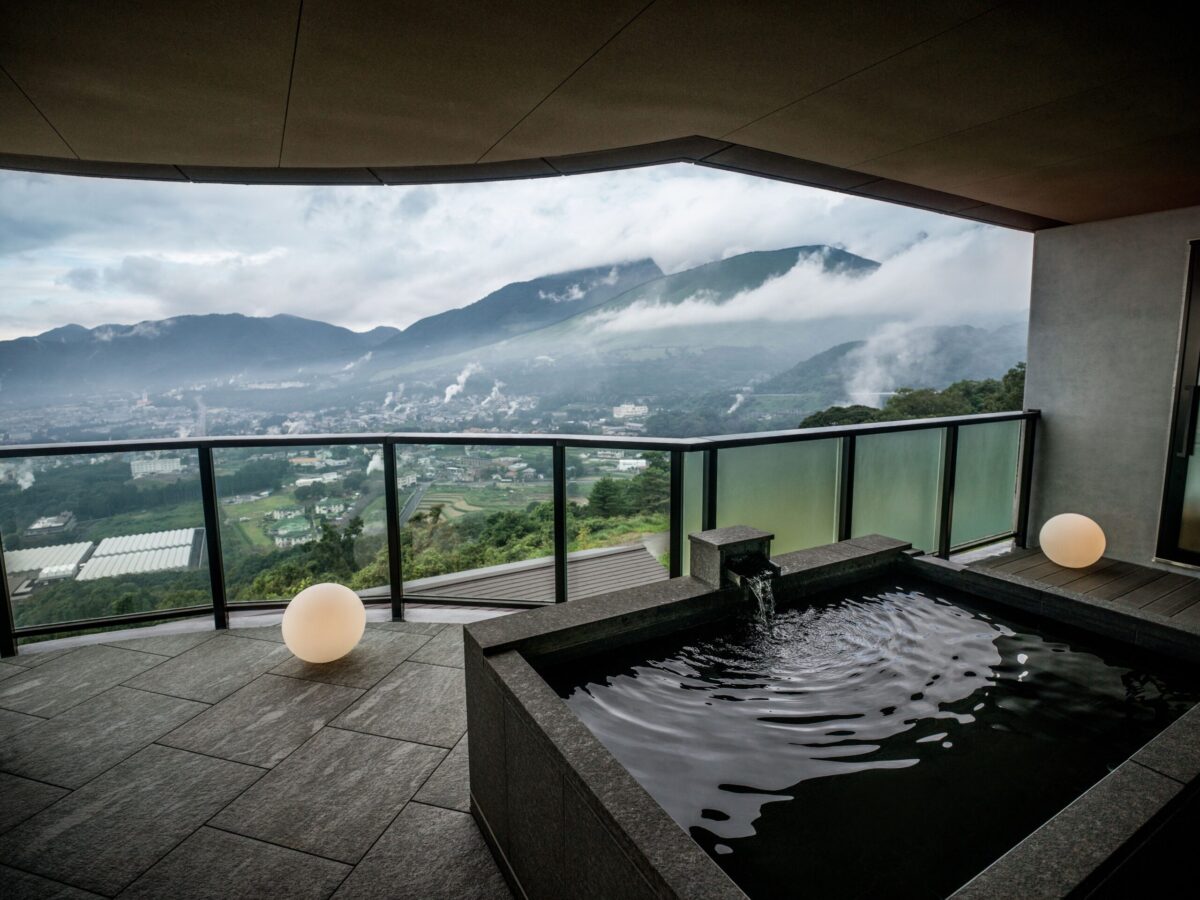
The 77-square-metre Suite occupies the former library. Windows face south across the schoolyard toward the Kanagaso quarry and north over the rice fields. A glass-enclosed bath adds another line of sight through the room.
Three 55-square-metre Junior Suites each use the full area of a former classroom. They face the schoolyard and quarry, with a white board placed where the classroom blackboard once stood.
The Premium Twin and Deluxe Twin Type A were formed from the music room. Their views include the fields, schoolyard, and the brewery of the nearby Noguchi Naohiko Sake Institute. Five 28-square-metre Comfort rooms occupy a more compact category, and connecting arrangements are available between selected rooms.
Room size tells only part of the story here. A former library opens in two directions; classrooms retain the strongest sense of the school; the old music room looks toward a working sake brewery. Choosing a room also means choosing a particular part of the building’s memory.
 (Paid link)
Shota Itoi’s Cooking Begins with the Water of Kanagaso
The kitchen is led by Kyoto-born chef Shota Itoi. His training has taken him through restaurants in Japan, France, and the United States. In 2018, at 26, he won the RED U-35 competition for emerging chefs; he became the chef of Auberge eaufeu in July 2022.
His cooking draws on ingredients and culture found around Komatsu. Clear mountain water sustains crops and animals before flowing through rivers to the sea, allowing produce from the hills and seafood from the Japan Sea to belong to the same geographical story.
Menus change with season and supply. Instead of reducing Ishikawa to a fixed list of specialties, the kitchen works with what the region offers at that moment and with the knowledge held by its growers, fishers, and makers.
Staying overnight changes the rhythm of dinner. Once the meal ends, there is no journey back to a city hotel. Guests leave the restaurant, cross the former school corridors, and return to a room within the same building.
 (Paid link)
Nikka Stone and the Working Quarry Beyond the Windows
The rock wall visible from the rooms and schoolyard belongs to the Kanagaso quarry. Nikka stone has been extracted here since the Taisho era. Komatsu’s Japan Heritage account places stone from the area’s quarries among the materials used in prominent buildings, including Japan’s National Diet Building.
Komatsu’s stone culture forms part of the Japan Heritage story known as “A Tale of Walking with Jewels.” The quarry is therefore more than scenery placed outside a resort window. It is a landscape shaped by generations of skilled work and by material that travelled into Japanese architecture.
From the former school, the quarry, fields, and classrooms sit within one view. They show how education, agriculture, stonework, and the present-day kitchen have occupied the same valley.
Kiichiro Ogawa’s Art Moves Through the School
Works by contemporary artist Kiichiro Ogawa are installed throughout the building. They were created during time spent in Komatsu, drawing on encounters with local waterfalls, shrines, and the surrounding terrain.
The art is not confined to a single gallery. It appears along the route through the old school, where the measured lines of the architecture meet colour and movement. Walking the corridors becomes part of seeing the work, while the work alters how the former school is perceived.
Planning the Journey Beyond Komatsu Station
Auberge eaufeu is in Kanagaso, on the mountain side of Komatsu rather than near the station or airport. The official access information places it approximately 30 minutes by car from Komatsu Airport and about 25 minutes from the Komatsu Interchange.
Fixed-fare taxi arrangements are listed from Komatsu Station and Komatsu Airport. Prices and booking conditions can change, so they should be checked with the property before travel. A rental car or pre-arranged taxi makes the final section of the journey easier to plan; public transport does not provide a simple door-to-door route.
Check-in begins at 3:00 p.m. and checkout is at 11:00 a.m. The official site currently lists Tuesday and Wednesday as regular closing days, with holiday exceptions. Confirm the current restaurant calendar and opening dates when reserving.
After Dinner, the Night Continues Inside the School
At Auberge eaufeu, the former school, mountain water, quarry, cooking, and contemporary art meet inside one building. A meal leads back to the corridor; a guest-room window leads to the history of stone; the old library and music room carry their earlier proportions into the night.
This is a different Ishikawa stay from walking the historic districts of Kanazawa or settling into the hot springs of Kaga. The distinction lies in the valley itself: a working stone landscape, a small agricultural community, and a closed school whose next chapter revolves around the table.
For a city stay before or after Komatsu, see our guide to six luxury hotels and ryotei ryokan in Kanazawa. To continue through Ishikawa’s hot-spring country, explore our guide to Kaga and Wakura Onsen.