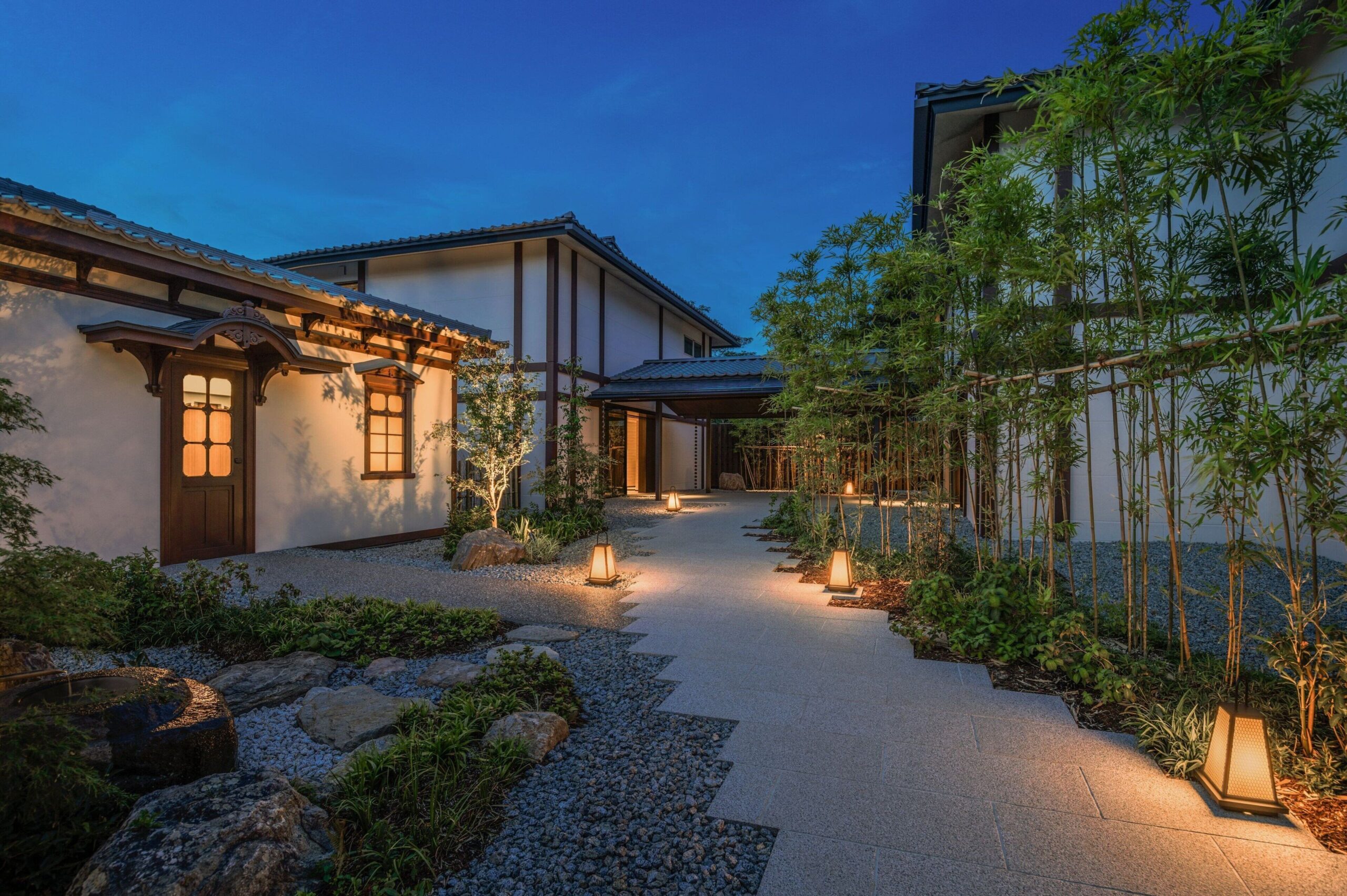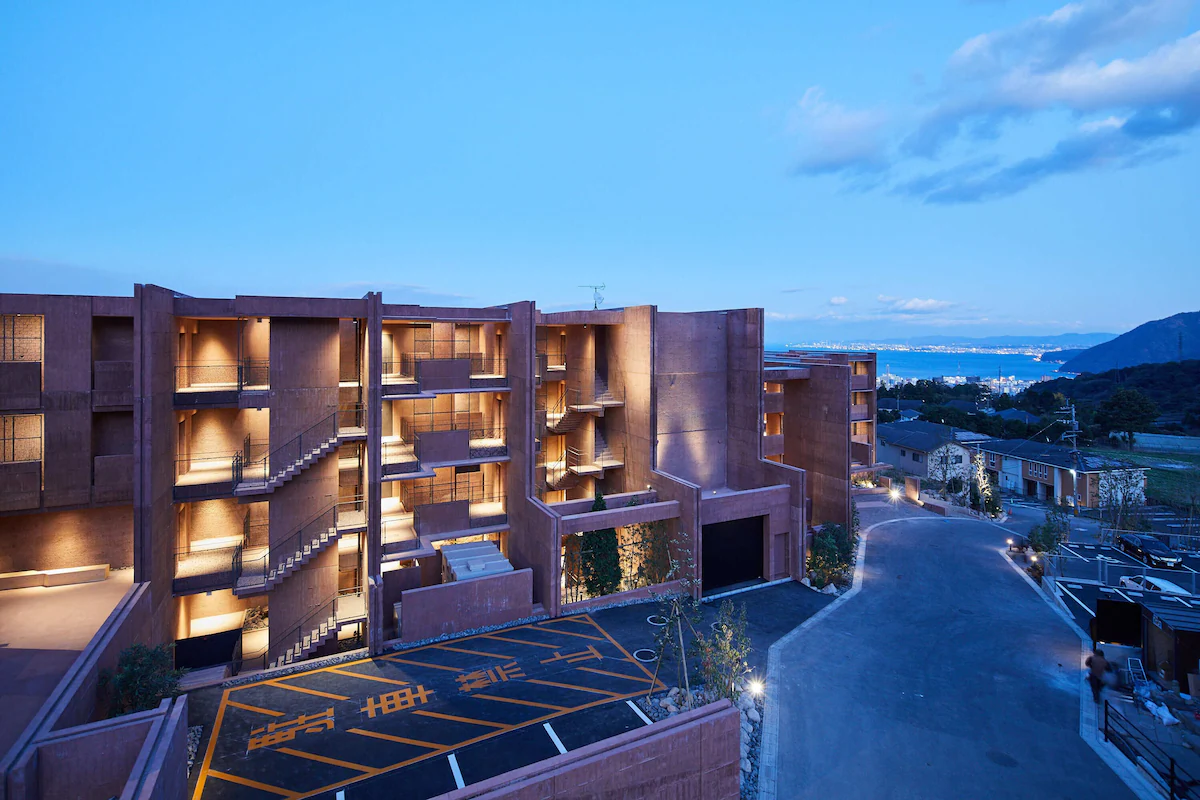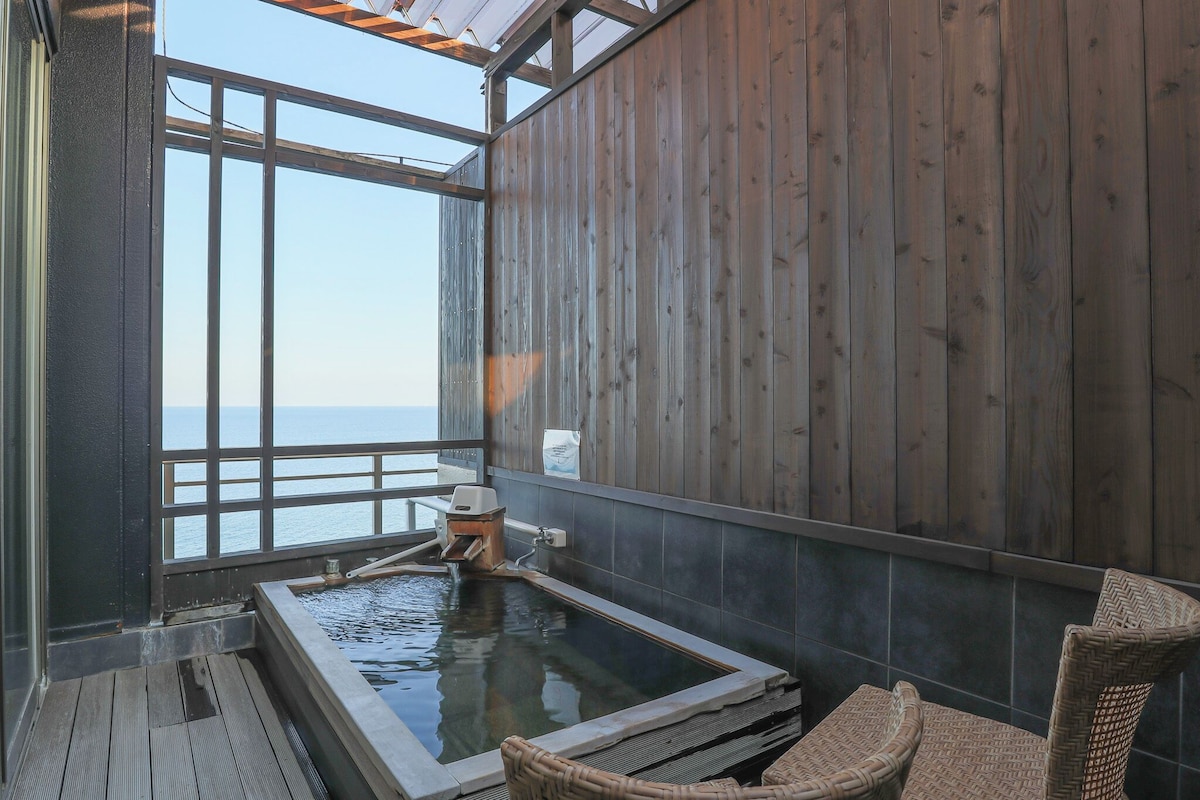
At many seaside hotels, the water remains a view: something admired through glass, photographed from a terrace and left outside when the curtains are drawn. AMANE RESORT SEIKAI arranges the stay differently. Across its varied room categories, every room faces Beppu Bay and includes a private bath supplied with free-flowing natural hot-spring water. In most categories the onsen bath is open-air or semi-open-air; the Signature Collection instead pairs an indoor onsen bath with an outdoor jacuzzi. The sea and the onsen are not upgrades reserved for a handful of suites. They are the premise of the hotel.
That promise sounds simple, but choosing a room is not. SEIKAI is spread across several distinct settings, from the spacious Hare-no-To rooms and the panoramic annex rooms to the more contemporary Umi-no-To, its top-floor Signature Collection and the resort-like Sora-no-To. Sizes range from an intimate 51-square-metre twin to a 150-square-metre junior suite with a private pool and jacuzzi. Some rooms are designed for two people who will spend most of the day by the water; others make space for children, friends or a multigenerational journey. The best booking is therefore not automatically the largest. It is the room whose layout, bathing style and dining plan match the way you actually want to spend the stay.
Room names and meal inclusions vary by date. Before payment, confirm the wing, room size, occupancy, bath description and dinner venue shown for your chosen plan.
The booking decision in brief
Choose AMANE RESORT SEIKAI when you want the onsen to belong to the room rather than to a timetable. A private bath changes the emotional shape of a night in Beppu. There is no need to decide whether the public bath will be quiet, to dress for a corridor or to compress bathing into one formal visit. The first soak can happen before dinner, the second when the building has grown still, and the last in the pale light over Beppu Bay. Because the water is free-flowing and the sea remains present beyond the bath, repetition does not feel repetitive.
The hotel is especially persuasive for couples who value privacy, for families who need a separate living or tatami space, and for travellers who would rather watch the changing water than assemble a long sightseeing schedule. It is less suitable if the priority is a station-centre location or an urban itinerary that keeps everyone outside from morning until night. SEIKAI rewards time spent at the property. One night can be satisfying, but two allow the room and public bath to be enjoyed without haste, with time to experience more than one of the hotel’s three dining styles.
Where Beppu Bay becomes part of the room
The hotel stands at Shōningahama on the northern side of central Beppu, close enough to the water for the bay to feel physical rather than decorative. From the terraces and baths, the horizon changes by the hour: silver in the morning, sharply blue in clear weather, then softened by evening colour. The architecture repeatedly turns seating, beds and baths towards that movement. Even when the room itself is contemporary, the experience retains a distinctly Japanese idea of luxury—the privilege of noticing small changes slowly.
“Ocean view” can be an imprecise hotel phrase, so the more meaningful fact is the combination: all rooms are sea-facing, all have a private bath, and the hotel states that every hot-spring bath in the building, including the guest-room onsen baths, uses free-flowing water. The spring is sodium chloride water, traditionally valued for the deep warmth it leaves after bathing. The practical pleasure is simpler. You can step from a cool room into warm water while the sound and light of the bay remain close.
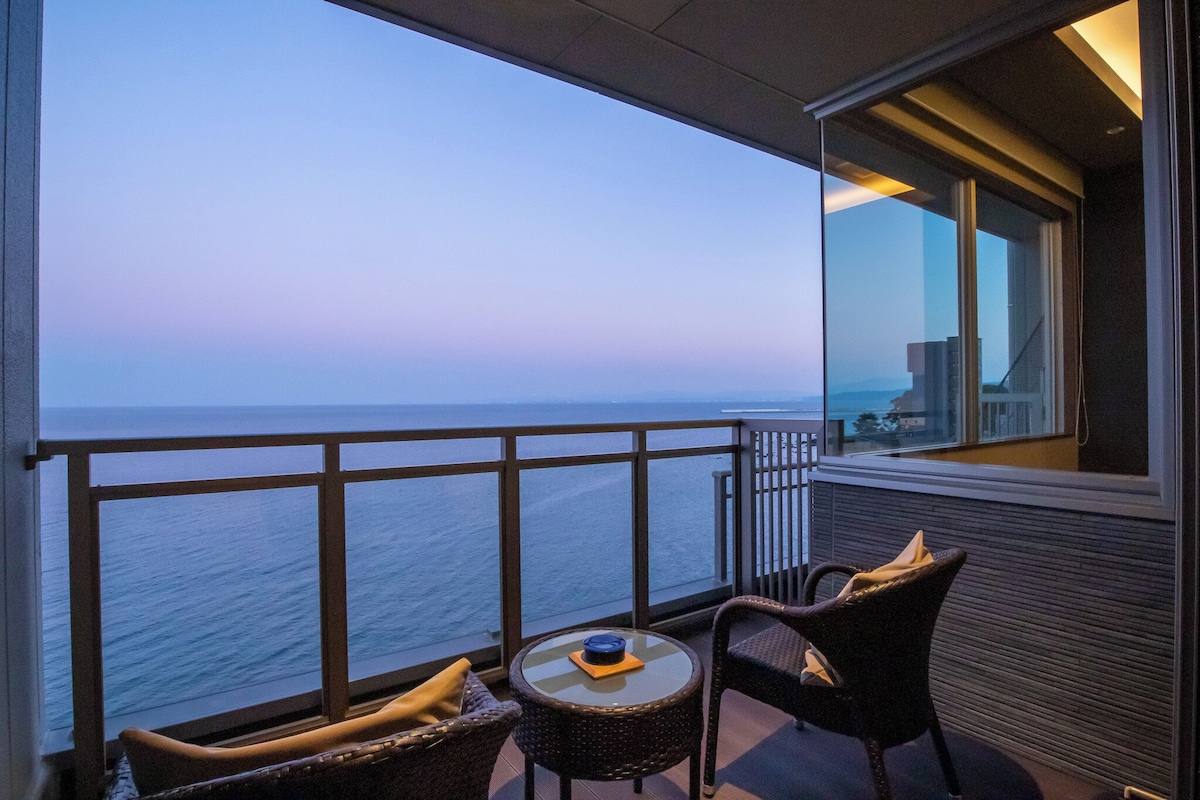
Four settings and a wide range of room types
SEIKAI’s room list is generous enough to be confusing. The clearest way to read it is by character rather than by price alone. Hare-no-To favours breadth, sunrooms and the comfort of a residential stay. Hare-no-To Tenbo contains expansive panoramic rooms created with a more secluded, annex-like feeling. Umi-no-To offers the most legible progression from a compact twin to larger Japanese-Western rooms and a corner suite. Its top-floor Signature Collection introduces private gardens, two-bedroom arrangements and outdoor jacuzzis. Sora-no-To is the most overtly resort-like, culminating in the pool-and-jacuzzi junior suite.
Expedia may translate or group these categories differently from the hotel’s Japanese room names. Do not rely on a single gallery image or the word “suite.” Match the listing against four details: room size, number of beds, maximum occupancy and the exact bath description. If a particular named room matters, contact the property after booking rather than assuming that a broad Expedia category guarantees it.
Hare-no-To: space, sunrooms and longer stays
Hare-no-To is the place to begin when interior space matters as much as the bath. Type A2 measures 80 square metres and combines two double beds with a 14-tatami living area, a seven-tatami sunroom and a walk-in wardrobe. A microwave, a generously sized refrigerator and a smart television make it unusually practical for a longer stay. It is a strong choice for two people who dislike compact resort rooms, or for three travellers who want a room that still feels calm after an extra bed is added.
Type D2 expands dramatically to 128 square metres, with a 20-tatami living area, a substantial sleeping area, sunroom, walk-in wardrobe and terrace. This is not simply more floor space. The bed is placed near the windows so that sea and sky remain visible at rest, and the large room gives a family or small group several ways to be together without remaining in the same conversation all evening. Type S, at 65 square metres, is the more restrained alternative: a renovated twin with an extra daybed and a sea-view bath, suitable for up to three guests.
The panoramic Hare-no-To Tenbo rooms are more individual. Yoikaze, Type O, is a 128-square-metre two-bedroom arrangement with four double beds, well suited to friends or adults travelling together. Asagiri, Type P, measures 129 square metres and balances a Western bedroom with a ten-tatami Japanese room. The more intimate Sora and Niji rooms, Type G2, are 65 square metres for two, with beds near the windows and a seven-square-metre terrace. Here, the appeal is not maximum size but the quiet directness of waking beside the sea.
Umi-no-To: the clearest room-choice ladder
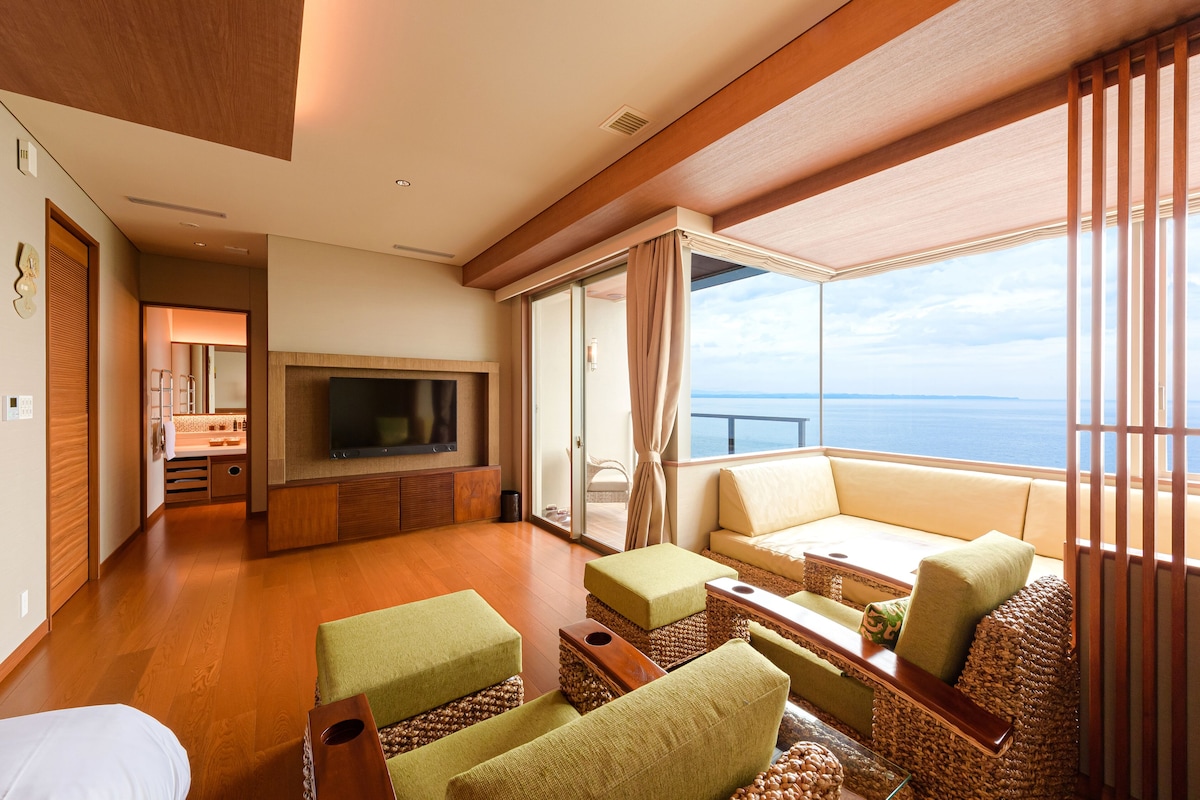
For a first stay, Umi-no-To offers the simplest set of decisions. Type I, the Resort Twin, is the 51-square-metre entry point for one or two guests. It is smaller than most rooms at SEIKAI, yet it still includes two 140-centimetre beds, a living area, terrace and private open-air bath facing the water. Couples who intend to spend time in the bath, at dinner and on the terrace may find this a more rational choice than paying for rooms they will barely use.
Types J and K introduce Japanese-Western layouts for up to four guests. Type J is 77 square metres; Type K is 83 square metres and gives slightly more separation between the bedroom, living room and six-tatami room. Both can accommodate two futons in addition to the two double beds. The design works well for parents and children, or for two travellers who want tatami for reading and tea rather than only another sofa.
Type L is also 83 square metres, but its value lies in position. As a southeast corner room on the sixth or seventh floor, it opens to the sky and sea in two directions. The terrace and bath are generously proportioned, and the layout separates the bedroom from a six-tatami room. Reserve it when the view and the feeling of openness are central to the occasion; choose K when the practical division of space matters more than the corner outlook.
Signature Collection and Sora-no-To
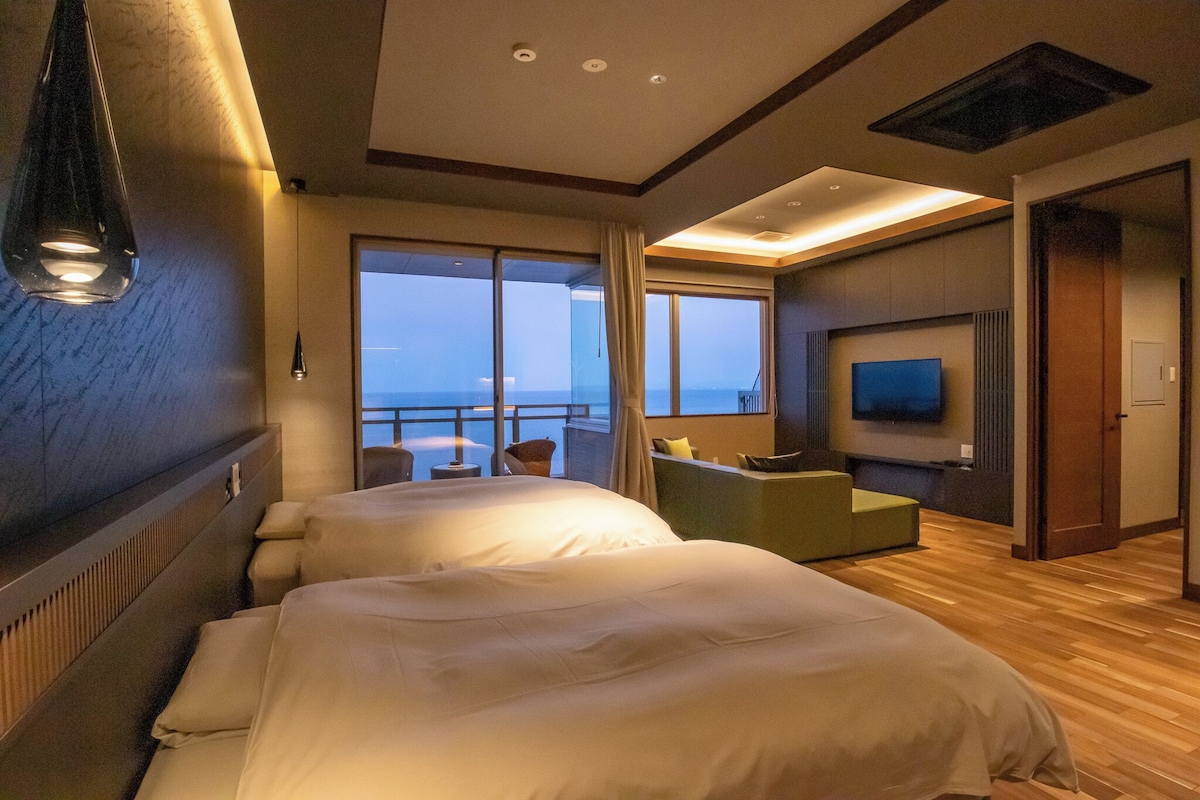
The Umi-no-To Signature Collection occupies the top floor and should be booked with careful attention to what is—and is not—hot-spring water. UMI Suites 01 and 02 are each 94 square metres; Suite 03 is 77 square metres. These rooms pair a private indoor bath supplied with free-flowing onsen water with an outdoor jacuzzi. The jacuzzi is not an onsen. This distinction matters, but it does not lessen the rooms’ appeal: the arrangement allows a deeply warm mineral bath indoors and a more open-air, celebratory soak outside.
Suite 01 has a broad northeast-facing terrace, two bedrooms, a private garden and long views towards Hiji, Kunisaki and, in clear conditions, beyond the bay. Its desk and bookshelves also make it credible as a room for a slower stay rather than only a one-night occasion. The Signature Collection is best for travellers who want the top-floor perspective and a contemporary suite ritual, provided they understand the difference between the onsen bath and the jacuzzi.
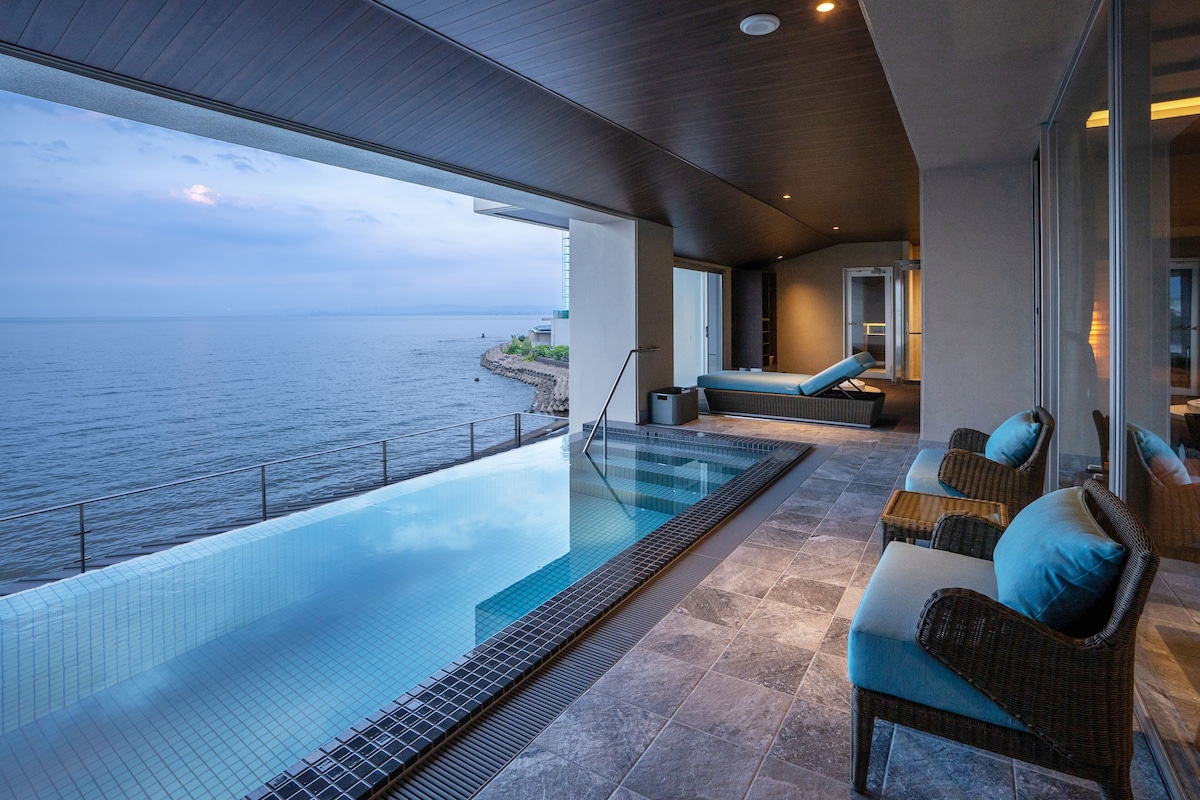
Sora-no-To takes the resort idea further. The universal Type U is 75 square metres, with a level entrance and an accessible toilet. Type R and Type Q bring larger daybeds, terraces and sea-facing baths into a brighter resort vocabulary. The 150-square-metre Type PS Junior Suite is the category that attracts the most attention: four beds, a private pool, jacuzzi, shower booth and semi-open-air hot-spring bath. The pool and jacuzzi should not be mistaken for onsen facilities. Reserve PS when several people will genuinely use the outdoor living space; for a couple focused on the spring water and the view, a smaller category may feel more coherent.
Shiosai-no-Yu: bathing close to the waterline
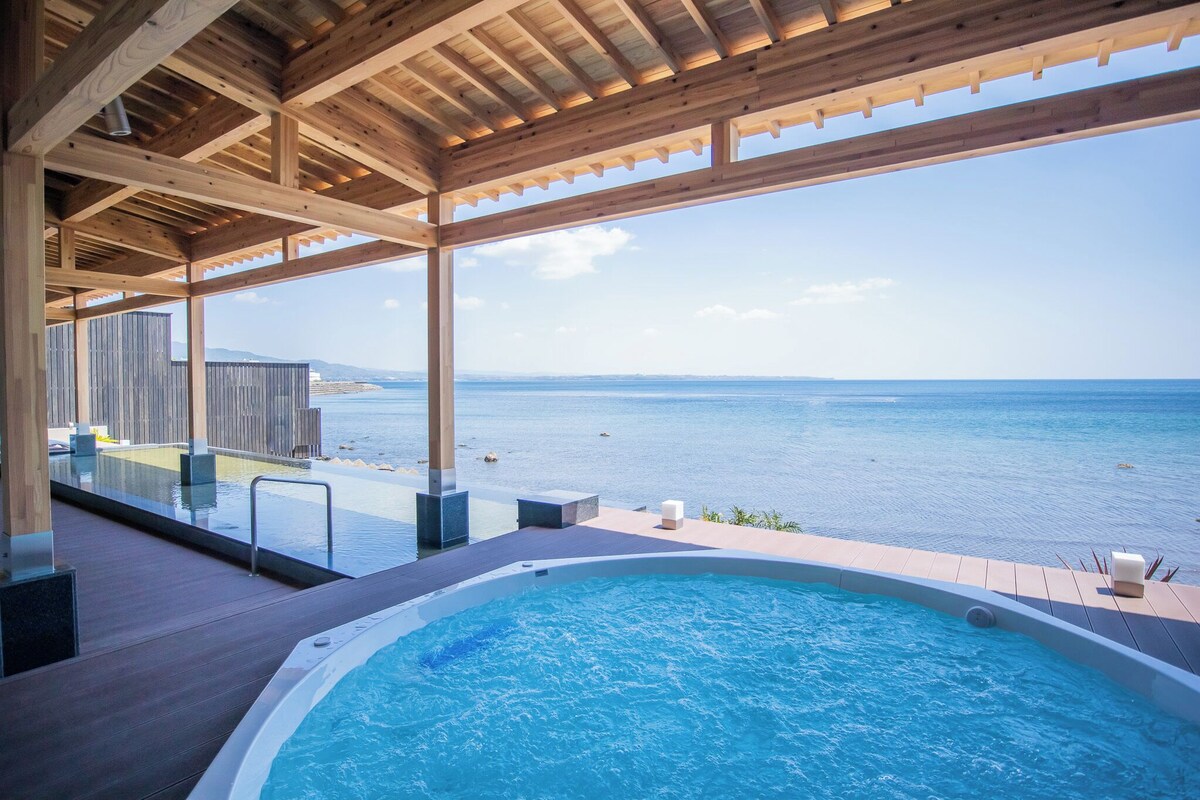
The private bath is the reason to choose the hotel, but it should not be the only bath you experience. On the first floor, Shiosai-no-Yu sits so close to Beppu Bay that the hotel describes it as being at “sea level zero.” When the body is lowered into the open-air bath, the edge of the water and the horizon seem to draw nearer to one another. It is a different pleasure from the room bath: more expansive, more elemental and shaped by the sound of the shore.
The public bath includes indoor and open-air baths, a jacuzzi, an 85-degree sauna and a cold bath containing seawater. Overnight guests currently have access from 3:00 p.m. until midnight and again from 5:00 a.m. to 10:00 a.m. Bathing hours and facilities can change, so confirm them at check-in. The most satisfying sequence is to visit Shiosai-no-Yu while the horizon is still visible, then return to the private room bath later, when privacy and repetition become the luxury.
Three ways to dine
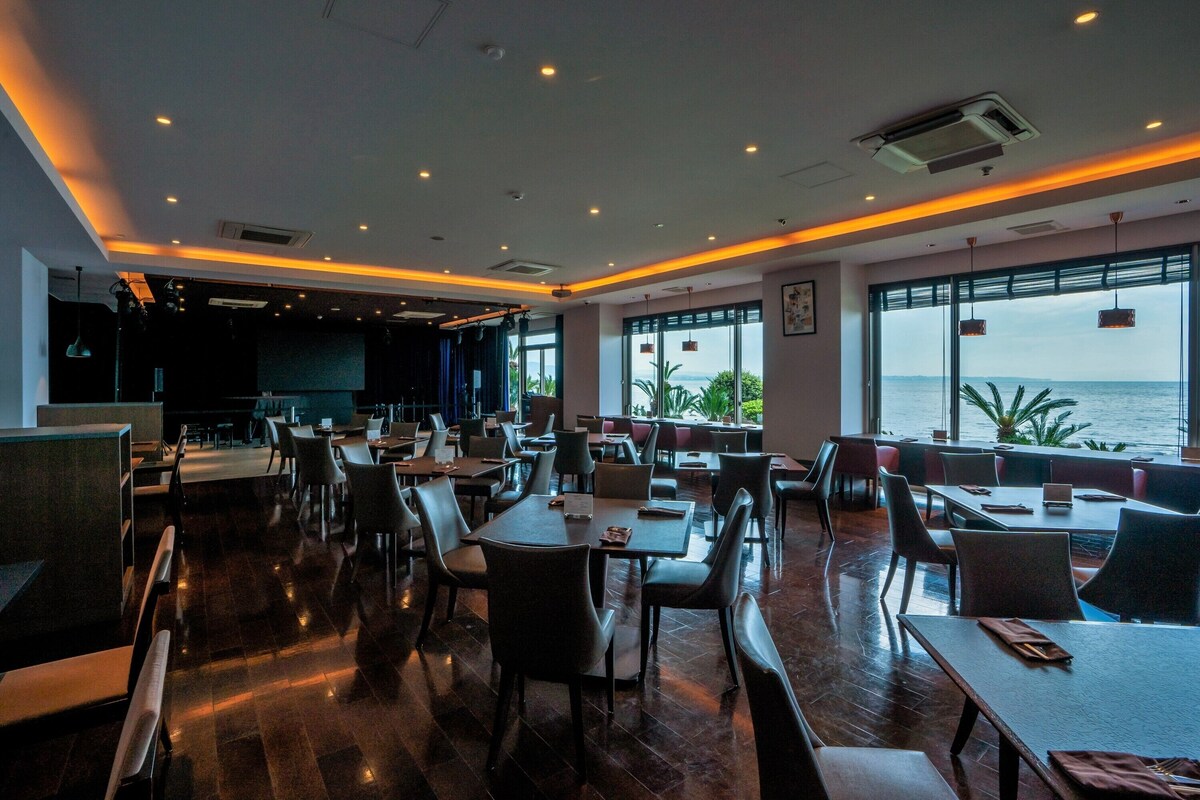
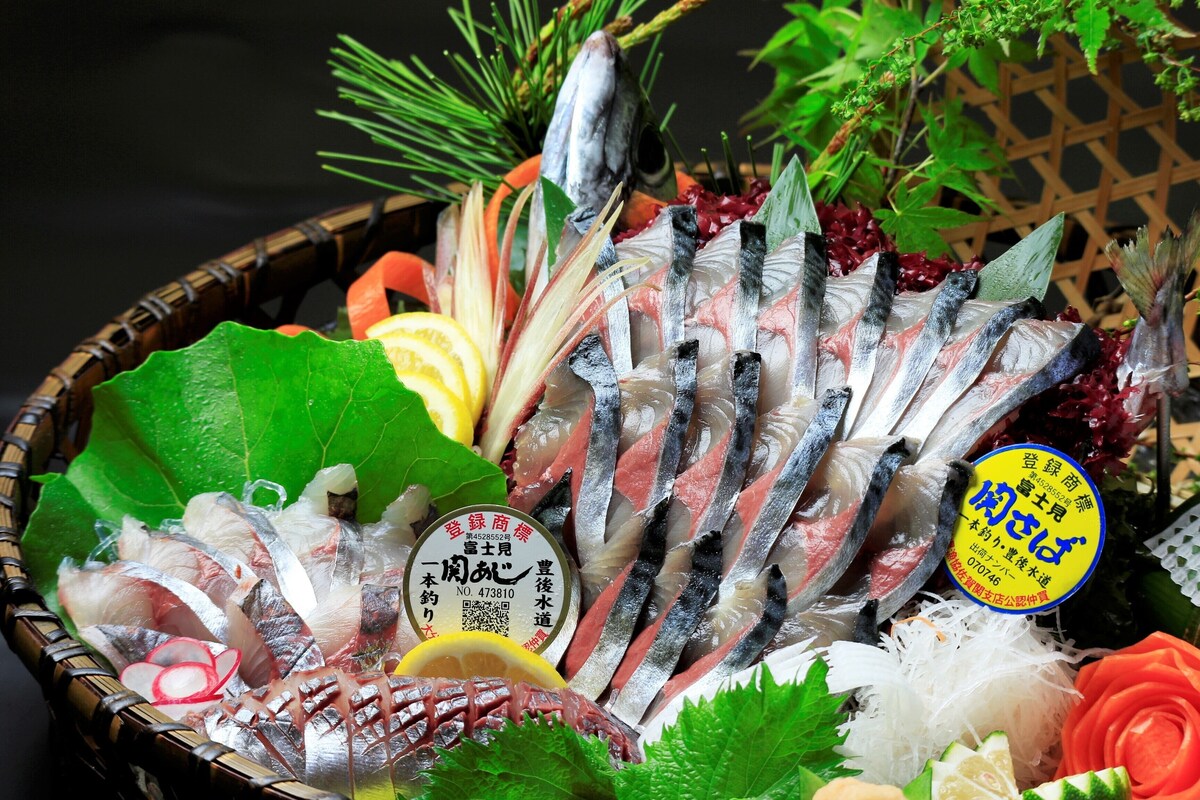
Dinner is not a single house style at SEIKAI. Japanese restaurant Gen serves seasonal kaiseki in private rooms and is the natural choice for a quiet celebration. Eitaro places the emphasis on natural seafood in a more animated setting, with table, raised and private seating. Bistro Vent Nouveau interprets local ingredients through approachable French cooking. None is merely a substitute for another; the selected restaurant changes the tone of the evening.
This makes the meal plan part of the room decision. A large Japanese-Western room booked for a family may pair naturally with the privacy of Gen. Travellers drawn by the immediate seafront location may prefer Eitaro’s focus on fish and shellfish. Vent Nouveau suits a stay that wants to remain lighter and more contemporary. Before booking, check whether dinner is included and which restaurant the plan specifies. A general “half-board” label is not enough when the experiences differ so substantially.
Breakfast offers another choice. The Japanese breakfast at Gen is built around carefully handled local ingredients, including seafood miso soup and tofu made with natural water from Oita. The buffet at Vent Nouveau provides more freedom and a longer, less formal morning. Families and travellers who prefer several small tastes may favour the buffet; those who want the day to begin with composure may find the Japanese set more memorable.
One night or two?
A single night works when the plan is disciplined: arrive near check-in, use the room bath before dinner, visit Shiosai-no-Yu, return for a late private soak and protect the following morning from an early departure. Two nights change the stay from a sequence into a rhythm. They allow one evening for kaiseki and another for seafood or French cooking, more than one quality of light over the bay, and enough time to understand whether the room itself was the correct choice.
The hotel is about 15 minutes by taxi from Beppu Station according to the hotel’s access guide. From Oita Airport, the airport bus journey to the tourist port takes roughly an hour, followed by a short taxi ride. Drivers should allow around 15 minutes from Beppu Interchange and pay attention to the hotel’s caution about approaching the entrance safely from the Hiji direction rather than making a hazardous direct turn across Route 10. This is a seaside retreat, not an address designed around walking back and forth to the station.
Booking cautions before you reserve
- Confirm the exact wing and room size. Expedia’s English category names may not mirror the hotel’s Japanese Type I, J, K, L and other labels.
- Do not treat every water feature as an onsen. Guest-room hot-spring baths use free-flowing water, but the private pools and outdoor jacuzzis in certain suites are not themselves onsen.
- Check the dinner venue. Gen, Eitaro and Vent Nouveau create meaningfully different stays.
- Respect the arrival time. Expedia currently shows check-in ending at 6:00 p.m.; guests with dinner plans should arrive comfortably earlier and verify the latest conditions for their dates.
- Do not assume a room photograph guarantees a named category. Match the listing by size, beds, occupancy and bath, then contact the property if a particular layout is essential.
- Check current spa arrangements. The hotel’s official information states that Shiosai Spa Mizuki has moved and been integrated with Spa Respiration at the neighbouring AMANE RESORT GAHAMA.
Who SEIKAI suits
SEIKAI suits the traveller who measures a hotel by how it feels at 6:00 a.m. and 10:00 p.m., not only by the impression made at check-in. It is for couples who want the freedom of a private bath, families who need real living space, and repeat visitors to Beppu who no longer need every hour filled with sightseeing. It is also unusually accommodating of different definitions of luxury: a compact sea-facing twin with a private onsen can be as convincing as a vast suite, provided the room is chosen honestly.
It is not the best match for someone who will be away from the property all day, who needs an effortless station walk, or who expects a conventional beach resort with swimming and sand at the centre of the experience. The sea here is contemplative. Its role is to shape the light, sound and pace of the onsen stay.
A stay shaped by the bay
AMANE RESORT SEIKAI’s strongest luxury is not rarity but consistency. The bay is not confined to the most expensive room, and the private hot-spring bath is not held back as a special privilege. Once those two promises are present in every category, the decision becomes more personal: how much space is necessary, whether tatami matters, which dinner feels right, and how much time can be given to doing very little.
Choose the room carefully and the hotel becomes wonderfully uncomplicated. Open the window, listen for the water, bathe before the day asks anything of you, and return to the spring when the bay has changed colour. In a city celebrated for the abundance of its hot water, SEIKAI makes that abundance feel private.
Hotel services, restaurant assignments, bathing hours and room labels may change. Check the current Expedia listing and your final booking confirmation before travel.