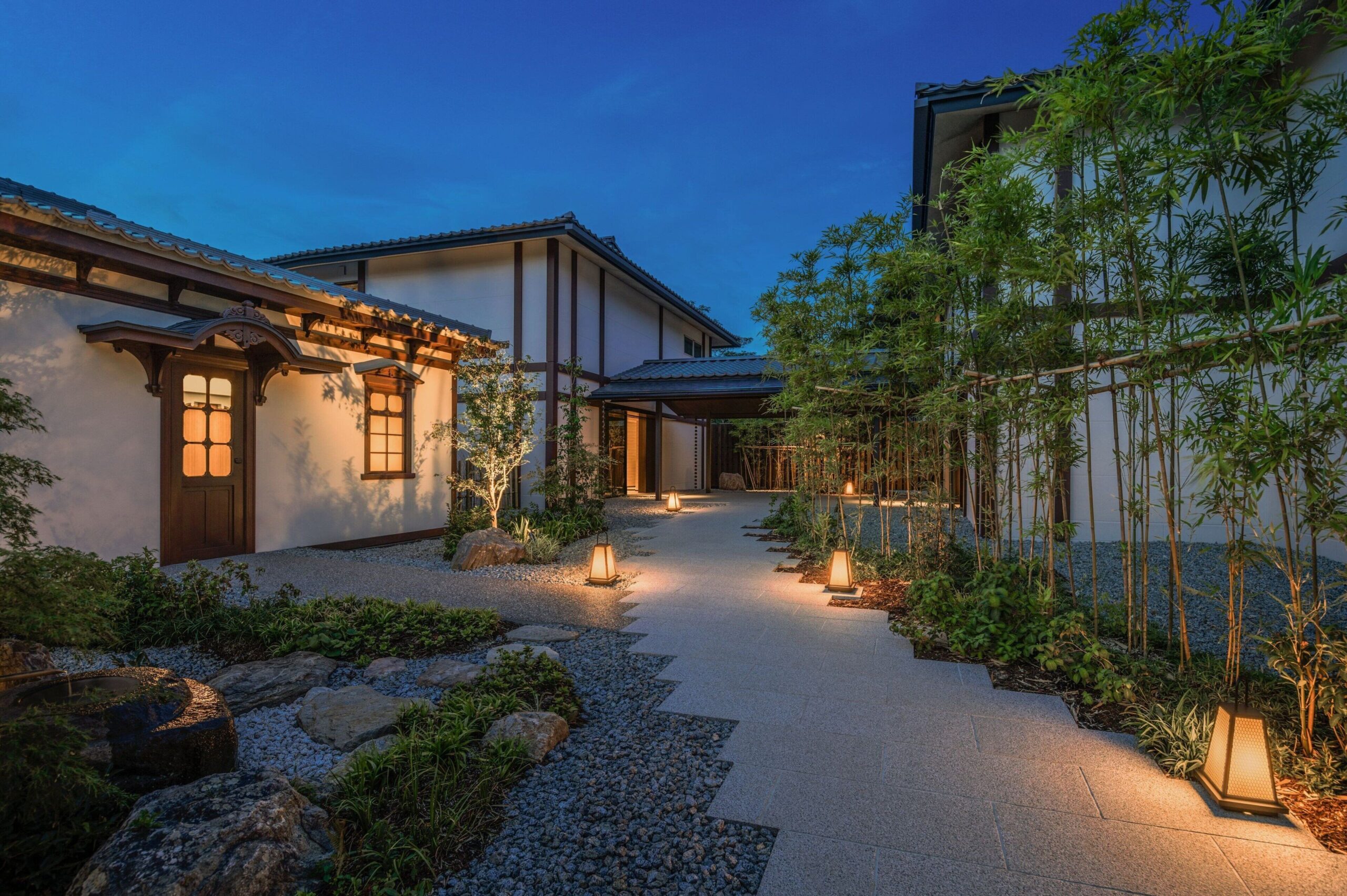
At the western edge of Nara Park, Shisui, a Luxury Collection Hotel, Nara begins with a gate rather than a tower. Beyond it stands a building completed in 1922 as the official residence of the Nara Prefectural Governor, now preserved as the main structure of a 43-room hotel. The address is also part of the former grounds of a sub-temple of Kofuku-ji, while Yoshikien garden and several of Nara’s great temples lie close at hand. History here is not confined to a plaque in the lobby. It determines how the hotel is entered, how its dining rooms are arranged and how a day moves between the property and the old capital around it.
Shisui opened on 29 August 2023, following a design project led by Kengo Kuma and Associates. Its name comes from shikan suiyou, purple trunks and green leaves, an expression associated with the scenery of Nara. The phrase provides a quiet key to the hotel. Architecture, garden and park are treated as parts of one setting, while the surviving residence gives that setting a civic history distinct from the temples beyond the gate.
Booking Snapshot
- Best for
- Couples and cultural stays combining Nara Park with a historically grounded hotel
- Setting
- A preserved 1922 governor’s residence beside Yoshikien and the western edge of Nara Park
- Private onsen
- 23 of 43 rooms have a natural hot-spring bath; 20 do not
- Dining
- Restaurant Suiyou in the former reception room and an eight-seat sushi counter in the storehouse
- Access
- About 15 minutes on foot or five minutes by taxi from Kintetsu Nara Station
- Room decision
- Check whether the exact category has no onsen, an indoor onsen, or an open-air onsen
Check Shisui Nara rooms and current rates on Expedia →(Paid link)
In This Guide
Arrival Through a Century-Old Residence
The first practical decision is how to arrive. From Kintetsu Nara Station, the hotel is approximately fifteen minutes on foot or five minutes by taxi. From JR Nara Station, a bus to Kencho Higashi leaves a walk of about three minutes. These are short urban journeys, yet the entrance signals a change in scale: the guest rooms themselves occupy only two floors, and the historic gate remains part of the approach.
Drivers should plan more carefully. There are ten paid parking spaces, all requiring advance reservation. Because the property preserves a historic structure, the entrance gate has a step that may prevent very low-clearance cars from entering; the hotel advises contacting it in advance when this may be a concern. This is a small but revealing detail. The site has been adapted to present-day hospitality, but it has not been flattened into a neutral arrival court.
Check-in begins at 3:00pm. That timing allows the afternoon to unfold naturally: first the building and room, then the garden or the park, followed by the hotel’s early-evening rituals and dinner. Shisui is most coherent when read in this sequence, not as a collection of separate facilities.
The Governor’s Residence, Reworked for a Hotel
The former governor’s residence is more than an exterior retained for atmosphere. It forms the hotel’s main building, and parts of its earlier plan have been given new uses. What was once a formal guest room now houses Restaurant Suiyou. A storehouse dating from the same property has become Sushi & Bar Shousou. Rather than referring vaguely to “heritage,” these rooms make the building’s previous life legible through function: the formal guest room receives diners, and the storehouse has been reduced to an intimate counter of eight seats.
Kengo Kuma and Associates designed both the hotel and its interiors around this inherited fabric. The contemporary additions do not turn the residence into a period reconstruction. Instead, the project places present-day rooms, spa facilities and circulation beside elements that already carried the memory of official use. The result is best understood as a meeting of periods rather than a return to 1922.
That distinction matters to the tone of a stay. Shisui is not a ryokan, despite its gardens, baths and low-rise setting, and it is not a conventional city hotel transplanted beside Nara Park. Its identity rests in the tension between a preserved public residence and a private place to sleep.
Choosing Among 43 Rooms
The 43 rooms occupy the first and second floors and range from 40 to 98 square metres, with an average of approximately 46 square metres. Floor-to-ceiling windows bring the grounds into the interior, while designs draw on techniques associated with Nara’s traditional crafts. The official room descriptions emphasise muted natural colours, wood-grain furniture and layouts that place seating close to the windows.
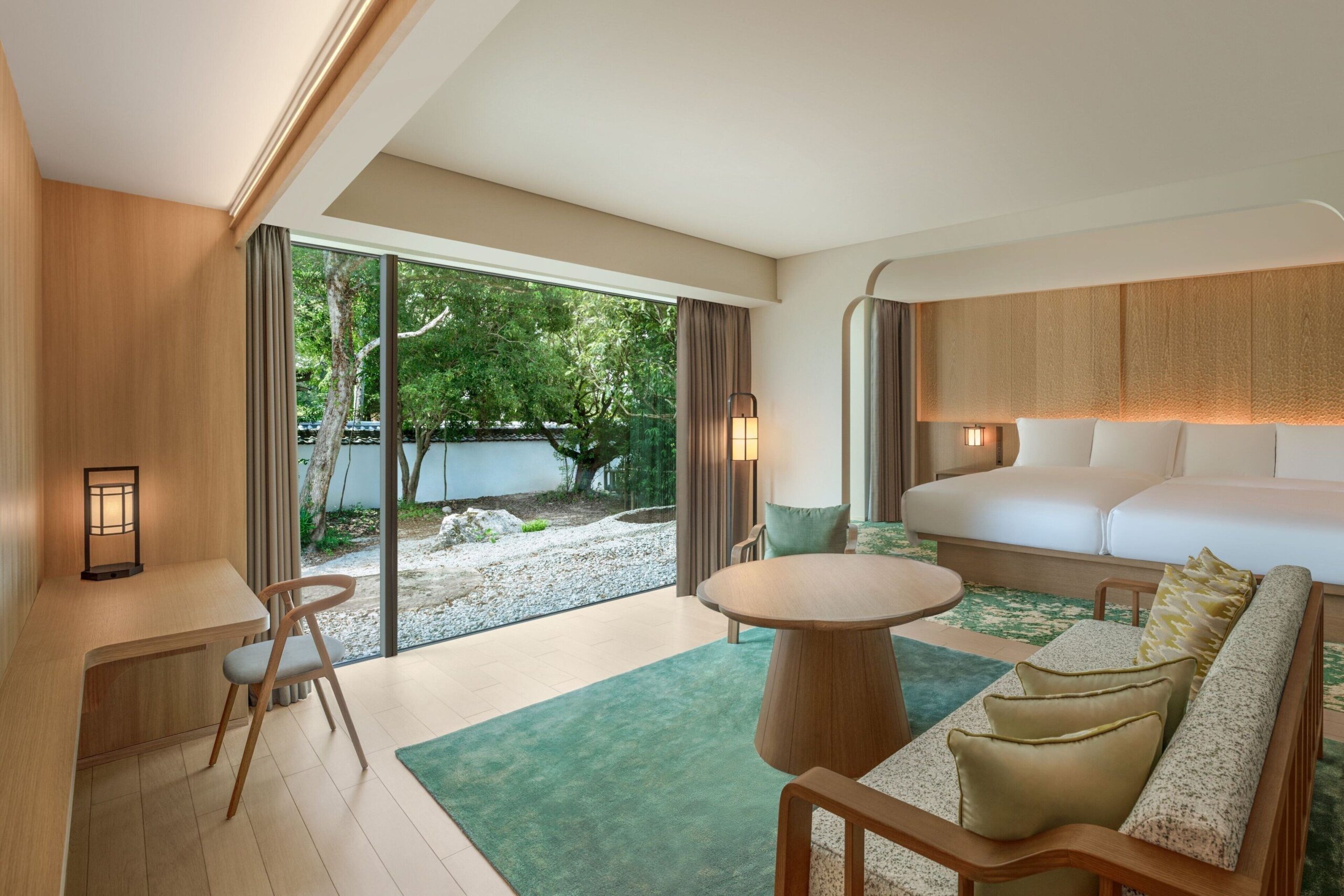
Room choice begins with a simple division: twenty rooms do not have a private hot-spring bath, while twenty-three do. Standard Rooms measure 40 to 41 square metres; Superior Rooms measure 43 to 46 square metres. Both categories are offered with king or twin beds and can accommodate up to three guests. They retain the same low-rise relationship with the grounds, but bathing takes place in a conventional bathroom or, by separate reservation, at the private spa.
The onsen categories require closer reading because the hotel distinguishes between an indoor ONSEN and an OPEN AIR ONSEN. Deluxe Rooms with an indoor natural hot-spring bath measure 41 to 49 square metres; Deluxe Rooms with an open-air bath measure 43 to 46 square metres and add a small private garden setting. The difference is not one of room hierarchy so much as the relationship between the bath and the outside air. The exact category name should therefore be checked before booking rather than relying on the word “onsen” alone.
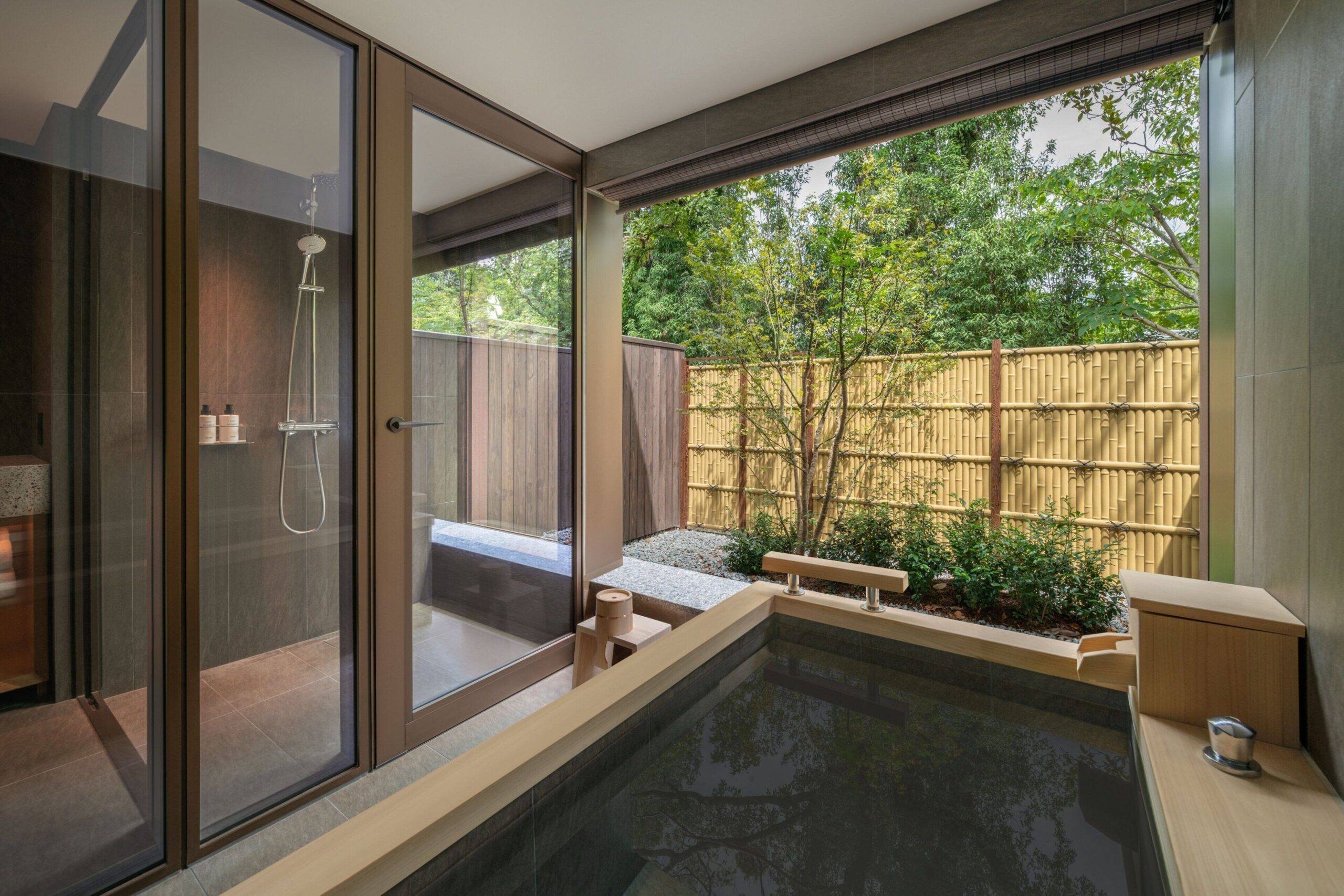
Junior Suites continue the same distinction. Those with an indoor onsen range from 53 to 61 square metres, while the open-air onsen version measures 57 square metres. Both use twin beds and accommodate up to three guests. Above them, the 64-square-metre Suite and the 98-square-metre Presidential Suite each have an indoor hot-spring bath. The Presidential Suite is the largest accommodation in the hotel and is described by the property in relation to the natural scenery of Nara Park.
Views also vary. The hotel’s current FAQ notes that guestrooms look onto greenery and gardens within the grounds, with different compositions that may include a lantern garden or a stream crossed by a stone bridge. These are examples given by the hotel, not guaranteed features of every category. Travellers for whom the outlook matters as much as the bath should ask about both, especially because the room name chiefly identifies size and onsen type rather than a single standardised view.
| Category | Bath and size | Booking reason |
|---|---|---|
| Standard / Superior | 40–46㎡; no private onsen | The setting and location matter more than bathing in the room |
| Deluxe Onsen | 41–49㎡; indoor natural onsen | Private hot-spring bathing independent of the weather |
| Deluxe Open Air Onsen | 43–46㎡; open-air bath with a small garden setting | Bathing with outside air |
| Junior Suite Onsen | 53–61㎡ indoor, or 57㎡ open-air | More living space for two or three guests |
| Suite / Presidential Suite | 64㎡ / 98㎡; indoor onsen | The largest plans and a more occasion-led stay |
From Yoshikien to Nara Park
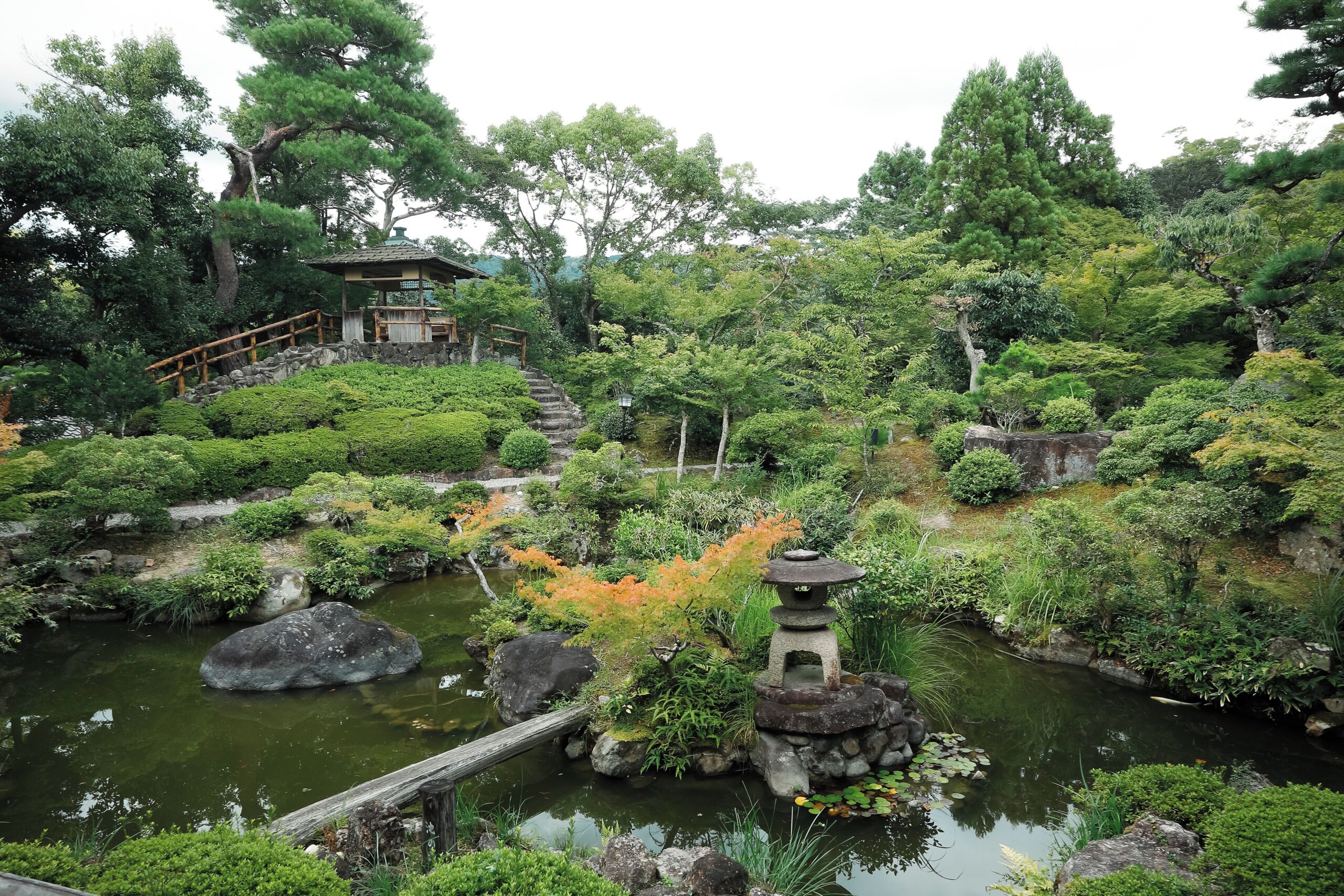
Once the room is settled, the location begins to do much of the work of the afternoon. Yoshikien, a Japanese garden, forms part of the same grounds, while the wider area places Kasuga Taisha, Kofuku-ji and Todai-ji within walking distance. The value of that proximity is not simply the number of sights nearby. It allows the day to move between temple and hotel without repeated transfers.
A temple visit can begin after check-in and end back at the former governor’s residence before dinner. The hotel becomes neither an isolated resort nor only a bed beside a sightseeing district; it acts as a measured interval within the landscape of Nara Park. The route outward leads into the city’s religious history, while the return passes through a gate tied to the building’s earlier public role.
There is no need to claim a view of deer from a room or promise a particular encounter in the park. The stronger fact is the address itself: 62 Noborioji-cho, at the park’s western edge, close enough for the surrounding temples and greenery to shape the hours on either side of a night indoors.
Champagne Before Dinner
For staying guests, the hotel currently offers Garden Delight, a complimentary champagne free-flow period from 5:00 to 7:00pm, with last orders at 6:30pm. It is designed as an open interval rather than a scheduled tasting; guests may arrive at any point during the service. Because hotel programmes can change, the current hours should be checked for the stay date.
Its place in the day is well judged. The service falls between the return from the park and the first dinner seating, giving the evening a pause before attention turns indoors. In a hotel whose central idea is the relationship between a residence and its garden, this hour links the two without needing a formal activity.
Two Dining Rooms, Two Parts of the Former Residence
Restaurant Suiyou occupies a restored guest room of the 1922 governor’s residence. The garden is presented across the dining room, while lighting refers to Nara’s stone lanterns and the tables take their cue from the former residence’s entrance. These details are most persuasive because they begin with the specific building rather than applying a generalised Japanese motif.
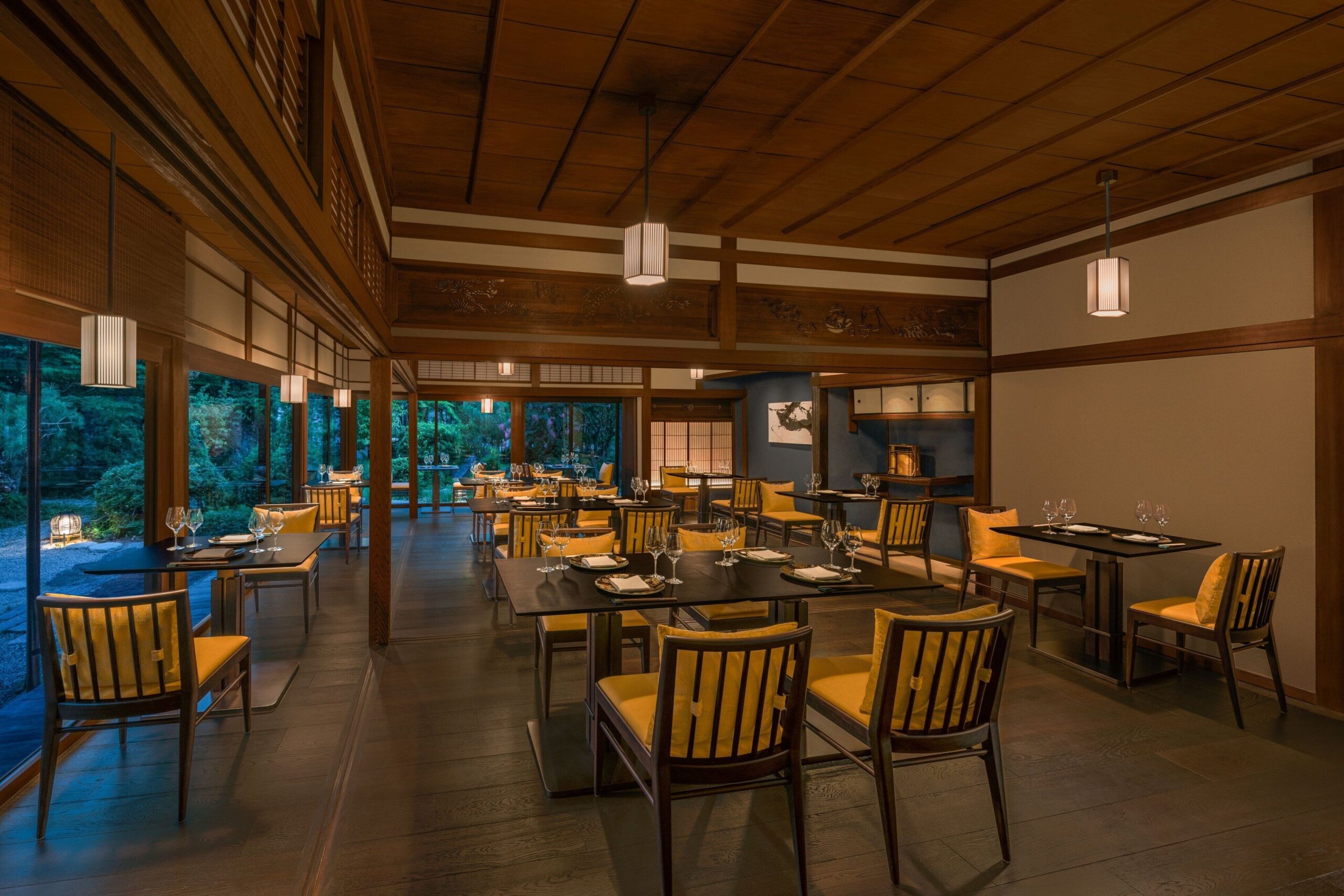
Suiyou has 54 seats: 44 in the main dining room and 10 in a private room. It serves breakfast from 7:00 to 10:00am, lunch from noon to 2:30pm and dinner from 5:30 to 9:00pm. The restaurant frames Nara’s food culture through the city’s history as a destination on routes of exchange, including the traditions that reached the old capital through the Silk Road. Dinner courses currently require reservation by 5:00pm on the previous day. Private Room Shitan accommodates two to ten guests.
Sushi & Bar Shousou is smaller and more concentrated: an eight-seat counter created within the former storehouse. Its sushi courses are served at lunch and dinner, both by complete advance reservation, currently closing at 5:00pm the day before. Choosing between the two is also a choice between parts of the property. Suiyou opens the restored guest room towards the garden; Shousou turns a utilitarian storehouse into a closely focused counter.
The room’s yukata should be left behind for either restaurant. The hotel requests that guests do not wear it in dining rooms or other public areas; it is intended for the guestroom and spa. This may seem a minor point, but it clarifies again that Shisui does not present itself as a ryokan where the entire evening unfolds in robe and slippers.
A Private Onsen, With or Without an Onsen Room
Guests in one of the twenty-three onsen rooms can return directly to an indoor or open-air bath after dinner. For the other twenty rooms, SUI Spa provides a separate possibility: private open-air hot-spring bathing reserved for hotel guests. The private spa is booked for one party at a time in 60-minute sessions and operates during morning and afternoon-to-night periods. Availability, exact session times and the current charge should be confirmed before arrival, particularly when the bath is central to the stay.
This distinction prevents the room decision from becoming unnecessarily absolute. A Standard or Superior Room does not include an onsen, but a separately booked private spa can still bring a hot-spring bath into the itinerary. Conversely, selecting an onsen room removes the need to organise the evening around a reserved hour. The more useful question at booking is therefore not merely whether an onsen is desired, but whether it should belong to the room itself.
SUI Spa also offers treatments informed by botanical and herbal traditions associated with Nara. The hotel has a complimentary 24-hour fitness centre, but there is no need to let a facilities list overtake the central rhythm of the stay. The private bath, because it changes the choice of room and the shape of the evening, is the detail that deserves attention first.
Breakfast, Then a Noon Departure
Morning returns to Suiyou for breakfast, served from 7:00 to 10:00am. With check-out at 12:00, the schedule leaves space after breakfast for the garden or a final walk nearby without an early departure pressing against the meal.
The last passage through the gate reverses the first. Outside lies Nara Park and the route back to the station; behind it remain the restored guest room, the storehouse counter, the low-rise guestrooms and the garden. None belongs to the same historical moment, yet the hotel is at its most convincing when it allows those moments to remain distinct.
The Address Is the Story
Shisui’s defining feature is not simply that it occupies an old building, nor that more than half of its rooms contain natural hot-spring baths. It is the way a single address connects former temple ground, a 1922 governor’s residence, Yoshikien and the western edge of Nara Park. The architecture gives dinner a setting; the room category determines the evening bath; the gate opens directly towards an afternoon among the temples.
That continuity gives the hotel substance without requiring spectacle. A stay can proceed in a deliberate sequence, from the gate to the room, from the room into the park, then back through the restored residence for dinner and towards hot water at night. By morning, the same garden and building are present in a different light, and Nara’s older histories wait again beyond the entrance.
View current availability at Shisui, Nara(Paid link)
Related Stories
HOTEL THE MITSUI KYOTO
Imperial Hotel Kyoto
Luxury Hotel Guides in Japan