Check HOTEL THE MITSUI KYOTO rates and availability on Expedia →(Paid link)
HOTEL THE MITSUI KYOTO occupies an address with two histories in view. Nijo Castle stands across the road, while the hotel itself sits on land held for more than 250 years by the Kitake, the executive branch of the Mitsui family. What remains is not an old residence converted into a hotel. It is a contemporary property that has carried selected pieces of the estate forward: a gate, garden stones, a central courtyard and a rebuilt formal room.
Opened in November 2020, the hotel has 160 rooms, a central garden and natural hot-spring water drawn from beneath the site. Those elements give it a character distinct from Kyoto’s Higashiyama hotels. This is a central-city stay built around one historic address, with enough on-property interest to justify leaving part of the day unplanned.
Check current HOTEL THE MITSUI KYOTO availability on Expedia →(Paid link)
The 1703 Gate That Frames a New Hotel
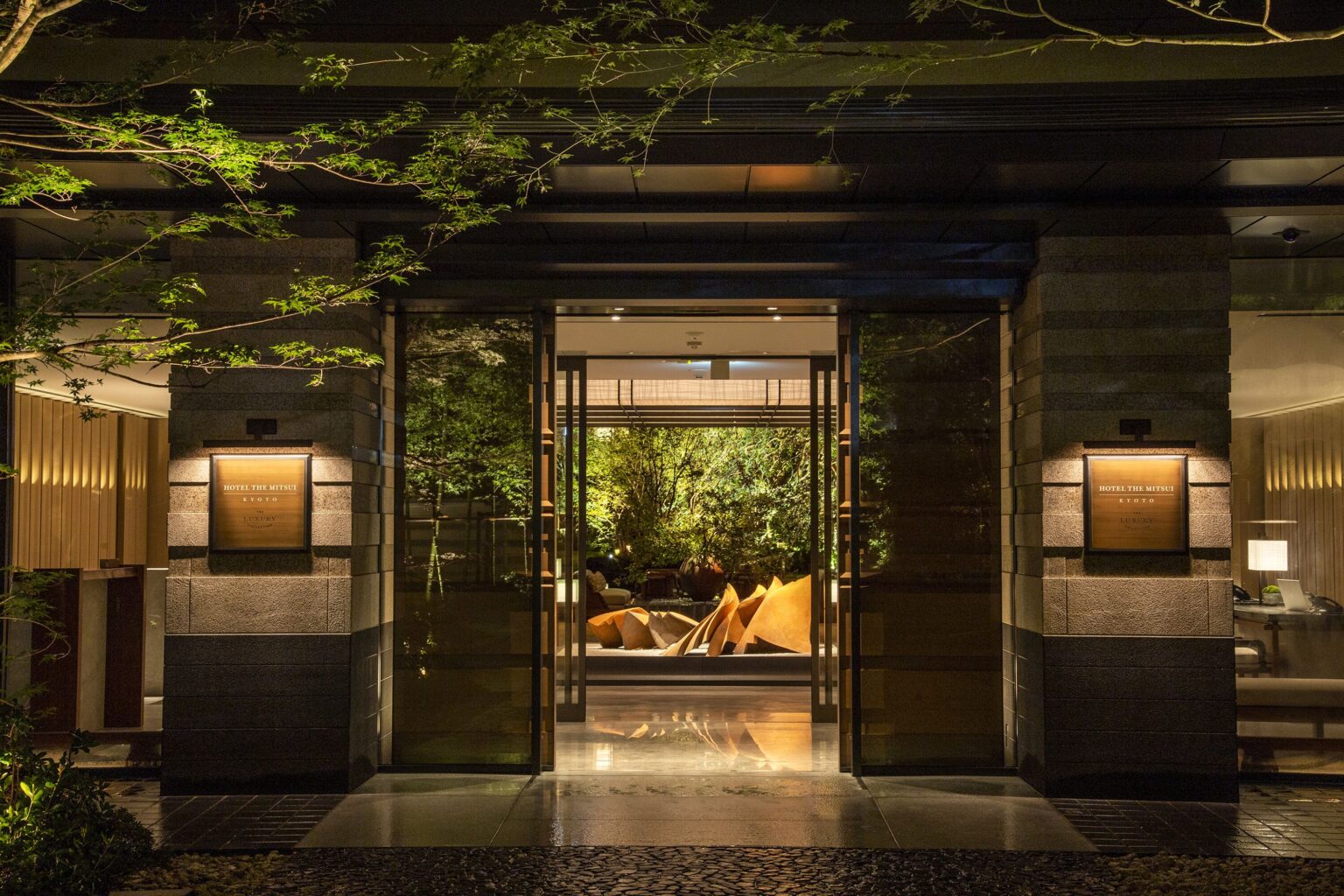
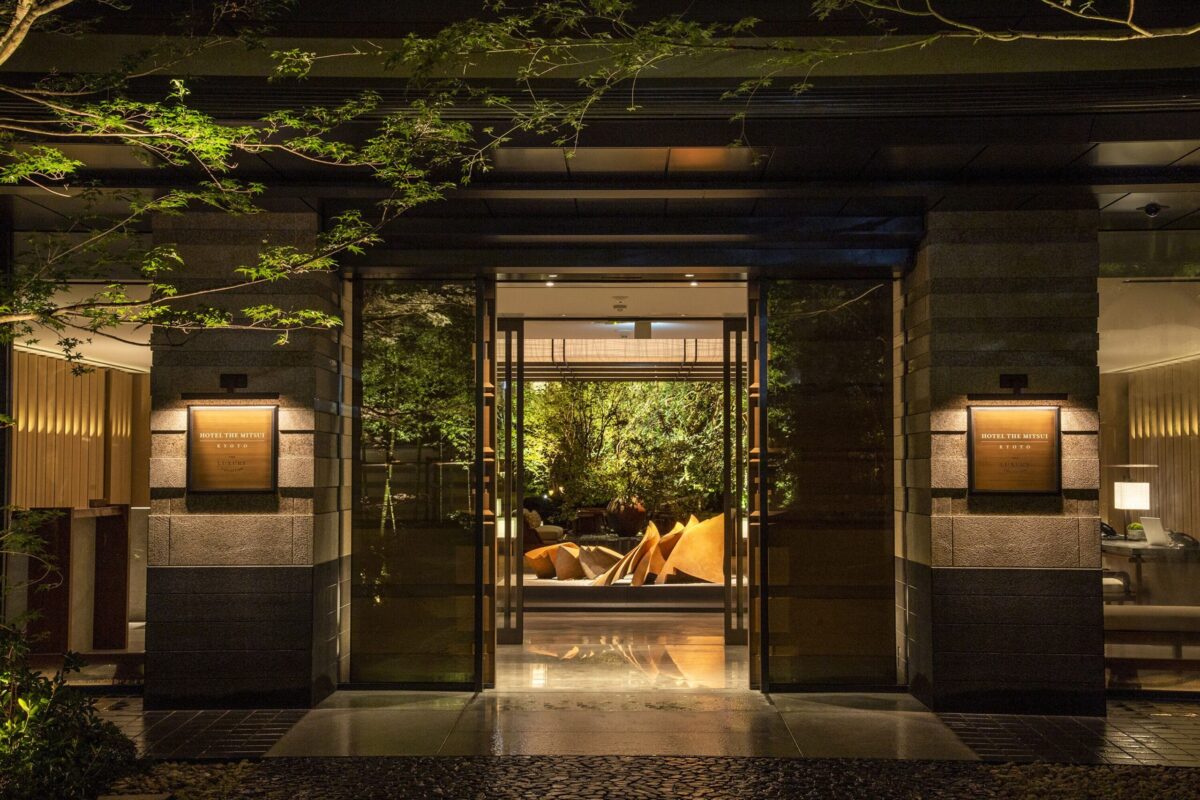
The Kajiimiya Gate sets the tone before the lobby comes into view. Built in 1703 for the Kajiimiya court, it was moved more than once before arriving at the Mitsui family’s Aburakoji residence in 1935. For the hotel, specialist shrine and temple carpenters dismantled and restored it; more than 80 percent of the original wooden components were retained.
That history matters because it prevents the hotel from becoming a vague exercise in “Kyoto style.” The gate is genuinely old, but the buildings behind it are new. The interest lies in the meeting of the two rather than in any suggestion that guests are entering an untouched estate.
A 1,300-Square-Metre Garden Holds the Hotel Together
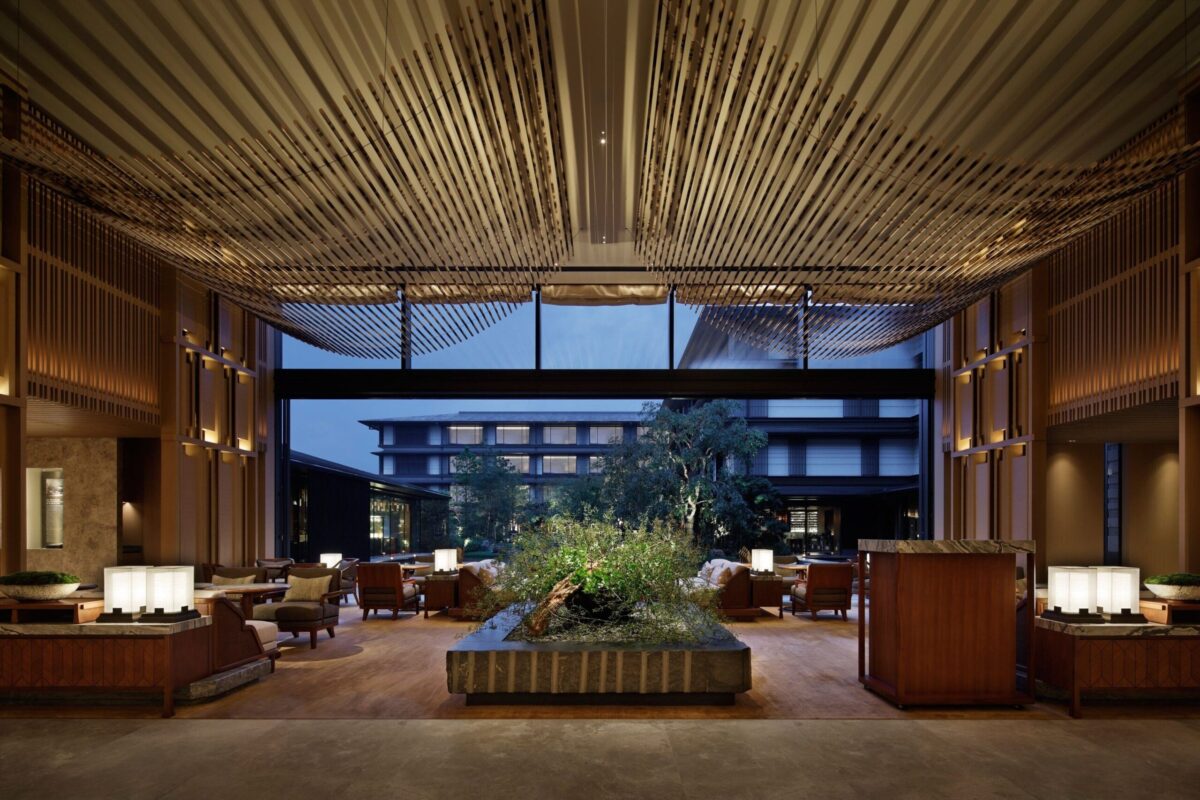
Landscape designer Shunsaku Miyagi reinterpreted the former residence’s garden as a courtyard of roughly 1,300 square metres. Some stone lanterns and landscape rocks came from the Mitsui property. The garden is not confined to a single viewpoint: the lobby, lounge, restaurants and several room categories turn toward it, so it becomes an organizing element rather than an ornament at the edge of the grounds.
André Fu designed the guest rooms and lobby, drawing on the scale and restraint of a tea room without reproducing one. SHIKI-NO-MA takes a more direct approach to the site’s history. Built in Japanese cypress, it is a modern reconstruction of the former residence’s Oku-Shoin and now serves private dining and tea gatherings. Together, these spaces move between preservation, reconstruction and contemporary design without treating them as the same thing.
See available HOTEL THE MITSUI KYOTO room plans on Expedia →(Paid link)
Garden, Castle or Private Onsen: Choosing the Room
The 160 rooms and suites range from 43 to 213 square metres. Deluxe and Premier Rooms face the city. Garden Rooms, measuring 47 to 61 square metres, look into the courtyard; Nijo Rooms are 50 square metres and face the castle, including its Higashi Otemon Gate. The decision is therefore not simply about moving up through room sizes. Outlook changes the relationship between the room and the address.
Suites extend those choices. Garden Suites face inward, while Nijo Suites and the Presidential Suite look toward the castle. Onsen Suites occupy the basement level and measure 101 to 111 square metres, with an open-air bath supplied by the hotel’s natural spring and a small private garden. They suit travelers who value bathing privacy more than an elevated view. The hotel’s large stone bathtubs appear across the accommodation, but they should not be confused with a private onsen unless the room category specifically includes one.
Kyoto Nijo Onsen, With Swimsuits Required
The shared Thermal Spring uses water drawn from approximately 1,000 metres below the property. It is a mixed-gender bathing facility where swimsuits are required, closer in use to a thermal bathing pool than to a traditional separated onsen. The official hours are 7:00 a.m. to 11:00 p.m., with last entry at 10:30 p.m.
Age rules are worth checking before booking. The usual minimum age is 13, although children aged four to twelve may enter from 9:00 a.m. to 5:00 p.m. with a parent or guardian. Families should plan around that window rather than assume unrestricted access.
The two Private Onsen rooms are a separate facility, not the same as the Onsen Suite category. Each is more than 100 square metres and includes a bathing area, living space and private garden; use is reserved for registered hotel guests and carries an additional charge. This distinction—shared Thermal Spring, bookable Private Onsen, or an in-room bath in an Onsen Suite—is central to choosing the right way to stay.
TOKI, FORNI and a Table Facing the Courtyard
The dining rooms follow the same inward-looking plan as the lobby. TOKI, FORNI, THE GARDEN BAR and SHIKI-NO-MA all sit around the courtyard, allowing the garden to remain present from breakfast into the evening.
TOKI is the signature restaurant, where chef Tetsuya Asano uses Kyoto’s water as the starting point for French stocks and sauces. FORNI serves Italian food and breakfast, with a reworked okudosan cooking range used as an oven for pizza and roasted dishes. THE GARDEN BAR faces the garden as daylight recedes. Menus and opening arrangements change, particularly at TOKI, so restaurant reservations and current hours are best confirmed for the dates of the stay.
Nijo-jo-mae, Not Gion
The hotel is about a three-minute walk from Nijojo-mae Station and roughly ten minutes on foot from Karasuma Oike. The official estimate from Kyoto Station is about 15 minutes by car. This makes the property central in a transport sense, but the immediate surroundings do not offer the same evening density as Gion or Kawaramachi.
For an itinerary centered on Nijo Castle and easy subway connections across the city, the address is practical. Travelers who want to step directly into Higashiyama lanes each morning or walk home from Gion restaurants will use more taxis. The trade-off is a hotel with its own garden, spa and dining rhythm rather than a base that depends entirely on what lies outside the door.
When This Address Fits a Kyoto Itinerary
HOTEL THE MITSUI KYOTO is most persuasive for travelers who want a central location without giving up time in a garden or natural hot-spring water. It also suits those prepared to choose a room by view and bathing style, not only by floor area. The Nijo Rooms make the castle part of the outlook; Garden Rooms turn toward the courtyard; Onsen Suites exchange height for private bathing.
Look elsewhere if the priority is a traditional ryokan format, a doorstep in Gion, or a remote resort setting. This hotel works differently: its history is contained within a contemporary city property, and the strongest stay is one that leaves time to notice how the gate, garden, rooms and spring water relate to one another.
Planning a wider luxury journey through Japan?
Explore all of our curated hotel guides here → Luxury Hotel Guides in Japan
Compare HOTEL THE MITSUI KYOTO rates for your dates on Expedia →(Paid link)